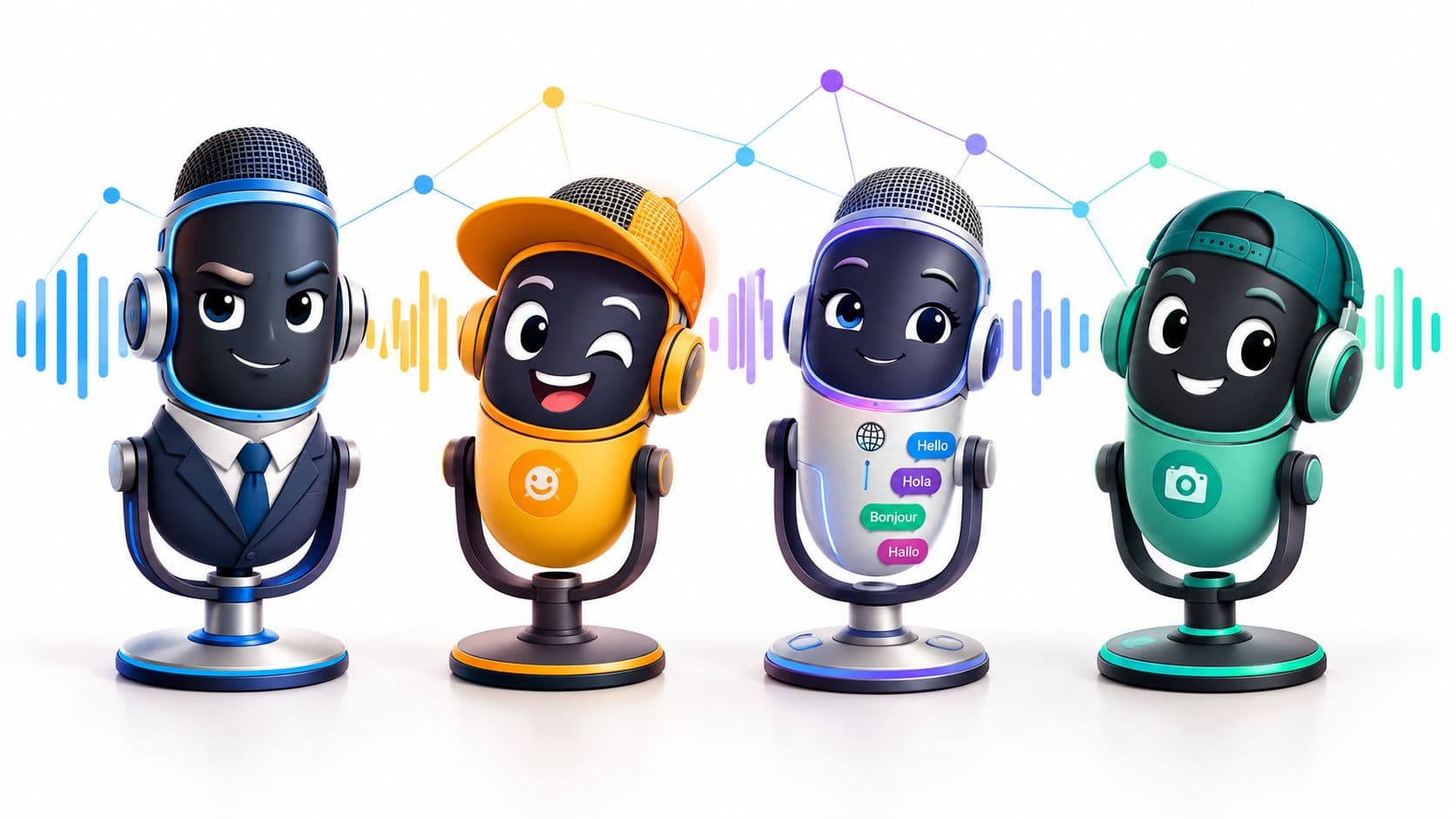
A voice clone can preserve who is speaking while changing what the audience believes about the message. That's why AI voice characters aren't interchangeable narration presets. A founder-style clone suggests personal accountability, an expressive character creates entertainment, a multilingual enterprise voice signals consistency, and an avatar-led presenter adds visible authority.
The right choice depends on the job: personal-brand authenticity, expressive storytelling, multilingual scale, avatar presentation, or enterprise automation. Evaluate each option by audience, format, emotional range, language coverage, production volume, licensing, and workflow fit. Voice identity also needs governance. Research on professional voice actors highlights biometric-identity risks, long-tailed reuse, and weak control after recordings are delivered, making consent scope and revocation part of production planning, not legal housekeeping. Recent research on synthetic voice replication explains why.
The best voice isn't the most realistic one. It's the one that reinforces the format and conversion goal.
Hooked can connect scripts, voiceovers, faceless videos, avatars, and social publishing, so creators can combine several voice roles instead of forcing one narrator across every format. The list below compares eight practical options by control, scalability, production fit, and trade-offs.
1. ElevenLabs AI Voice Characters
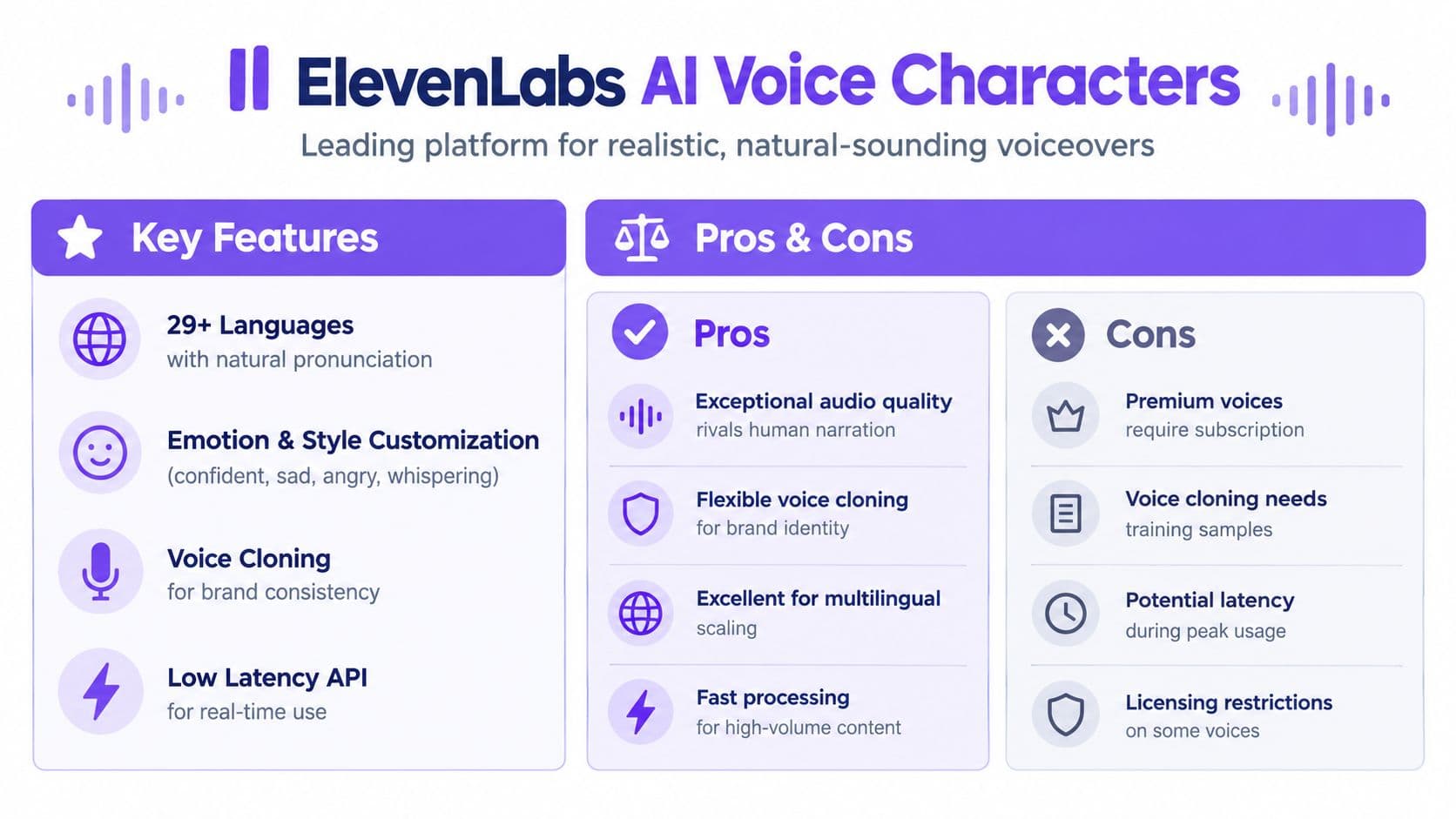
ElevenLabs fits projects where voice identity and expressive delivery matter more than a basic text-to-speech output. Its natural-sounding generation, style controls, and voice customization make it a strong candidate for recurring narrators, founder-led faceless channels, product explainers, and character-driven short videos.
The strongest use case is consistency. A creator can establish a recognizable narrator for a series, while a D2C brand can use an authorized founder clone to preserve a personal tone without placing the founder on camera for every production cycle. That identity should never be treated as a casual asset. The voice owner needs clear permission covering intended channels, duration, contexts, reuse, and removal.
Production fit and control
ElevenLabs is especially useful when a script needs emotional variation. A factual explainer may need calm authority, while a UGC-style product ad may need more energy and conversational emphasis. Use those controls deliberately rather than making every line sound dramatic. The voice should support the content's purpose, not compete with it.
Hooked's AI Video Builder includes native voiceover generation, which makes this type of narrator practical inside a broader script-to-video workflow. A creator can test a voice on a short hook, review pacing and pronunciation, then move the winning version into a repeatable publishing process.
- Best for: Personal-brand authenticity, faceless channels, branded explainers, and expressive storytelling.
- Control advantage: Voice identity, tone, accent, and delivery can remain consistent across a content series.
- Trade-off: Cloning creates governance obligations. A voice that sounds convincing can also create confusion if the audience isn't told when synthetic speech is being used.
- Workflow note: Test several emotional treatments on the same opening before committing to a full batch.
2. Google Cloud Text-to-Speech
Google Cloud Text-to-Speech is the practical choice when API control, repeatability, and enterprise integration drive the decision. Its WaveNet technology and broad language support fit ecommerce platforms, agencies, software products, and automated content systems that need dependable synthesis instead of a character-first interface.
A structured product catalog shows the fit clearly. A retailer can generate narration from product data, pass the audio into a video template, and keep the workflow predictable from script to publish. The main advantage is not only voice quality. It is the ability to connect text, pronunciation rules, audio generation, storage, rendering, and publishing inside one controlled pipeline.
Production fit and control
SSML gives production teams more precise control over pauses, emphasis, pronunciation, and speaking rate. That matters in an ad where the product benefit must land clearly, or in a dialogue script where two voices need distinct roles. Slower delivery can improve comprehension, but the final check should happen in the finished video, alongside captions and on-screen motion.
For agencies, multiple voice variants help separate clients or campaign concepts without rebuilding the workflow each time. For global brands, language coverage supports localization, but translation and voice generation are still different tasks. Local reviewers need to check names, product terms, idioms, and cultural tone before a version goes live.
The trade-off is control overhead. Teams that want precise specifications will spend more time on setup, testing, and engineering ownership than they would with a creator-focused interface. That cost is acceptable when the voice sits inside a larger system and needs to stay consistent across many outputs.
Decision note: Use Google Cloud TTS when the voice is one component inside a larger content infrastructure, not the creative centerpiece.
Pairing the output with Hooked's scripts and templates makes sense when the team needs a faster route from trend idea to social video. The voice stays configurable, while the production system stays repeatable.
3. Microsoft Azure Speech Synthesis
Microsoft Azure Speech Synthesis fits teams that need multilingual breadth, enterprise governance, and expressive variation. Its neural voices and style controls work well for global ecommerce, localized campaigns, training content, and customer-facing flows where a single neutral narrator would sound flat.
The key question is not whether Azure can generate speech across markets, but whether each market should receive the same emotional treatment. A cheerful read may suit a wellness product, while a financial explanation usually needs restraint and clarity. Azure gives production teams a practical way to test those choices instead of guessing.
Production fit and control
Azure is strongest when one voice is not enough. A campaign can use a confident voice for the main proposition, a warmer voice for support content, and localized voices for regional versions. That structure is more deliberate than forcing every script through one “universal” narrator.
Use Azure when voice choice needs to track audience, market, and content type, not just brand consistency.
Custom voice work can also support an authorized founder-led brand, but the commercial agreement should define where that identity can appear. Research into voice cloning shows that speaker similarity is measurable, and production teams can compare identity preservation, naturalness, and efficiency instead of relying on listening alone. The 2025 open voice-cloning benchmark provides that evaluation frame.
The trade-off is control overhead. More voice options mean more brand rules, more local review, and more coordination across producers. That cost is justified when the voice system has to stay consistent across many outputs.
- Best for: Global campaigns, regional voice testing, enterprise applications, and emotionally differentiated localization.
- Control advantage: Teams can vary style by audience, market, and content type.
- Trade-off: More options create a stronger need for brand voice guidelines and local quality review.
- Workflow note: Build a small approved voice library by market rather than letting every producer choose independently.
4. Synthesia AI Video Presenters
Synthesia shifts the decision from voice selection to presenter design. Its digital avatars and synchronized voiceovers fit explainers, tutorials, onboarding, product announcements, and branded educational content. A visible presenter works best when the message depends on instruction, demonstration, or a stronger sense of authority.
That use case is narrower than it first appears. A fast TikTok built around captions, product footage, and a sharp hook can stay faceless. A software tutorial, internal training update, or product launch often benefits from a presenter who appears to address the viewer directly.
For teams building that kind of format, Hooked's guide to AI voiceovers for videos is a useful reference for matching synthetic narration to the video structure.
Use Synthesia when the presenter is part of the message, not just a delivery layer.
Production fit and control
The strongest use of this format is alignment. Voice, pacing, script vocabulary, wardrobe, background, and captions all shape whether the presenter feels credible. A polished avatar with the wrong tone can weaken trust, even if the visuals look clean.
Public acceptance of AI-generated voices is conditional, and concerns about misuse, harm, and social risk remain. Research in Japan also found that people who care about voice actors or anime may accept replication while still asking for stronger governance. That points to a practical rule. Disclose synthetic use, moderate sensitive applications, and avoid identity confusion.
Control also extends to the visual layer. If the audience may watch without sound, add clear text overlays and keep the spoken message aligned with the on-screen claim. That reduces drift between what viewers hear and what they see.
Use an avatar when presentation structure matters more than vocal improvisation.
- Best for: Tutorials, explainers, training, product announcements, and presenter-led authority.
- Control advantage: Voice, appearance, layout, and delivery can be managed as one video system.
- Trade-off: The avatar becomes part of the brand impression, so awkward movement or weak script direction affects the whole asset.
- Alternative reference: Teams comparing avatar workflows can also review AI Video Avatar Generation.
5. Play.ht AI Voice Platform
Play.ht is a strong fit for creators who need fast experimentation with recognizable voice identity. Its creator-oriented interface supports narration, podcast intros, faceless videos, and conversational ad concepts without requiring an engineering-led production pipeline.
The platform makes sense for a founder who wants a consistent voice across short videos but can't record every variation. It also fits a podcast producer who needs repeatable intros and outros, or a UGC creator testing several conversational treatments for the same product. The creative advantage comes from iteration. A producer can preview alternatives, compare how each voice handles the hook, and choose based on the finished script rather than a generic voice label.
Production fit and control
Voice cloning can strengthen recognition, but recognition raises the stakes for consent and disclosure. Don't clone another person's voice because it matches the brand mood. Use an authorized voice, define the permitted use, and keep records of where the asset can appear.
The platform's conversational direction is particularly relevant to testimonial-style creative. A stiff commercial read can make a first-person script feel artificial, while a more natural delivery may better suit a social ad. That still requires editorial judgment. Conversational doesn't mean careless, and a warm voice can't fix an unconvincing claim.
- Best for: Podcast production, personal brands, faceless channels, and rapid UGC-style testing.
- Control advantage: Preview and voice variation support quick creative iteration.
- Trade-off: Too much cycling between voices can weaken recognition if the channel lacks a clear character system.
- Workflow note: Keep one anchor narrator for the brand, then introduce supporting voices only when the format needs dialogue or contrast.
For more selection guidance, see Hooked's overview of the best AI voiceovers.
6. Murf AI Voice Generator
Murf AI is most useful when the team wants voice generation and video assembly in one creator-friendly environment. Small businesses, agencies, ecommerce teams, and internal communications groups can use a consistent voice alongside templates, visuals, and branded layouts instead of moving audio between disconnected tools.
The production fit is straightforward. A marketing team can create a product demonstration, adjust the script, regenerate the read, and refine the visual sequence within the same working session. That shortens the feedback loop, which matters when the content needs to respond to changing offers, product details, or social formats.
Production fit and control
Murf suits brands that need a defined voice system more than a single one-off character. Create guidelines for narrator selection, pace, pronunciation, emotional register, and use by product category. A professional voice may suit a technical explainer, while a more relaxed option may work better for a lifestyle product. The decision should follow audience expectations and conversion context.
Team collaboration is another practical advantage for agencies. Different contributors can work from shared templates and approved voice choices, reducing the risk that every client video sounds like it came from a different production process.
- Best for: Branded explainers, product demos, internal videos, and template-led social production.
- Control advantage: Voice and video decisions stay close together during editing.
- Trade-off: An all-in-one workflow may be less suitable for teams that already have a specialized audio pipeline.
- Workflow note: Build reusable templates for recurring formats, then change the script and product visuals without abandoning the approved voice direction.
Production rule: A fast voice workflow only creates value when the team also controls pronunciation, pacing, visual context, and final review.
7. Descript Voice Cloning Overdub
Descript's Overdub is the clearest choice for creators whose priority is maintaining their own recognizable voice while scaling edited content. Its position inside an audio and video editing environment makes it useful for YouTube creators, podcasters, video essayists, and personal-brand operators who already work from transcripts and scripted edits.
The central scenario is revision. A creator records an episode, notices a missing sentence, and needs to repair the narration without rebuilding the entire recording session. A cloned voice can also support intros, outros, corrections, and scripted segments where the creator wants a consistent presence without recording every line manually.
Production fit and control
The quality of the source material matters. Train or test the voice with varied pacing and recording conditions, then review short samples before using it across a complete production. A voice that sounds acceptable in one sentence may reveal pronunciation, rhythm, or emotional problems over a longer passage.
Descript's editing context also changes the workflow. Automatic transcription, script changes, voice generation, and timeline adjustments can sit close together, which reduces the friction between writing and audio revision. That's valuable for creators publishing regularly, but it doesn't remove the need to listen to the final cut.
- Best for: Personal brands, podcasts, YouTube narration, video essays, and voice-consistent corrections.
- Control advantage: The creator's identity can remain present across revised or newly scripted material.
- Trade-off: Personal identity is an asset with lasting exposure, so licensing, access control, and deletion procedures deserve explicit attention.
- Workflow note: Start with a short passage, compare it with a real recording, and approve the voice only after checking names, emphasis, and emotional transitions.
Creators who want a broader process can follow this guide to making an AI voice, then connect the approved audio style to recurring video formats.
8. Amazon Polly Voice Characters
Amazon Polly belongs in the shortlist when enterprise scale, AWS integration, and programmatic control outweigh the need for a highly visual creator interface. It can support ecommerce narration, application-generated audio, internal communications, localized product content, and automated video systems that already operate inside AWS.
The advantage is architectural fit. A business can connect structured content to speech generation, use SSML and lexicons for pronunciation, and coordinate audio with downstream video rendering. That's particularly important for product names, technical terms, and calls to action that must sound consistent across repeated outputs.
Production fit and control
Custom lexicons help teams manage brand terminology, while speech marks can support precise synchronization between audio and visual events. Those controls matter when a product video highlights individual features in sequence or when captions and animations need to follow the spoken line closely.
The platform's broad voice and locale coverage can support market-specific testing, but language availability doesn't remove the need for review. A fluent-sounding output can still use an unsuitable tone, pronounce a local name poorly, or carry a translated phrase that feels unnatural in context. Regional reviewers should approve high-visibility campaigns.
- Best for: AWS-based businesses, automated product narration, enterprise communications, and high-volume localization.
- Control advantage: SSML, lexicons, speech marks, and infrastructure integration support precise automation.
- Trade-off: Teams without cloud engineering resources may face more setup than they would with a creator-first tool.
- Workflow note: Keep the voice layer modular so the same approved audio can feed product videos, social clips, and application experiences.
Top 8 AI Voice Characters Comparison
| Solution | Implementation Complexity 🔄 | Resource Requirements | Expected Outcomes 📊 | Ideal Use Cases 💡 | Key Advantages ⭐⚡ |
|---|---|---|---|---|---|
| ElevenLabs AI Voice Characters | Moderate; API integration and voice-cloning setup may require technical resources | Subscription, training audio for cloning, API or web workflow | Highly realistic, emotionally expressive voiceovers with fast processing | Faceless channels, branded narration, multilingual campaigns, high-volume video production | ⭐ Exceptional audio quality; ⚡ fast generation; flexible cloning; strong multilingual support |
| Google Cloud Text-to-Speech | High; requires Google Cloud configuration, billing, and SSML knowledge | Developer support, cloud account, API integration, SSML configuration | Reliable, scalable voice generation with precise pacing and pronunciation control | Enterprise campaigns, ecommerce narration, multilingual ads, automated content pipelines | ⭐ Enterprise reliability; 📊 strong scalability; precise SSML control; commercial licensing |
| Microsoft Azure Speech Synthesis | High; Azure setup and advanced voice configuration may be required | Azure account, development resources, optional training data for custom voices | Broad multilingual coverage with expressive and customizable speech | Global campaigns, regulated enterprises, emotionally driven marketing, localized content | ⭐ Largest voice diversity; 📊 strong compliance; expressive styles; batch-processing efficiency |
| Synthesia AI Video Presenters | Moderate; template-based workflow reduces production complexity | Platform subscription, scripts, avatar and scene configuration | Complete presenter-led videos with synchronized speech and visuals | Product explainers, training, faceless channels, onboarding, branded social videos | ⭐ Full video solution; ⚡ reduced production needs; professional avatars; strong format templates |
| Play.ht AI Voice Platform | Low to moderate; accessible interface with optional API and conversational tools | Subscription, optional voice-cloning recordings, minimal technical expertise | Rapid production of varied, natural-sounding voiceovers and dialogue | Podcasts, UGC ads, faceless content, personal branding, daily video publishing | ⭐ Large voice library; ⚡ instant previews; creator-friendly workflow; commercial licensing |
| Murf AI Voice Generator | Low to moderate; integrated editing and templates simplify implementation | Platform subscription, scripts, optional team collaboration resources | Professional voiceovers and branded videos from a single workflow | SMB marketing, product demos, social content, corporate communications, agency projects | ⭐ All-in-one workflow; ⚡ fast iteration; team collaboration; marketing-focused templates |
| Descript Voice Cloning (Overdub) | Moderate to high; requires quality audio samples and familiarity with editing tools | At least 15 minutes of audio, editing platform, setup and review time | Consistent personal voice replication with integrated audio/video editing | Podcasts, personal brands, YouTube channels, video essays, founder-led content | ⭐ Highly authentic cloning; 📊 efficient content scaling; transcription integration; unified editing |
| Amazon Polly Voice Characters | High; AWS infrastructure, SSML, and technical configuration may be needed | AWS account, development resources, SSML and lexicon setup | Cost-efficient, highly scalable multilingual voice generation | Enterprise automation, global ecommerce, large agency campaigns, application-generated audio | ⭐ Extensive voice and language coverage; 📊 enterprise scalability; ⚡ pay-per-use processing; custom lexicons |
Build a Voice System, Not Just a Voice List
The right choice depends on the role the voice plays. ElevenLabs or Descript suit recognizable identity, especially when a founder or creator needs continuity across faceless content. Play.ht or Murf fit creator speed and rapid iteration, with less emphasis on building a complex audio infrastructure. Synthesia makes sense when a visible presenter adds authority or instructional clarity.
For multilingual variation, Azure Speech Synthesis offers a strong enterprise-oriented path when style and regional differentiation matter. Google Cloud TTS or Amazon Polly lead the shortlist when API control, structured data, AWS or Google Cloud integration, and production scale determine the decision. These aren't universal rankings. They're job-based recommendations.
A voice character should also match the content's emotional burden. A synthetic voice can sound realistic without becoming more persuasive in every context. A 2025 experimental study found no overall hyperrealism effect. Synthetic voices were judged realistic, but not consistently more human-like than real voices across tasks. The same research found cloned voices could be rated as more authoritative, warm, customer-service-like, and human-like than their source voices, which suggests that paralinguistic style can change brand perception independently of identity matching. The experimental study of AI-generated voices supports testing warmth, authority, and service tone instead of chasing realism as an end in itself.
A practical selection matrix
- Choose ElevenLabs: When expressive identity and recurring character performance matter.
- Choose Descript: When a creator's own voice must survive edits, corrections, and scripted expansion.
- Choose Play.ht: When social creators need quick voice testing and conversational variation.
- Choose Murf: When voice, templates, and video editing should stay in one production workspace.
- Choose Synthesia: When an avatar should teach, present, or visibly represent the brand.
- Choose Azure: When multilingual campaigns need expressive regional variation and enterprise controls.
- Choose Google Cloud TTS: When an API-first content pipeline needs repeatable synthesis and SSML control.
- Choose Amazon Polly: When AWS integration, lexicons, synchronization, and automated scale lead the brief.
Test two or three voices on the same script before scaling. Compare the first hook, pacing, pronunciation, emotional fit, caption alignment, and the action the viewer should take. If the audience can't tell why one version is better, use the production criteria instead: revision speed, workflow compatibility, governance, and ease of localization.
The strongest setup may combine voices across a Hooked workflow. Use one character for founder authenticity, another for expressive storytelling, a localized voice for market-specific campaigns, and an avatar for instructional content. Hooked also fits adjacent workflows such as real-time translation, as described by BubblyPhone's real-time translation overview. The point isn't to collect tools. It's to assign each voice a clear job, then connect research, scripts, voiceovers, avatars, video creation, scheduling, and measurement into one repeatable content system.
Hooked helps creators and brands turn trend research into scripts, faceless videos, voiceovers, custom avatars, and scheduled social content. Test your leading AI voice characters inside a repeatable workflow by visiting Hooked.