
Competitor analysis is the systematic tracking of rival content, metrics, and formats to identify market gaps and replicate successful creative patterns. The competitive intelligence market was valued at about $50.87 billion in 2024 and is projected to reach $122.77 billion by 2033, with 9.1% annual growth. Source details support what content teams are already experiencing: watching competitors isn't a side task anymore.
You publish a video because the hook feels right. It underperforms. A competitor posts a similar idea with a different opening, pacing, caption, or language variant, and suddenly your team is studying the result after the opportunity has passed. The problem usually isn't a lack of creativity. It's that your creative decisions are disconnected from the signals already visible in your market.
Redefining Competitor Analysis for Modern Creators
Traditional competitor analysis often starts with products, pricing, positioning, and market behavior. That strategic discipline has deep roots, becoming formally established around the mid-20th century as management frameworks matured, while strategy writing in the 1960s placed greater emphasis on structured cost-based assessments of competitive position. The Decision Lab's overview explains why the practice belongs to business strategy, not only marketing.
For a modern social team, however, a yearly review is too slow to guide tomorrow's content. Competitor analysis is better understood as a live benchmarking system. You observe rival accounts, record their content choices, normalize the available metrics, and turn repeated patterns into decisions about hooks, formats, publishing cadence, and audience fit.
That shift changes the question. Instead of asking, “Who are our competitors?”, ask:
- What are they publishing repeatedly?
- Which formats attract efficient engagement?
- Are they winning through creative resonance, distribution, or audience size?
- What are they ignoring that our audience might value?
A rival with fast follower growth but weak engagement efficiency may have stronger distribution, paid amplification, or a broader existing audience. That doesn't automatically mean its creative is better. Conversely, an account with a smaller audience but strong engagement rate may be revealing a format or message worth adapting.
Practical rule: Don't copy the visible outcome. Isolate the repeatable creative decision behind it.
Competitor analysis becomes useful for creators here. You aren't building a scrapbook of rival posts. You're building an intelligence feed that helps distinguish volume effects from quality effects. Posting more often can increase visibility, but declining engagement per post suggests fatigue, weak hooks, or poor content-market fit rather than a simple need for more output.
A useful framework should connect observation to execution. Resources such as find your X growth edge can help structure the broader analysis, while Hooked's guide to competitive intelligence monitoring is more directly relevant when your team needs to connect competitor signals with ongoing content production.
The practical outcome is a move from guessing to testing. Competitor activity gives you hypotheses, not instructions. Your job is to adapt the structure, preserve your own positioning, and measure whether the pattern works for your audience.
The Metrics That Actually Drive Content Decisions
Raw follower counts and total likes are easy to collect, but they rarely tell a creator what to change next. A large account can accumulate engagement because it has a large exposed audience. A smaller account may generate stronger efficiency with a clearer hook or tighter audience fit.
Start with three metric tiers. The strategic tier shows market position, the tactical tier explains publishing behavior, and the diagnostic tier helps identify why a post worked or failed. Brandwatch's guidance on competitor analysis tools emphasizes this benchmarking approach and the need to compare normalized measures rather than isolated totals.
| Metric Tier | Examples | What It Reveals |
|---|---|---|
| Strategic metrics | Share of voice, engagement rate, audience growth | Whether a competitor is gaining attention and how efficiently it converts exposure into interaction |
| Tactical metrics | Posting frequency, content format mix, engagement by post type | Which production choices may be contributing to visibility |
| Diagnostic metrics | Sentiment, content pillars, top-performing content | What audiences respond to and which themes create friction or interest |
Strategic metrics show the competitive position
Share of voice indicates how much of the visible conversation a brand occupies relative to the accounts you're tracking. It matters because a competitor can dominate attention without having the strongest individual posts.
Engagement rate is more useful than raw likes when you want to compare accounts with different audience sizes. Pair it with reach or impressions where those figures are available. Comparing engagement against followers alone can still mislead you because not every follower sees every post.
Audience growth provides direction, but not explanation. Fast growth might reflect a strong recurring format, a distribution advantage, paid activity, or a temporary trend. Treat it as a prompt to investigate, not proof of superior creative.
Tactical metrics explain the publishing machine
Record how often each competitor posts, then separate the account's output by format. For short-form video, useful categories might include talking-head commentary, faceless narration, product demonstration, reaction, slideshow, UGC-style ad, and trend-led remix.
Next, compare engagement by format rather than averaging the entire account. If short videos consistently outperform static posts for one rival, investigate the opening, pacing, caption, topic, and call to action before assuming the format alone caused the difference.
A LinkedIn-focused team may also need platform-specific measurement rather than forcing every channel into the same model. A curated list of LinkedIn analytics tools can help teams choose reporting workflows suited to that platform's available data.
Diagnostic metrics reveal what to adapt
Content pillars show the subjects a competitor returns to. Top-performing content exposes the combinations of topic, format, and hook that deserve closer inspection. Sentiment adds context, especially when high engagement includes criticism rather than approval.
Build a post-level record with the publishing date, platform, format, topic, opening line, language, visible call to action, reach where available, impressions where available, and engagement rate. Keep the observation window consistent. A post from a launch week shouldn't be compared casually with a routine post from a quiet period.
The objective isn't perfect measurement. It's consistent comparison. You want enough structure to answer whether a competitor's result came from audience scale, publishing volume, distribution, or a creative pattern your team can test.
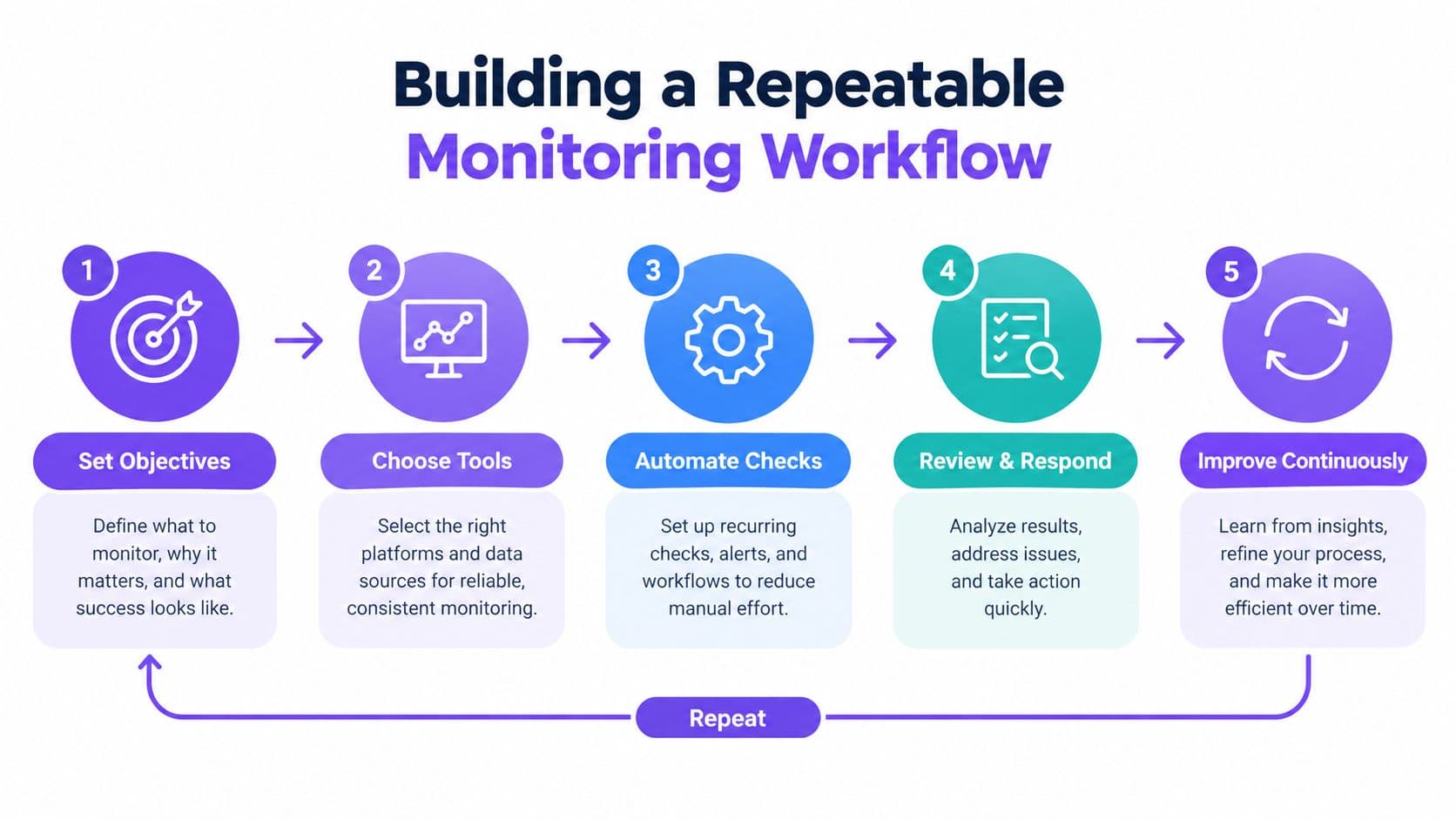
Building a Repeatable Monitoring Workflow
A useful workflow is small enough to maintain and disciplined enough to reveal change. Tracking every account in your category creates noise. Tracking only one rival leaves you vulnerable to blind spots. Independent guidance from Meltwater on social media competitor analysis recommends a focused competitor set of about 4–5 direct competitors, with time-bounded collection and repeatable metric tiers.
Start with a defined competitor set
Choose direct competitors that target a similar audience and publish in a comparable category. Add an indirect competitor when it competes for the same attention or solves a related need. An aspirational account can be useful for creative direction, but don't let its scale distort your operational benchmarks.
Write down why each account is included. For example, one rival may be strong in short-form video, another in multilingual publishing, and another in paid creative. This prevents the list from becoming a random collection of popular brands.
Set a fixed observation cadence
Choose a regular review rhythm that matches the speed of your channel. Daily checks can capture trend movement and new creative angles. A recurring weekly review is better for identifying cadence, format mix, and engagement patterns. Keep the collection window clear so you can connect a change to a campaign, launch, or creative shift instead of treating every fluctuation as meaningful.
Record observations in the same fields every time:
- Capture the post: Save the link, date, format, language, topic, and opening hook.
- Classify the creative: Tag the content pillar, angle, audience promise, and call to action.
- Normalize the result: Use engagement rate, reach, or impressions when available instead of raw likes alone.
- Compare the pattern: Look for repeated formats and changes in posting frequency.
- Assign an action: Turn the observation into a test, a content brief, or a decision to avoid the pattern.
Build a dashboard that answers decisions
Your dashboard shouldn't merely display activity. It should highlight changes your content team can act on. Use one view for strategic metrics, another for post-level creative analysis, and a short notes field for interpretation.
A useful note sounds like this: “Competitor increased short-form video frequency, but engagement per post declined after the format became repetitive.” A weak note says: “Competitor is doing well.”
For tool selection, compare capabilities against your workflow rather than choosing a platform because it offers the largest feature list. Hooked's competitor tracking tools resource is relevant for teams that want to connect monitoring with short-form content planning.
Why Annual Reviews Fail in Fast-Moving Channels
An annual competitor review can still help with broad positioning, product strategy, and market structure. It fails when a creator expects it to guide fast-moving decisions on TikTok, paid social, or short-form video.
A static SWOT document describes a moment. Social channels produce new hooks, sounds, editing styles, offers, and audience reactions continuously. By the time a team finishes a broad audit, the creative pattern it identified may already be saturated or replaced.
Adobe's explanation of competitor analysis reflects the gap between established business planning and the tactical question creators face: how often should monitoring be refreshed in rapidly changing channels? The answer depends on the decision. Strategic positioning can move slowly. Creative testing needs a much faster loop.
Match the cadence to the decision
Use a layered schedule rather than forcing every analysis into a single review date.
- Daily: Scan new formats, hooks, trend participation, and visible changes in rival publishing.
- Weekly: Compare posting frequency, format mix, engagement efficiency, and content themes.
- Campaign-based: Review creative before launch, during active testing, and after the campaign has produced enough observations to inform the next iteration.
- Periodically: Revisit positioning, audience segments, product claims, and broader competitive threats.
The daily layer is for discovery. The weekly layer is for attribution and prioritization. The strategic layer is for deciding whether your brand still occupies a clear position.
Avoid reacting to noise
Fast monitoring doesn't mean copying every new post. A single viral-looking video may be an outlier, a paid placement, or a format that works only because of the creator's established identity. Look for repetition across posts, platforms, or languages before treating a pattern as a reliable hypothesis.
A monitoring system should make your team faster at rejecting weak ideas, not just faster at collecting them.
The strongest workflow links an observation to a production decision. If a competitor's new format appears repeatedly and earns efficient engagement, adapt its structural logic in your own voice. If output rises while engagement efficiency falls, investigate audience fatigue before increasing your own volume.
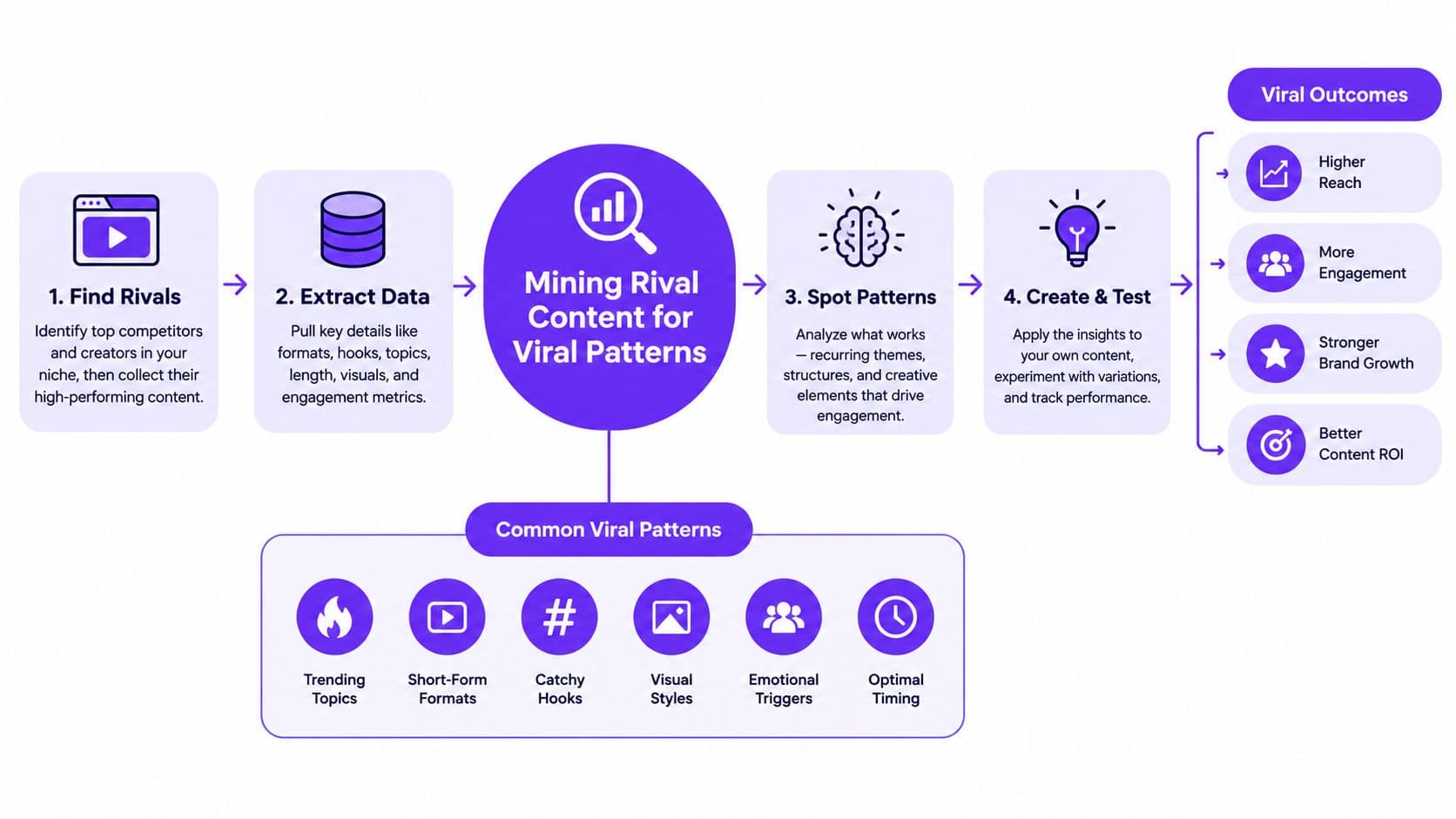
Mining Rival Content for Viral Patterns
Creative pattern mining begins inside the content library, not inside a spreadsheet of follower counts. Open a competitor's recent videos and study the first seconds, the promise made to the viewer, the visual change rate, the payoff, and the action requested at the end.
Suppose a rival repeatedly opens with a sharp problem statement, follows with a visual demonstration, and ends with a concise product comparison. Don't copy the wording or scene. Extract the structure: problem, proof, contrast, action. That structure can become a brief for a different topic, audience, product, or language.
Deconstruct the creative components
Create a pattern card for every meaningful post. Include:
- Hook: The first claim, question, visual, or tension point.
- Format: Narration, demonstration, reaction, slideshow, UGC-style ad, interview, or another repeatable structure.
- Angle: Education, comparison, controversy, aspiration, urgency, or problem solving.
- Proof device: Screen recording, product use, testimonial, before-and-after framing, data visualization, or visual evidence.
- Pacing: How quickly the video introduces the idea and changes visual context.
- Language variant: Whether the same concept appears in another language or is localized with different examples.
- Conversion path: Comment prompt, profile visit, landing page action, product interaction, or no visible call to action.
The point is to identify what can travel across platforms. A visual demonstration may work on TikTok and Instagram Reels. A detailed explanation may need a longer version for YouTube. A local-language adaptation may require more than translation, especially when the humor, references, or buyer objection changes by market.
Turn patterns into tests
Rank each pattern by evidence and effort. A repeated format with strong engagement efficiency deserves a controlled adaptation. A single outlier deserves observation. A format that depends heavily on a competitor's recognizable personality may not transfer well to a faceless channel.
Use a simple testing brief:
- Keep the structural hook.
- Replace the claim with your own audience problem.
- Change the proof and examples.
- Adapt the pacing to the target platform.
- Create language variants where the audience warrants them.
- Publish and compare against your own baseline.
The ethical boundary is clear. Learn from publicly visible structures, but don't duplicate scripts, footage, branding, or distinctive creative expression. Your advantage comes from translating the pattern into a stronger fit for your audience.
This kind of work becomes easier when trend discovery sits close to production. Hooked's TikTok trend discovery guide is relevant for teams that need to turn observed patterns into current content ideas rather than archive them for a later planning cycle.
Turning Intelligence into High-Converting Videos
A competitor report has no value until it changes what gets produced. The handoff from analysis to creation should be short: identify a pattern, write a test brief, produce a variant, publish it, and feed the result back into the next review.
Start with the creative variable you want to test. If the competitor pattern suggests that a direct question opens the strongest videos, don't change the hook, topic, voice, length, and call to action at the same time. Keep the test interpretable. Your team needs to know whether the improved response came from the opening or from an unrelated production change.
Convert observations into production briefs
A practical brief can contain five fields:
- Observed pattern: “Short demonstration follows a problem-led opening.”
- Adaptation: “Use the same sequence for our audience's onboarding objection.”
- Channel version: “Create a vertical short-form cut and a professional-network version.”
- Language plan: “Localize the example and voiceover for the priority audience.”
- Success signal: “Compare engagement efficiency and retention indicators with our recent posts.”
AI video tools can reduce the distance between that brief and a finished asset. A platform such as Hooked offers trend tracking, niche-specific analytics, competitor monitoring, AI-generated scripts, drag-and-drop editing, multilingual voiceovers, and scheduling across TikTok, Instagram, YouTube, and LinkedIn. Treat those capabilities as workflow components, not as a substitute for judgment.

Scale the parts that deserve repetition
Once a format proves useful for your audience, turn it into a template. Store the hook pattern, scene sequence, voice direction, visual style, language notes, and call to action separately. This lets a team produce several adaptations without recreating the workflow from scratch.
Faceless channels, AI Shorts, UGC-style ads, and slideshow videos each need different creative controls. A faceless video depends more heavily on narration, stock or generated visuals, and pacing. A UGC-style ad needs credible spoken language and a clear product moment. A slideshow needs strong text hierarchy because each frame carries more of the explanation.
Natural-sounding voiceovers and language variants can support multilingual testing, but translation alone won't guarantee audience fit. Rewrite examples, idioms, objections, and calls to action for the local audience. A competitor's local-language version may reveal a market opportunity, but it doesn't tell you which cultural reference belongs in your own content.
Schedule experiments, don't flood channels
Automated scheduling helps a team publish consistently, but volume can hide weak creative. Set a production ceiling that protects review quality. Each new batch should answer a specific question from the monitoring dashboard.
Measure the outcome using the same normalized framework used for competitor observation. Compare engagement rate against reach or impressions when available, track format-level performance, and record whether the result supports or weakens the original hypothesis. The loop is complete only when the result changes the next brief.
Scaling Your Competitive Advantage Over Time
Competitor analysis becomes a durable advantage when it operates as a loop rather than a report. The loop has four parts: benchmark rival behavior, create an adapted response, measure your result, and update the next decision.
Consistency matters because creative teams often confuse production activity with learning. Publishing more assets won't help if nobody records which hook, format, language, or audience promise drove the response. A daily roadmap should therefore include both an output task and a learning task.
Use a working checklist
Before approving a competitor-inspired video, ask:
- Pattern: Have we seen this structure repeat, or are we reacting to an outlier?
- Difference: What makes our version meaningfully distinct?
- Audience fit: Does the topic address our audience's problem rather than the rival's?
- Format: Are we adapting the structure to the platform instead of copying the original edit?
- Localization: Do language, examples, and voice match the intended market?
- Measurement: Which normalized metric will tell us whether the test worked?
- Next action: What will we change if the result is weak, mixed, or strong?
A personalized warmup plan can help teams establish publishing consistency before they scale production. A daily content roadmap can then rotate proven formats, emerging patterns, and original experiments so the channel doesn't become a clone of its competitors.
Protect the strategic view
Daily monitoring should inform your positioning, not replace it. If every competitor begins using the same hook, the pattern may still attract attention, but it no longer differentiates your brand. The strongest response may be to use the underlying audience tension with a fresher proof device, clearer point of view, or underserved language variant.
Share of voice is useful at the strategic level because it shows whether your brand is becoming more visible within the monitored conversation. Teams that need a focused way to organize that measurement can review a SoV calculator for SaaS teams, then adapt the underlying logic to their own category and channels.
Decision test: If a competitor insight doesn't change a brief, a publishing decision, or a measurement plan, it hasn't become intelligence yet.
The resilient content engine doesn't chase every rival move. It watches systematically, identifies patterns with evidence, adapts them without losing brand identity, and keeps only what works for its own audience. That process turns market observation into a repeatable creative discipline.
Hooked brings competitor monitoring, real-time trend tracking, niche analytics, AI scripts, multilingual voiceovers, video creation, and cross-platform scheduling into one workflow for creators and brands. Visit Hooked to turn the patterns you find into structured content tests and a consistent publishing roadmap.