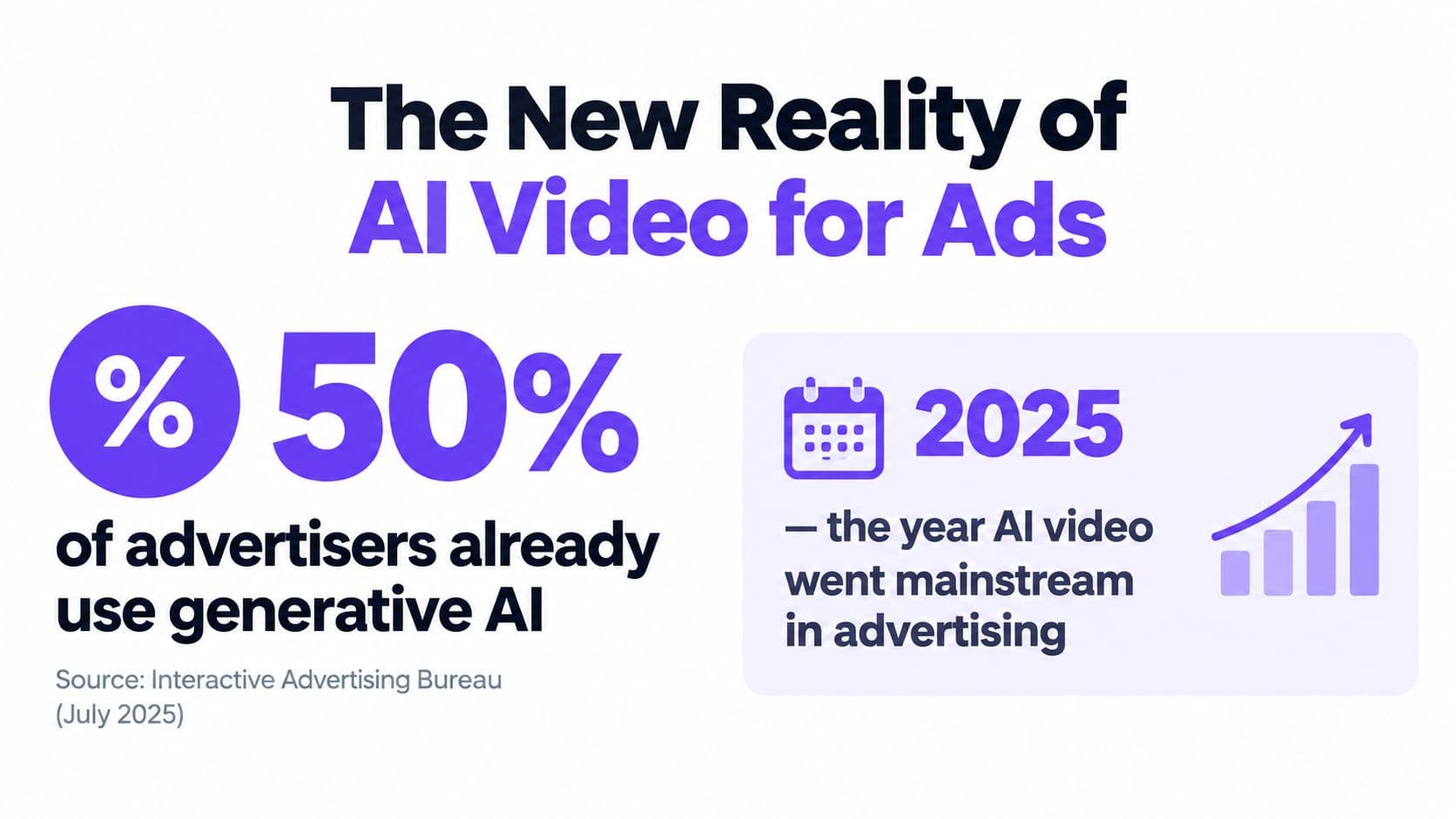
50% of advertisers were already using generative AI to build video ads in July 2025, and 86% of buyers were using it or planning to use it. The right AI video generator for ads can multiply your creative testing capacity, but scaling synthetic content without protecting trust can increase waste instead of lowering CPA.
That's the decision in 2026. You're not choosing between “AI” and “traditional video.” You're choosing where automation should handle production, where human judgment must control the message, and how much artificiality your audience will tolerate before the hook loses credibility.
The strongest ad teams use AI to create more relevant variations, not just more videos. They adapt hooks, formats, voiceovers, offers, and visual treatments to specific audiences and channels. They also reject weak renders quickly. A high-volume workflow only works when the output is good enough to earn attention and believable enough to support the brand.
The New Reality of AI Video for Ads
The adoption curve has already crossed the point where experimentation is a meaningful strategy. In July 2025, the Interactive Advertising Bureau report on generative AI in marketing reported that 50% of advertisers were already using generative AI to build video ads, while 86% of buyers were using it or planning to use it for video ad creative. The same report projected that generative AI creative would account for 40% of all ads by 2026, a forecast that frames AI video as a production standard rather than a novelty.
The shift changes the economics of creative operations. A studio shoot produces a small set of deliberate assets. An AI workflow can turn one approved concept into multiple openings, presenters, aspect ratios, languages, CTAs, and product angles. That matters because performance teams need a steady supply of fresh creative to test against changing audience fatigue and platform distribution.
But output volume isn't the objective. Useful variation is. Five videos with different colors and identical hooks aren't a testing system. A productive ad workflow changes one meaningful variable at a time, such as the first sentence, proof point, visual demonstration, audience framing, or CTA. It then preserves the winning structure while producing controlled adaptations.
The production shift
Synthetic clips can cost roughly 0.15 per second, compared with 2,000 or more per second for traditional production, according to the industry economics summarized by Sovran's video ad creation benchmarks. The same source reports an estimate that AI tools can reduce production cost from about 400 per minute and compress delivery from 13 days to under 30 minutes for a 60-second spot.
Those figures don't mean every AI render is campaign-ready. Failed generations, editing time, legal review, brand approvals, localization, and media testing still carry a cost. They do mean creative teams can afford to treat production as an iterative operating system instead of a rare event.
Practical rule: Use AI to increase the number of credible creative hypotheses your team can test. Don't use it to flood ad accounts with near-identical filler.
For brands that need controlled, polished production rather than basic prompt experiments, high-end AI video solutions can provide a useful reference point for evaluating visual quality, workflow support, and production oversight.
Comparing the Top AI Video Generator for Ads
The best tool depends on the job. A cinematic model may produce an excellent product reveal but slow down a direct-response team that needs new hooks every day. An avatar platform may localize a script efficiently but look too synthetic for a premium brand campaign.
| Tool or workflow | Best fit | Main strength | Main risk |
|---|---|---|---|
| Hooked | Social-first performance creative | Trend-led formats, AI ad creation, UGC and faceless workflows | Requires strict brand review at high volume |
| Runway | Cinematic brand visuals | Strong visual direction and polished generated footage | More hands-on assembly and iteration |
| Creatify | Product-led ecommerce ads | Product-page-to-ad workflows and variant production | Product claims and final composition need review |
| Avatar platforms | Presenter-led and multilingual ads | Consistent scripts, voiceovers, and localization | Synthetic delivery can weaken trust |
| Traditional editing suites | Finishing and brand control | Precise timing, captions, overlays, and compliance edits | They don't solve creative ideation or production volume alone |
Hooked fits teams that treat social advertising as a recurring creative pipeline. Its AI video generator supports formats such as faceless videos, short-form social content, UGC-style ads, and platform adaptations. That makes it more relevant to performance marketers than a pure text-to-video model when the bottleneck is turning ideas into usable social assets.
Runway is the better choice when visual polish carries the campaign. It gives creative teams more control over generated scenes and cinematic treatments, but it isn't the obvious first choice for a marketer whose immediate need is a large batch of direct-response hooks. You'll still need human direction to maintain product continuity, message clarity, and a coherent edit.
Creatify is useful for ecommerce workflows where product information already exists on a page. A URL-to-video process can shorten the distance between catalog data and a testable ad, but automation shouldn't be allowed to invent product benefits, alter offer language, or present a product in a way that creates misleading expectations.
Compare finished ads, not model demos
A model's resolution or visual spectacle tells you little about paid performance. Test the same brief across tools and compare the finished export on a phone screen. Check the opening second, product visibility, spoken claim accuracy, caption timing, lip-sync, motion continuity, CTA clarity, and the amount of manual correction required.
For a broader automated video ad platform overview, use the same discipline. Treat feature lists as a starting point, then judge whether the tool can produce platform-ready creative within your approval process.
The right platform is the one that turns your existing brief, assets, and feedback loop into more credible variants. If it creates beautiful footage that your team can't localize, edit, approve, or test efficiently, it isn't solving the advertising problem.
Performance Signals and Production Economics
Production savings matter only when the ad earns attention and converts it. Independent evaluations now judge AI video systems by finished-ad quality, not isolated model output. The OpenArt Arena research places Seedance 2.5 first on its overall video board with 1,081, followed by Wan 3.0 at 1,004 and Seedance 2.0 at 1,000. Its task-based evaluation and pairwise human judgments resemble an advertiser's decision process more closely than a polished model demo.
The same research gives Creatify's ad agent a 94% win rate against the top-scoring competing ad agent in the same evaluation and 93% against raw video models, based on roughly 1,400 pairwise verdicts. The production lesson is clear. An orchestration layer can beat a stronger base generator when it handles the brief, scene selection, editing, and ad constraints with greater discipline.
The hook still carries the account
Industry benchmarks report high-quality AI avatars reaching hook rates of roughly 26% to 36% on Meta and 20% to 30% on TikTok, close to human UGC and above static ads. They also report AI video ads lifting click-through rates by 12% versus human-made equivalents, while potentially trailing by about 8% on conversion for products priced above $100.
The gap between attention and persuasion defines the economics. A synthetic face may stop the scroll, yet a high-ticket buyer still needs proof, specific claims, believable product demonstrations, and confidence in the seller. Mass production increases creative volume, but weak hooks or artificial UGC signals can turn that volume into expensive, low-quality traffic. Brand trust limits the return on scale.
Track the full funnel:
- Attention: Hook rate, hold rate, and early retention show whether the opening earns another second.
- Intent: Click-through rate and landing-page engagement show whether the promise matches the audience's need.
- Trust: Comments, branded search behavior, and qualitative feedback reveal discomfort with synthetic delivery.
- Business value: Conversion rate and CPA determine whether the creative deserves more spend.
A high hook rate is not permission to scale. It is permission to inspect the next stage of the funnel.
“Good enough” AI becomes a false economy when poor lip-sync, flat voice cadence, distorted products, or generic UGC cues reduce credibility. Review those signals before increasing spend, then localize winning concepts with market-accurate claims and natural delivery. Use this guide to measuring content performance to connect creative signals with downstream outcomes instead of optimizing for cheap attention alone.
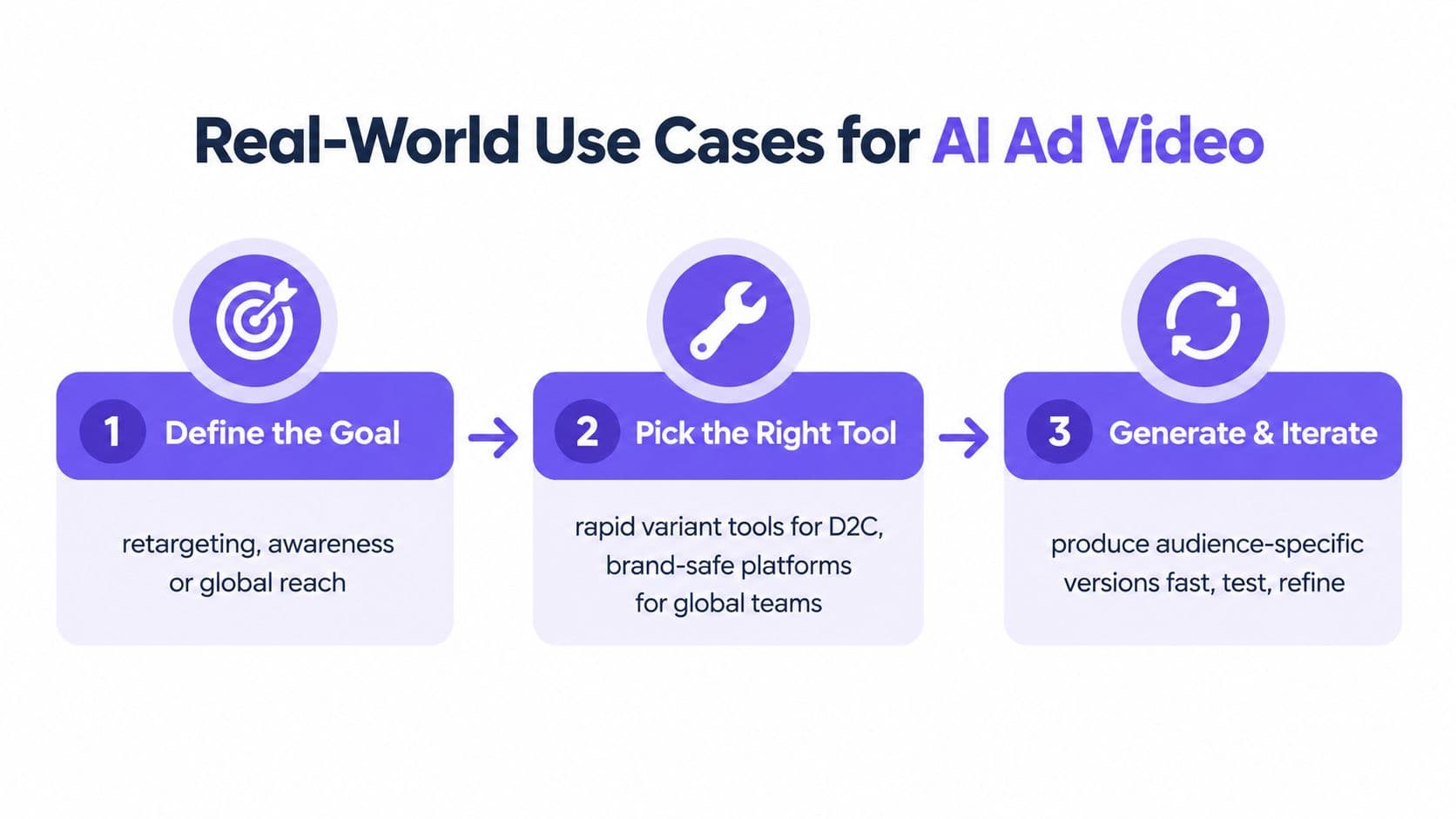
Real-World Use Cases for AI Ad Video
The same generator can behave very differently depending on the objective. A faceless channel needs visual rhythm and a clear narrative. A UGC ad needs believable delivery and a strong first line. A multilingual retargeting campaign needs accurate claims, natural voiceovers, and market-specific review.
Faceless channels
Faceless ads work when the product, situation, or insight carries the story. Use screen recordings, product close-ups, animated text, demonstrations, stock footage, or generated scenes. The voiceover should sound like a person with a point of view, not a neutral reading of a landing page.
This format suits awareness and discovery campaigns where the viewer doesn't need to trust a visible spokesperson. It becomes weaker when the product requires tactile proof, personal testimony, or a complex explanation. For those cases, add authentic footage, real customer language, or a human-recorded segment rather than hiding every human signal.
UGC-style hooks
UGC-style ads need more than an avatar standing beside a headline. The script should open with a specific problem, demonstrate a product action, and use language that matches the audience's actual experience. Generic phrases such as “you need to try this” rarely create a credible reason to continue watching.
A strong workflow generates several hook angles, then changes the visual context and delivery only when that variation tests a real hypothesis. Review hands, product scale, facial reactions, captions, and pauses. Audiences notice visual errors quickly, and the consumer research summarized in the brief found that 83% of people can spot AI videos, 55% cite unnatural voices as a giveaway, and 36% say AI video would lower brand trust.
Multilingual retargeting
Localization is more than translating a sentence. Adapt the offer framing, cultural references, pacing, subtitle density, legal language, and CTA for each market. The IAB data reported by The Desk's coverage of generative AI in CTV advertising says advertisers most often use generative AI for audience-specific versions at 42%, visual style adaptation at 38%, and contextual relevance at 36%.
That pattern identifies the highest-value use of AI. Don't begin by replacing the hero film. Begin by creating market and audience variants around an approved core message. Human reviewers should verify pronunciation, claims, cultural fit, disclosure requirements, and platform compliance before launch.
Why Hooked Stands Out for Scalable Ad Production
Performance marketers don't need a general video editor alone. They need a repeatable path from trend signal to concept, script, render, edit, approval, and publication. Hooked's workflow is built around that social-first sequence, with trend tracking, niche-specific insights, an AI Video Builder, drag-and-drop editing, and ad formats designed for platforms where hooks determine whether the viewer keeps watching.
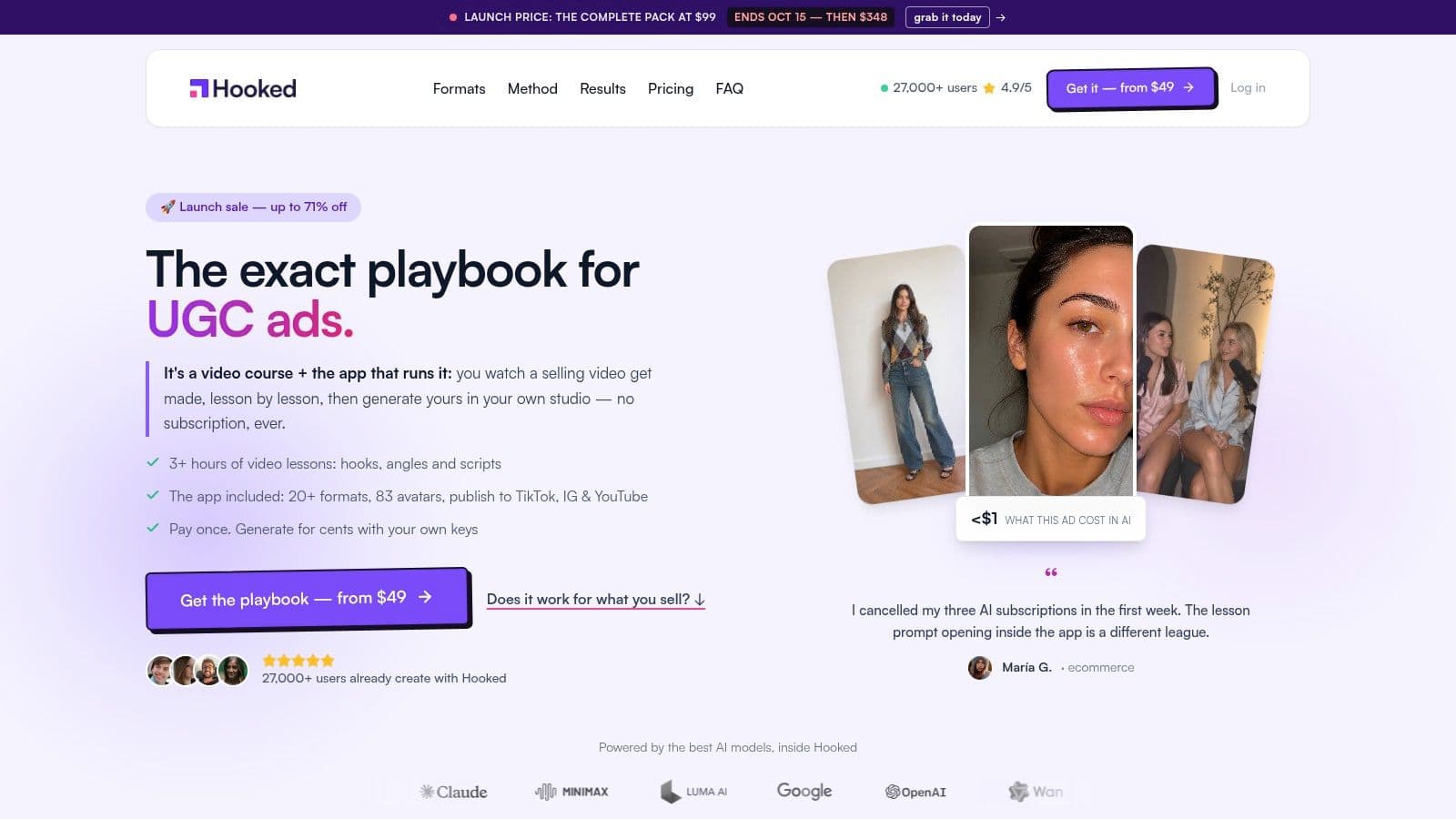
The practical advantage is context. A blank generative canvas asks your team to invent the concept, structure the script, select a format, and decide how to package the result. A trend-informed workflow gives the team a usable creative pattern to adapt, while still requiring judgment about the brand, audience, and offer.
Hooked supports faceless channels, UGC-style ads, short-form videos, slideshows, custom avatars, lip-sync, voice cloning, and voiceovers in 29 languages, according to the publisher information provided for the platform. Its AI ad generator can turn product details into ad variations for different platforms and audiences, which is useful when the bottleneck is iteration rather than one-off production.
Volume needs guardrails
More output creates more opportunities to publish something off-brand. Build approval checkpoints into the workflow. Check the first frame, spoken claims, product depiction, disclosure language, captions, music rights, and final CTA before any asset reaches paid distribution.
Trend alignment also isn't a substitute for positioning. A format may be popular because it rewards humor, confession, demonstration, or controversy. Your brand still needs a reason to use that pattern. Copy the structure, not another advertiser's identity.
The winning combination is native format plus distinctive proof. Remove either one and the ad starts to look interchangeable.
Hooked's AI ad generator feature is relevant for teams that want to combine templates, scripts, avatars, editing, and platform-oriented creative production in one workflow. It won't eliminate the need for human review. It can reduce the friction between an approved idea and a finished asset, which is where many performance teams lose momentum.
A social ad pipeline should make iteration easy without making quality optional. The tool helps with the first part. Your creative brief and approval standard handle the second.
AI Video Generator for Ads Buyer Checklist
Choose a platform against the workflow you run, not the demo you watched. Start with the number and type of variations your team needs, then test whether the tool can produce them without introducing new review bottlenecks.
1. Define the creative job
Write down the primary use case before comparing plans.
- Direct response: Prioritize hook variation, rapid rendering, product visibility, captions, and exports for paid social.
- Brand campaigns: Prioritize visual consistency, art direction, asset control, and human-led editing.
- Localization: Prioritize natural pronunciation, voice adaptation, subtitle control, and market-specific review.
- Retargeting: Prioritize audience-specific messaging, offer changes, and fast production from approved assets.
A platform that excels at one category may be poor at another. Don't pay for cinematic generation if your team mainly needs new UGC-style openings.
2. Inspect the real unit economics
Look beyond the subscription price. Ask how many failed renders consume credits, whether revisions cost extra, and how much editing remains after generation. Synthetic production can be dramatically cheaper per second than traditional production, but a low nominal cost doesn't help if every usable ad requires extensive repair.
Calculate the cost of a finished, approved variation, including creative labor, localization, review, and exports. Then compare that number with the cost of your current workflow.
3. Test trust before scale
Run a controlled pilot with your actual product, not a polished sample brief. Have reviewers watch the ads without being told which ones are AI-generated. Record where they notice artificial voices, awkward gestures, incorrect product details, or generic claims.
For UGC-style creative, ask whether the speaker sounds like a plausible customer. For faceless creative, ask whether the visuals prove the claim. For multilingual work, use native reviewers where possible.
4. Check operational controls
Confirm that the platform supports the formats, caption styles, aspect ratios, brand assets, and publishing workflow your team needs. Check access controls, revision history, asset organization, and export quality before committing to a larger rollout.
Also confirm how the tool handles voice rights, avatar permissions, product imagery, music, and AI disclosure. Legal and brand teams should review the workflow before media buyers build it into a campaign calendar.
5. Judge the testing loop
A useful AI video generator for ads should make it easy to connect a creative concept to a result. You need naming conventions, version control, clear hypothesis tracking, and a process for feeding winning patterns back into production.
Don't judge success by how many files the tool creates. Judge it by whether your team can identify stronger hooks, produce credible adaptations, and move budget toward ads that generate profitable action.
Start with a narrow pilot. Pick one audience, one platform, and one offer. Build a small set of distinct concepts, review every render for trust and accuracy, then scale the workflow only after the full funnel supports it.
Hooked offers trend-informed video creation, an AI Video Builder, UGC and faceless formats, avatars, voiceovers, editing, and publishing workflows for teams producing social ad creative at scale. Visit Hooked to evaluate whether its workflow fits your next creative testing sprint.