AI funny video content succeeds for a less obvious reason than novelty. The technology has reached a scale where major platforms are handling millions to billions of generated or labeled AI videos, while generation times have fallen from minutes to seconds, according to industry coverage of AI video milestones. That speed makes comedy easy to produce, but it also makes weak jokes, repetitive visuals, and unclear satire easy to publish.
The practical advantage comes from choosing a repeatable format before opening the generator. The seven formats below break down the hook, comedic contrast, pacing, production workflow, audience fit, platform risk, and adaptation route. Hooked can support that workflow with trend discovery, scripts, avatars, voiceovers, editing, and scheduling, but the creative decision still comes first: decide what makes the audience recognize the joke immediately.
1. AI-Generated Character Reactions to Trending Topics
A synthetic character reacting to a live topic works because the audience already understands the reference. The character adds a second layer of comedy through an exaggerated emotion, an inappropriate opinion, or a personality mismatch. A polite cartoon robot reacting to celebrity drama, for example, can be funnier than a realistic commentator because its limited emotional logic becomes part of the joke.
The strongest version uses a short setup, visible reaction, and sharp final expression. Give the avatar one clear point of view, such as an overconfident gossip, an anxious office worker, or a robot that treats every trend as a system failure. Keep the dialogue focused on one beat rather than asking the character to summarize the entire story.

Build the reaction around a character rule
A recurring character makes trend participation more recognizable. Hooked's AI reaction video generator can help turn a prompt, avatar, and voice into a repeatable production asset, while trend tracking can help identify topics before they become saturated.
Use these production choices:
- One emotional response: Choose surprise, outrage, confusion, or smug certainty. Combining all four weakens the punchline.
- A distinctive voice: A signature delivery style matters more than visual complexity. A slow, formal voice can make a trivial trend sound like a national emergency.
- Clear disclosure: Label synthetic characters when viewers could mistake them for real commentators, especially around news, public figures, or sensitive events.
The risk is timing without substance. A reaction posted quickly still fails if the audience needs context before understanding the joke. Test several opening lines against the same visual, then keep the version that communicates the topic and attitude fastest. This format suits faceless creators, entertainment pages, and brands that can respond quickly without pretending to offer authoritative news coverage.
2. Absurdist AI Script Comedy
Absurdist comedy starts with a familiar container and fills it with an impossible conclusion. A product review, life-advice clip, or serious interview gives the audience a stable expectation. The punchline then breaks that expectation, such as an AI narrator explaining that a pillow grants flight powers or two bots debating whether water is wet.
The format works best when the delivery stays calmer than the content. A deadpan avatar describing an obviously impossible solution creates stronger contrast than a character who announces the joke with exaggerated excitement. AI-generated dialogue can produce many premises quickly, but creators still need to remove lines that sound random rather than intentionally strange.
Give nonsense a recognizable frame
Start with a structure viewers know. “Three productivity tips,” “a customer review,” and “an expert explains” all provide immediate context. The absurdity should escalate from a believable opening, not arrive as disconnected gibberish.
Hooked's AI comedy skit generator can help generate scenarios, dialogue, and punchline variations. Treat those outputs as a writers' room, not a finished script. Choose one premise, establish the character's internal logic, and end with a specific reversal.
Practical rule: If the audience can describe why the character's conclusion is wrong, the absurdity has structure. If nothing connects to anything else, the clip probably needs a clearer premise.
A recurring character improves the format. One “expert” could give increasingly useless advice, while another character takes every claim at face value. Keep each episode centered on one contradiction and use visual changes sparingly. Rapid cuts, captions, and a recognizable opening phrase can make a series easier to follow without making every episode identical.
This format suits creators building an original voice and brands willing to adopt playful fictional personalities. It doesn't suit regulated categories where deliberately false instructions could be mistaken for real guidance. Add a clear satirical cue whenever the joke touches health, money, safety, or public information.
3. Side-by-Side AI Comparisons
Comparison comedy turns a gap into the punchline. The left side shows the polished expectation, while the right side exposes the chaotic reality. “How I plan my day versus how it goes” works because viewers don't need an explanation of the conflict. The labels establish the premise, and the contrast supplies the joke.
Split-screen visuals are useful, but quick sequential cuts can work just as well. The important production decision is to make the two sides feel genuinely different. Use a controlled, professional voice for the expectation and a rushed, distracted delivery for the reality. Give each side its own color treatment, framing, sound, or avatar.
Make the contrast legible without sound
Many viewers encounter short-form video in inconsistent audio conditions. Put the comparison in readable on-screen text, keep the labels short, and make the first visual difference obvious. A polished cooking-show frame beside an overfilled pan communicates the premise before the voiceover finishes the sentence.
Useful adaptation angles include:
- Career contrast: “What clients think a strategist does” versus “what the strategist really does.”
- Commerce contrast: A perfect product listing beside the messy reality of packing an order.
- Social contrast: A confident interview persona beside the creator forgetting the opening question.
- Routine contrast: A carefully planned morning beside a character still searching for a phone.
The format is easy to test because one subject can support several contrasts. Change the audience pain point, not just the caption. A creator might compare planning and execution, while a brand might compare the promised convenience of a category with the actual friction customers face.
The supplied comparison video example illustrates the value of presenting two recognizable versions of the same situation. Keep the resolution fast. If the audience sees the difference but waits too long for the payoff, the clip becomes a demonstration rather than a joke.
4. AI Celebrity Impressions via Voice Cloning and Lip-Sync
Celebrity parody earns attention through instant recognition, but the same shortcut creates a serious trust risk. A familiar public persona can make synthetic speech look like an actual statement. Use the format only when the audience can identify the fiction immediately, such as a fictional celebrity reviewing an unrelated product or commenting on an absurd situation.
The comedic mechanism is status mismatch. A high-status figure addresses something trivial, or a recognizable speaking style appears in an incompatible setting. The joke should expose the constructed persona, public image, or situation. It should not present fabricated claims as news, endorsements, or private opinions.
Treat disclosure as part of the creative
Use visible text such as “AI parody” or “satire” in the opening frame and caption. Don't use a cloned voice to imply an endorsement, political position, private statement, or product recommendation. A brand should obtain appropriate permission for likeness and voice use, then check whether the finished clip could be mistaken for an official message.
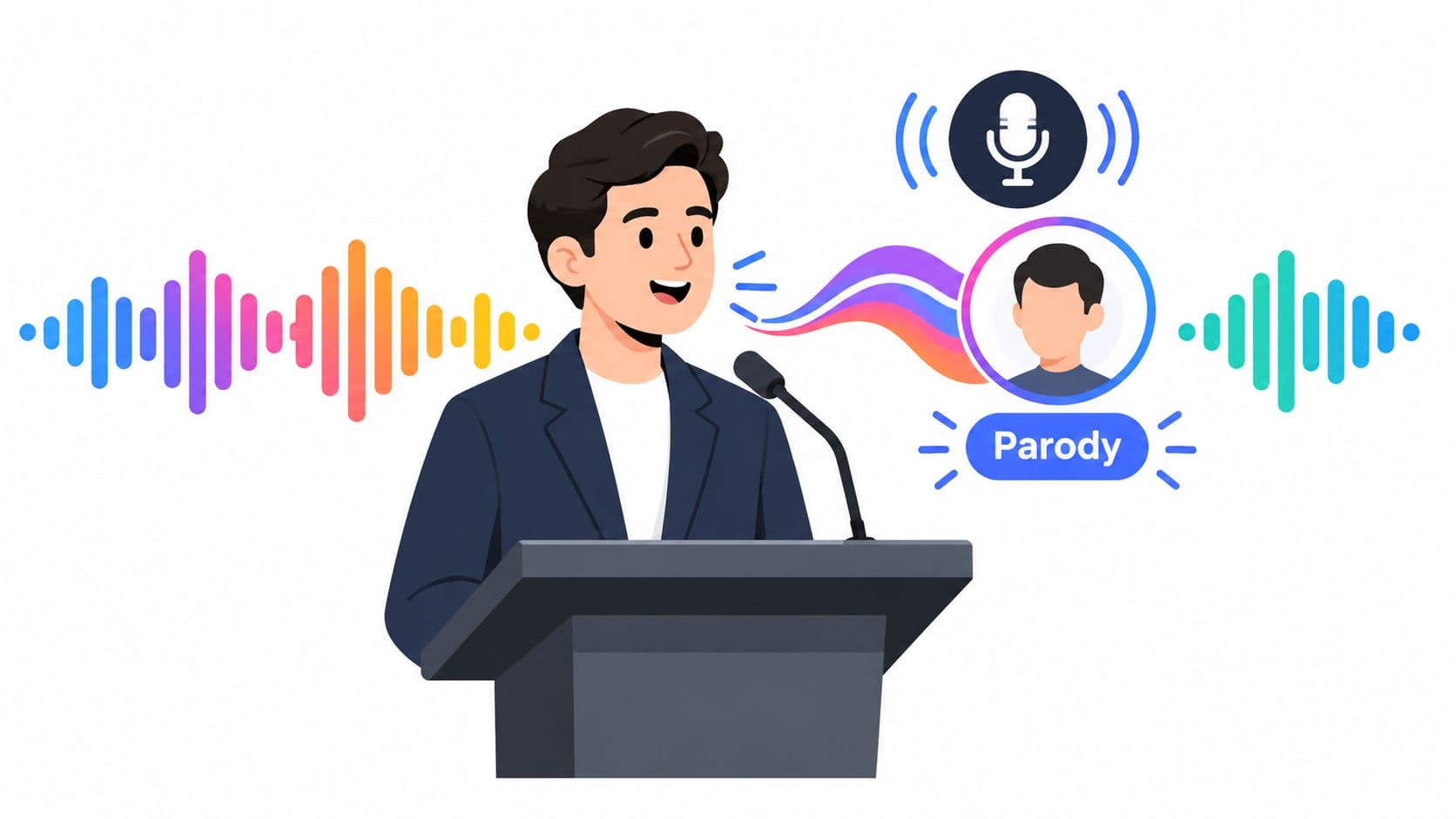
Hooked's guide to making an AI voice can support the production workflow, particularly for invented characters with no direct identity match. Build the joke around three controllable traits, such as pacing, vocabulary, and vocal emphasis. Then create several scripts that place the same character in different absurd contexts. This turns one impression into a repeatable series rather than a one-off imitation.
A useful test changes one variable at a time. Keep the character design and voice consistent, then vary the scenario, opening line, or caption. Review whether viewers understand the parody before the payoff, and remove any version that could be read as a genuine statement.
A believable voice isn't permission to make a believable lie.
The format suits entertainment pages, commentary channels, and clearly labeled parody campaigns. It is a poor fit for brands requiring strict identity control or operating in high-stakes contexts. Regulatory attention is increasing around labeling, impersonation, deception, and AI-made political content, as discussed in analysis of generative AI video disruption and risk. Check applicable rules and platform policies in each market before publishing.
5. AI-Generated How-To Parodies
A bad-advice tutorial borrows the authority of instructional content and then deliberately sabotages it. The narrator sounds calm and helpful while recommending a ridiculous approach to an interview, workout, recipe, or productivity problem. That collision between serious presentation and terrible guidance creates the laugh.
The format needs a strong safety boundary. “How to fail your job interview” is clearly framed as a joke. Advice about dangerous exercise, unsafe food handling, or medical behavior can confuse viewers even when the creator intends satire. Use an opening label such as “Satire” or “Do not do this,” and don't show instructions that a viewer could reasonably follow to cause harm.
Build the joke from a familiar search intent
Start with a question people ask, then reverse the expected answer. A productivity parody might advise viewers to create a new planning system every time they avoid a task. A cooking parody could treat an ordinary ingredient as an elite technical challenge and escalate into needless chaos.
Hooked's niche analytics can help identify topics with a clear audience, while its script and video tools can turn one premise into multiple safe variations. Keep the narrator's tone consistent, then let the visuals reveal the absurdity. Sound effects can support the escalation, but they shouldn't replace a readable premise.
A recurring bad-advice character gives the series a point of view. The character might be a relentlessly confident “expert” whose credentials become less plausible in each episode. Invite comments by asking viewers to identify the worst recommendation, but reinforce the satirical intent in replies rather than pretending the advice is real.
This format suits TikTok slideshows, voiceover shorts, and brands with a playful educational identity. It doesn't suit campaigns where viewers might mistake entertainment for official product, legal, financial, health, or safety guidance. The best parody teaches the audience what not to do without leaving them responsible for decoding the warning.
6. AI Debates Itself
Two AI personas arguing over a trivial question create a built-in engine for pacing. One character can be logical and severe, while the other is emotional, sarcastic, or confidently wrong. The argument over whether a hot dog is a sandwich matters less than the personalities fighting as though the subject were a national crisis.
Distinct voices make the dialogue easy to follow. Give each persona a different rhythm, vocabulary, visual treatment, and reaction style. A formal analyst can speak in careful complete sentences, while a chaotic rival interrupts, changes the subject, or treats an irrelevant detail as decisive evidence.
End with escalation, not a summary
A debate needs a turn near the end. The characters might reach an absurd compromise, reveal that they misunderstood the question, or introduce a third position that makes both arguments look reasonable. A clean resolution is less useful than a final escalation that invites the audience to choose a side.
Use Hooked's drag-and-drop editing to arrange the back-and-forth, then test whether captions remain understandable when the voices overlap with music. Audience participation is part of the format, so captions can ask, “Which AI is right?” or present the debate as a recurring rivalry.
The subject attracts the click, but the character conflict earns the comment.
Batch production becomes easier when the personas stay fixed. The same pair can debate cereal and soup, office etiquette, fashion choices, or competing product features. For a brand, the safer version compares two fictional approaches to a customer problem rather than making unsupported claims about a competitor.
Avoid debates about real political events, public health, or allegations unless the content has been reviewed carefully and labeled appropriately. Synthetic characters can make weak claims sound confident. Keep the subject low-stakes, the fictional framing visible, and the final joke separate from factual advice.
7. AI Day-in-My-Life Parodies
Day-in-my-life videos already have a dependable rhythm: timestamp, activity, reflection, repeat. The parody keeps that rhythm but fills it with recognizable dysfunction. An “AI day in the life of an ecommerce entrepreneur” might present abandoned carts, endless notifications, and improvised problem-solving in the tone of a luxury wellness vlog.
Relatability comes before absurdity. Identify a real frustration within a specific audience, then exaggerate it until the narrator's calm language becomes funny. A programmer, accountant, creator, or introvert should face details that members of that group recognize, not generic chaos that could belong to anyone.
Turn one audience into a series
Use timestamps as visual anchors, but let each time reveal a new form of the same problem. A creator's morning can begin with a carefully planned schedule, shift into notification overload, and end with a confident claim that everything remains under control. The narration should sound more composed as the situation gets less manageable.
Hooked's niche analytics can help identify audience themes, and its trend tools can guide the audio or structure around the format. Build variations around one niche before jumping between unrelated audiences. A series for marketers, for example, can cover reporting day, client feedback, campaign launches, and the search for the latest creative brief.
The format also supports meta-comedy. “A day in the life of an AI” can parody endless prompts, contradictory instructions, and characters asking for realism from impossible visuals. That approach keeps the subject fictional and avoids the impersonation risks associated with public figures.
The main trade-off is production volume versus distinctiveness. A template makes episodes easier to create, but repeated timestamps and identical narration can feel automated. Change the pain point, setting, and final observation while keeping the recognizable series structure. Audience comments can reveal which niche details deserve the next episode.
7 AI Comedy Video Types Compared
| Format | 🔄 Implementation Complexity | ⚡ Speed & Resources | 📊 Expected Outcomes | 💡 Ideal Use Cases | ⭐ Key Advantages |
|---|---|---|---|---|---|
| AI-Generated Character Reactions to Trending Topics | Low–Medium (templated avatars; trend ops required) | Very fast, minutes per clip, minimal equipment | High short-term engagement and virality; trend-dependent | Faceless trend channels, rapid posting, multilingual reach | Scalable production; consistent cadence |
| Absurdist AI Script Comedy (Unexpected Plot Twists) | Medium (nuanced script crafting, iteration) | Fast script generation; moderate editing/voice needs | High shareability and replay value; slower discovery curve | Brand personality, niche comedy, long-term growth | Distinctive, meme-worthy differentiation |
| Side-by-Side AI Comparisons (Expect vs. Reality) | Low (template-based editing; good writing needed) | Fast, drag-and-drop templates, low resource cost | High relatability and comments; broad topical fit | D2C/ecommerce, UGC ads, educational-entertainment hybrids | Relatable format that scales across topics |
| AI Celebrity Impressions via Voice Cloning & Lip-Sync | High (advanced cloning, quality control, legal checks) | Moderate, requires high-quality clones and review | Very high virality potential but legal/ToS risk | Viral marketing, parody/entertainment, UGC ad style | Instant recognizability and shareability |
| AI-Generated How-To Parodies (Intentionally Bad Advice) | Low–Medium (clear satire required) | Very fast, slideshow/templates, easy batching | Strong engagement and reuse; risk of misinterpretation | Comedy channels, educational brands, high-volume faceless content | Highly recyclable; easy to produce at scale |
| AI Debates Itself (Conflicting AI Personas) | Medium (multiple voices, tight scripting) | Fast production; low visual needs but scripting matters | Memorable, shareable; drives comment debates | Brand personality, debate/opinion niches, engagement drives | Original format with strong meme potential |
| AI Day-in-My-Life Parodies (Relatable Chaos) | Low (template-driven; needs niche specificity) | Fast, templates/slideshows, minimal resources | High relatability and identification; series-friendly | Niche audiences, B2B/professional, serialized channels | Infinite variation; strong audience resonance |
Turn One Funny Video Into a Repeatable Content System
These formats serve different creative goals. Reaction videos suit trend speed and timely commentary. Absurdist scripts build an original brand personality through recurring fictional logic. Side-by-side comparisons make familiar audience frustrations instantly legible. Celebrity impressions offer fast recognition but require the strictest disclosure and likeness safeguards. How-to parodies scale through search-friendly problems, while AI debates are designed to generate opinions in the comments. Day-in-my-life parodies work best when a niche audience sees its own routines and frustrations reflected in the joke.
Choose one format before producing a batch. Define either a recurring character or a specific audience pain point, then write several opening hooks around the same structure. Produce variations that change one meaningful element at a time, such as the premise, voice, ending, or visual contrast. That makes audience response more useful than publishing unrelated experiments and guessing why one performed differently.
Trust should remain part of the production brief. AI video can look convincingly native in a feed, and peer-reviewed research cited in AI video market coverage found that people identified video-only AI content with accuracy barely above chance. Clear labels for synthetic characters, cloned voices, parody, and fictional scenarios protect the audience and give the joke a cleaner frame.
Use trend signals for timing, but don't let them dictate the entire creative direction. Hooked can help track trends, generate scripts, build videos with avatars and voiceovers, edit short-form assets, and schedule content across social platforms. Creators who also need production-ready audio can explore these content creator audio tools as part of the workflow.
The most durable ai funny video series isn't the one with the strangest visual. It's the one where viewers recognize the format, understand the character, and know what kind of payoff they might get next. Start with one repeatable joke engine, make the synthetic nature clear, and use each batch to sharpen the next.
Use Hooked to track emerging trends, turn proven comedy structures into scripts and AI videos, and schedule your finished clips across social platforms. Visit Hooked to build a repeatable workflow for reactions, parodies, debates, and niche-focused short-form content.