Most businesses don't need a fresh creative concept for every TikTok post. They need a small set of adaptable formats, each tied to a clear outcome, such as building trust, answering questions, generating discovery, or moving a qualified viewer toward a purchase.
That matters because TikTok is now a major media and search channel, not just a place for casual entertainment. TikTok reached approximately 1.9 billion monthly active users worldwide in early 2026, while its global advertising revenue was projected at about $34.8 billion for 2026, according to TikTok statistics compiled by Charle Agency. The opportunity is substantial, but random posting makes it difficult to learn what works.
The ten TikTok video ideas for business below move from trust and education to discovery, conversion, localization, and scalable production. Each format includes a repeatable hook, a practical production structure, industry applications, and a caution about originality, speed, permissions, or brand fit.
Choose a format by asking three questions. What does the viewer intend to do next? Do they need proof, an explanation, or a reason to buy? What footage or assets can your team produce consistently? A service business may have expertise but little product footage. What action should follow the video? A save, comment, profile visit, direct message, or sale is more useful than a high view count with no business consequence.
1. Behind-the-Scenes Content and Process Videos
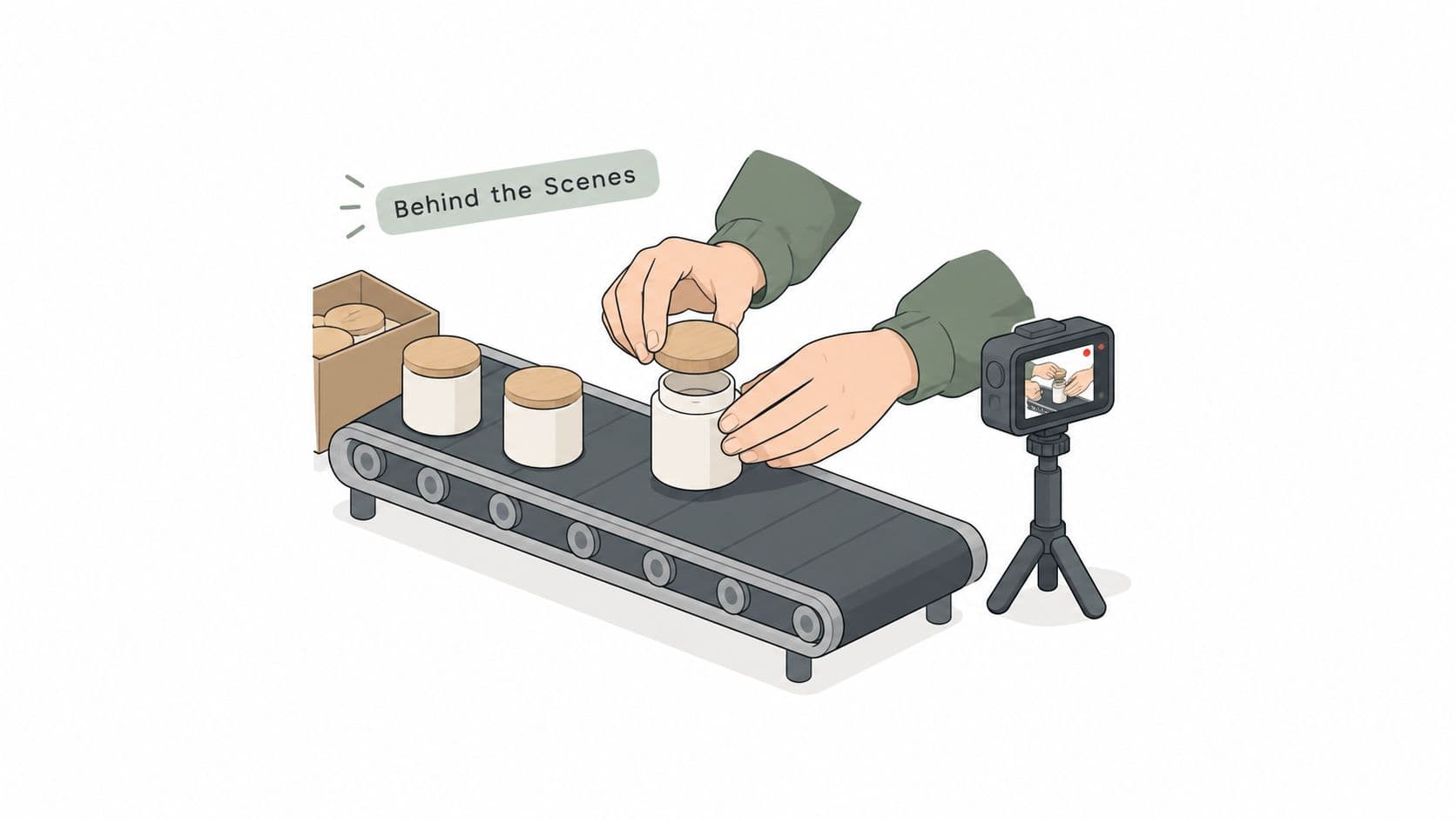
Trust often grows when people can see how a business works. A bakery can show dough becoming a finished product, a consultancy can show how it prepares a client workshop, and a D2C brand can document quality checks, packaging, or product assembly. These clips work particularly well for faceless channels because the process, not a presenter, carries the story.
Start with a visual hook that creates curiosity: “This is what happens before your order leaves our studio” or “From raw material to finished product in one process.” Then use a simple sequence:
- Show the starting material, problem, or workspace.
- Cut through two or three meaningful production steps.
- Reveal the finished result.
- Add one text overlay explaining a differentiator.
- End with a relevant CTA, such as “See the full process on our profile.”
A cosmetics brand might film filling jars, labeling units, and checking the final packaging. A fashion company can show fabric selection, cutting, stitching, and fitting. A software business can replace physical production footage with interface design, customer support workflows, or a bug moving from report to resolution.
Use captions to name the detail viewers might otherwise miss, such as material quality, inspection steps, or a service principle. Hooked's trend tracker can help match the footage to a current format, while templates make it easier to batch several versions during one filming session.
Practical rule: Use trends to frame the process, not to hide a process that has no interesting visual or customer relevance.
Speed can create problems here. Don't film confidential information, customer data, unreleased products, or staff members without permission. A polished factory tour may also feel less credible than a close, well-lit clip of real hands doing real work.
2. Educational Content and Quick Tutorials
Educational videos earn attention by solving a small problem immediately. They're useful for agencies, B2B companies, professional services, ecommerce brands, and any business whose expertise influences a purchase.
The strongest structure is direct:
- Hook: “Your product pages may be losing sales for this reason.”
- Tip: Explain one practical correction.
- Proof or example: Show the mistake and the improved version.
- CTA: Ask viewers to save the video, follow for the next lesson, or visit the profile for a deeper resource.
Keep one video focused on one idea. An SEO agency might demonstrate how to rewrite a weak title. A Shopify merchant could explain how to photograph a product from a more useful angle. A cybersecurity company might show how to recognize a suspicious login request without turning the video into a general lecture.
Search behavior makes wording important. One 2026 data set reported that 49% of US consumers used TikTok as a search engine, while TikTok users spent about 95 minutes per day on the platform on average, according to SocialPilot's TikTok statistics overview. Your spoken hook, on-screen text, and caption should use the language a potential customer would type or say, such as “how to choose running shoes for flat feet” or “how to prepare a B2B sales demo.”
Create a series when the subject has several related questions. Label each episode clearly, but make every video useful on its own. Hooked's niche-specific analytics can surface recurring topics, and competitor monitoring can reveal questions other brands have ignored.
Accessibility matters. Use readable captions, strong contrast, and voiceovers when appropriate. AI voiceovers can help a faceless channel, but a synthetic delivery that sounds detached may undermine authority in sensitive categories. Human review still matters, especially for legal, financial, health, and technical advice.
3. Trending Sounds and Audio-Driven Content
Trending audio can make a familiar product demonstration feel native to TikTok. It can also make a brand look late, forced, or legally careless. The format works when the sound adds a recognizable emotional or comic frame to a message that already makes sense without it.
Begin by identifying the sound's role. Is it building anticipation, emphasizing a reveal, creating irony, or supporting a transformation? Then write the visual action around that role. A restaurant can sync a new menu item reveal to a dramatic audio change. A beauty brand can use a rising sound to move from bare skin to a finished look. A language-learning app can pair a repeated phrase with a visual correction.
A useful production plan is to keep the core message constant while changing the audio and first visual. That lets a team compare creative framing without changing the offer, landing page, or audience. Hooked's real-time trend tracking can help identify emerging sounds, and its scheduler can organize several versions for deliberate release rather than publishing everything at once.
Use commercial-safe audio for paid campaigns and evergreen content when licensing requirements apply. Don't assume that an audio trend available to a personal account is automatically appropriate for a business advertisement. The creative idea should survive if the sound is removed.
A sound can increase discoverability, but it can't supply a strategy. The product, audience, and next action still need to be clear.
The main trade-off is speed versus originality. Publishing early may help a brand participate before a format becomes crowded, but copying the exact scene everyone else has made creates little memory or differentiation. Give the trend a business-specific twist, such as a customer objection, industry joke, product truth, or visual demonstration that competitors can't easily reproduce.
4. Customer Testimonials and User-Generated Content
Customer footage gives a business something polished brand videos often lack, the perspective of someone who had a problem, made a choice, and experienced the product or service. Unboxings, reviews, transformations, setup videos, and customer stories can all work, provided the viewer understands what changed and why it mattered.
Ask customers for a specific contribution instead of a vague request for “a testimonial.” A useful brief might ask them to show the initial problem, demonstrate the product in use, describe one meaningful benefit, and state who they'd recommend it to. Service businesses can request a short explanation of the process, while ecommerce brands can invite customers to show delivery, setup, or everyday use.
A repeatable structure looks like this:
- Open with the customer's original concern.
- Show the product or service in context.
- Include a concrete observation from the customer.
- Add brand context only where it helps.
- Close with a CTA matched to the buying stage.
Glossier-style fan features, Airbnb guest stories, fitness transformations, and customer outfit videos all demonstrate how the customer can become the narrator. For a B2B company, the equivalent might be a client explaining the workflow before and after implementation, without revealing confidential business information.
Use a branded hashtag if it helps collect submissions, but don't make participation depend on a campaign mechanic. Ask for written permission before reposting, editing, or using footage in paid media. Be especially careful with before-and-after claims in skincare, health, fitness, and financial categories.
For production guidance, see this user-generated content strategy. Hooked can help add captions, structure customer clips, and create reusable UGC ad layouts, but editing shouldn't erase the details that make the footage credible.
5. Carousel and Slideshow Format
A TikTok slideshow is a strong option when the business has useful images, product details, screenshots, or a story that benefits from controlled pacing. Real estate companies can present a property room by room. Ecommerce teams can show a collection. Travel brands can build an itinerary. A SaaS company can turn a workflow into a visual sequence of screens.
The first slide has one job, to earn the next swipe. Use a specific promise such as “Five desk setups for small spaces”, “The three details to check before buying this jacket”, or “What this rental looks like beyond the listing photo.” Each following slide should answer, demonstrate, or intensify that promise. The final slide should direct the viewer toward one action, such as a profile visit, product page, or direct message.
Avoid filling every slide with paragraphs. Use one idea per frame, large type, consistent colors, and enough contrast for mobile viewing. A product catalog should prioritize differences that influence selection, such as use case, size, finish, or compatibility, rather than repeating generic benefits.
Hooked's slideshow workflow can support creating a TikTok slideshow with AI-generated transitions and pacing. That's useful for teams that have many assets but limited editing capacity. Still, automation can create unnecessary motion. If every transition spins, zooms, and flashes, the viewer may remember the effect rather than the offer.
A slideshow should feel like a guided decision, not a folder of images exported to TikTok.
Use audio only when it supports the viewing experience. Trending sound may help discovery, but the text and visual order must remain understandable with sound off. For property listings, product catalogs, and regulated categories, verify every detail before publishing. A single incorrect feature or availability statement can damage trust faster than a stylish transition can build it.
6. Challenges and Trend Participation Videos
Challenges give businesses a way to join a shared behavior instead of speaking into an empty room. The opportunity is strongest when the challenge has a natural connection to the product, audience, or community. A sports brand can adapt a skill challenge. A restaurant can create a simple guessing format. A beauty company can invite variations on a look.
The production plan should make participation obvious within the opening moment. Show the challenge, state the rule in plain language, and demonstrate the brand's version quickly. If viewers need a long explanation, several pieces of equipment, or a professional skill, they're less likely to participate.
A useful brand variation might ask customers to show their workspace before and after organization, employees to demonstrate a product in an unusual setting, or users to answer a niche question through a duet. The format should leave room for response. A campaign that only showcases the brand gives people little reason to add their own video.
Hooked's trend tracking can help teams monitor emerging challenge formats, while batch production allows several variations to be prepared before the idea becomes stale. Employee participation can add reach and personality, but it should be voluntary and clearly separated from performance expectations. Customer incentives also need transparent terms.
The biggest risk is brand fit. A challenge may be popular but incompatible with a serious financial service, a premium product, or a business serving skeptical buyers. Trend participation can support discovery, but it rarely explains a complex value proposition. Pair it with educational, process, or problem-solution content so new viewers have a reason to stay.
Don't copy another company's branded execution. Borrow the participation mechanic, then introduce a distinct prompt, visual, or customer context. Review music, hashtag, creator, and intellectual property permissions before using the format in advertising. Organic participation and paid promotion don't always carry the same usage rights.
7. Niche Problem-Solution and Value Proposition Videos
Conversion-oriented TikTok content starts with a problem the right customer recognizes immediately. Broad claims such as “improve your business” are weak because they don't identify the situation, cost, frustration, or desired result. A sharper opening might be “Still sending product demos that answer features but not buying objections?”
Use a four-part sequence:
- Name the specific problem.
- Show the consequence or frustration.
- Demonstrate the solution in context.
- Explain the next step for someone who wants help.
A project-management platform can show a team searching across disconnected tools before consolidating the workflow. A professional service provider can explain why a common shortcut creates rework. A home product brand can show the awkward workaround customers use before introducing the product.
The strongest examples don't rush to the product reveal. They make the viewer feel understood first. That doesn't mean exaggerating pain or manufacturing panic. It means using the words customers already use in support tickets, sales calls, reviews, and search queries.
Hooked's niche analytics and competitor monitoring can help identify recurring pain points and underserved angles. Its AI script writer can generate alternative hooks, but the team should verify every claim and replace generic language with customer vocabulary. If the product creates a measurable improvement, use the company's verified evidence. If it doesn't, describe the benefit qualitatively rather than inventing a performance figure.
This format suits B2B, SaaS, agencies, healthcare-adjacent services, and specialist retailers because it narrows the audience. That's a strength, not a weakness. TikTok's engagement by views averaged 3.85% in the first half of 2026, based on a cross-platform analysis of 111,000 business videos, while smaller business accounts under 5,000 followers reached 4.40% in 2025, according to Socialinsider's video benchmarks. Those figures support testing tightly defined ideas, but they don't guarantee that any particular claim or format will convert.
8. Comparison and VS Format Videos
People often arrive on TikTok after they've identified a category and started weighing options. Comparison videos meet that intent directly. They can compare a product with an alternative, a current workflow with an older method, or two versions of the same offer for different customer needs.
Open with the decision, not a company introduction: “Which option suits a small team?” or “What changes when you replace manual reporting with an automated workflow?” Label each side clearly, then compare only criteria that affect the buyer's choice. A camera company might discuss stabilization, low-light use, and ease of setup. A SaaS brand could compare collaboration, integrations, and reporting. A furniture retailer might compare dimensions, materials, and room suitability.
The format works best when the conclusion is conditional. Instead of claiming that one option is universally superior, say which option suits a beginner, a larger team, a particular budget, or a specific use case. That approach sounds more credible and helps viewers self-select.
A simple structure is:
- Decision hook: State the choice.
- Criterion one: Demonstrate the practical difference.
- Criterion two: Explain the trade-off.
- Best fit: Recommend an option by customer type.
- CTA: Invite a question, comparison request, or product-page visit.
Use competitor monitoring to find comparison questions customers are already asking, but verify every detail. Don't misrepresent a competitor's features, pricing, terms, or product limits. Don't use a logo, screenshot, or name in a way that implies endorsement. Legal review may be appropriate for aggressive comparative advertising.
Comparison content can attract high-intent viewers, but it may also attract audiences who only want a debate. Keep the CTA connected to the decision, such as “Comment with your use case and we'll suggest the better fit,” rather than chasing generic engagement.
9. Multi-Language and Global Content Strategy Videos
Translation alone doesn't make a TikTok video local. A global version needs the right language, examples, pacing, cultural references, audio, offer, and CTA for the market. A travel company may show different destinations to different audiences. A fashion brand may adapt styling and seasonal context. A software company may change the customer scenario rather than merely replace the subtitles.
Start with one master concept and separate the variables:
- Core promise: What should remain consistent across markets?
- Local problem: Which situation will the audience recognize?
- Visual context: What environment, product use, or social cue feels natural?
- Language and voice: Does the delivery sound native and appropriate?
- Action: Should viewers visit a regional page, message a local team, or shop through a market-specific account?
Hooked supports multilingual production with AI voiceovers in 29 languages, based on the platform information provided for this article. That can reduce the time needed to create initial versions, especially for faceless channels and agencies managing several markets. Native speakers should still review pronunciation, idioms, claims, and tone before publication.
A global campaign also needs local trend research. A sound, challenge, or joke that feels current in one region may be unfamiliar or unsuitable elsewhere. Hooked's multilingual scheduler and market-level performance organization can help teams keep versions consistent without publishing every market from one generic calendar.
The main trade-off is efficiency versus cultural authenticity. Reusing the same template creates production speed and recognizable brand structure, but a literal copy can make the video feel imported. Local creators can improve credibility, particularly in categories where trust matters, but they introduce additional coordination, permissions, and brand-safety requirements.
Treat localization as adaptation, not duplication. Keep the strategic idea stable, then let each market change the proof, language, and presentation.
10. Trending Format Templates and Viral Video Structures
A trending structure is a production shortcut, not a substitute for an idea. Storytime, expectation versus reality, transformation, POV, rankings, and “get ready with me” formats give a team a familiar container. The brand still needs a relevant subject, a clear audience, and a reason to watch until the end.
Choose the structure based on the business outcome. Use a transformation format to show a visible change, a storytime format to explain a decision or lesson, and a POV format to dramatize a customer situation. For a B2B brand, “POV: your team needs a report before the meeting” may work better than forcing a dance trend. For a retailer, expectation versus reality can reveal a product's real use without promising perfection.
A repeatable template looks like this:
- Select one proven structure.
- Replace the generic premise with a customer-specific situation.
- Write a first-frame hook that names the tension.
- Keep the visual sequence recognizable.
- Add one original detail from the brand's experience.
- Close with a CTA that matches the viewer's intent.
Hooked's viral video-making workflow can help teams identify formats, generate scripts, and produce variations. Its trend tracker and AI Video Builder are most useful when they support a documented testing process, rather than encouraging endless template switching.
Originality doesn't require inventing a new format. It requires adding a point of view that belongs to your business.
Test formats against the same audience and comparable offers, then record the hook, structure, visual, CTA, and result. Avoid copying a competitor's exact wording, shot list, or punchline. For hashtag planning, this guide to 2026 TikTok hashtag strategies can support topic and discovery research, but hashtags shouldn't compensate for a weak opening or unclear value.
Top 10 TikTok Video Ideas Comparison
| Format | Complexity 🔄 | Resource & Cost ⚡ | Expected Outcomes 📊⭐ | Ideal Use Cases 💡 | Key Advantages ⭐ |
|---|---|---|---|---|---|
| Behind-the-Scenes Content & Process Videos | Medium 🔄, needs workspace/footage access | Low–Medium ⚡, simple gear; AI lowers cost | High trust & engagement 📊, credibility, repurposable | D2C, manufacturing, service businesses | Authenticity, transparency, strong engagement |
| Educational Content & Quick Tutorials | Medium 🔄, requires subject expertise | Low–Medium ⚡, research + simple visuals/AI voice | Strong authority & saves 📊, views, saves, qualified leads | Agencies, SaaS, B2B, course creators | Builds authority, highly shareable |
| Trending Sounds & Audio-Driven Content | Low–Medium 🔄, fast but time-sensitive | Low ⚡, minimal production; audio licensing caution | High virality potential 📊, algorithm boost, short lifespan | Ecommerce, beauty, fashion, faceless growth channels | Algorithmic reach, high engagement quickly |
| Customer Testimonials & User-Generated Content (UGC) | Low 🔄, relies on customer submissions | Very Low ⚡, repurposing customer footage; requires permissions | Very high trust & conversions 📊, improves ad performance | D2C, performance ads, beauty, fitness | Strong social proof, cost-effective |
| Carousel & Slideshow Format (TikTok Slideshow) | Low 🔄, image sequencing & pacing | Low ⚡, images + audio; bulk creation possible | Good product showcase engagement 📊, catalog-friendly | Ecommerce, real estate, furniture, faceless channels | Low cost, scalable, product-focused |
| Challenges & Trend Participation Videos | Low–Medium 🔄, creative spin + speed required | Low ⚡, quick production; scheduling critical | High visibility & organic UGC 📊, viral potential | Gen Z-targeting brands, D2C, agencies | Encourages UGC, strong organic reach |
| Niche Problem-Solution & Value Proposition Videos | Medium–High 🔄, needs deep audience insight | Medium ⚡, research, targeted scripting | High conversion intent 📊, attracts qualified leads | B2B, SaaS, consulting, performance campaigns | Targeted traffic, high intent conversions |
| Comparison & "VS" Format Videos | Medium 🔄, accurate, honest comparisons needed | Medium ⚡, research, visuals, possible legal checks | High conversion intent 📊, aids decision-making | Product-led brands, SaaS, premium positioning | Clarifies differentiation, addresses objections |
| Multi-Language & Global Content Strategy Videos | High 🔄, localization and cultural adaptation | Medium–High ⚡, multilingual voiceovers, market research | Expanded international reach 📊, higher regional engagement | Global D2C, agencies, SaaS with global users | Scales market reach, efficient localization |
| Trending Format Templates & Viral Video Structures | Low 🔄, template-based; needs customization | Low ⚡, fast production with AI/templates | Consistent high output & engagement 📊, scalable virality | Creators, agencies, high-volume brands | Fast scaling, proven formats, reduces guesswork |
Turn Ideas Into a Repeatable TikTok System
A list of TikTok video ideas for business becomes useful only after it turns into a production system. Start with three formats, not all ten. Choose one for discovery, such as a trend participation video or audio-led product demonstration. Choose one for trust, such as process footage, education, or customer content. Choose one for conversion, such as a problem-solution or comparison video.
Give each format a defined job. Discovery content should introduce the category or audience problem to people who may not know the brand. Trust content should answer the question, “Why should I believe you?” Conversion content should remove friction around the decision and make the next action clear. If every post asks for a purchase, the channel can feel like an uninterrupted sales pitch. If every post pursues views, the business may build attention without building demand.
Document every post in a simple content record:
- Hook: What appeared or was said first?
- Audience: Which specific customer situation did it address?
- Offer: What product, service, or expertise appeared?
- Structure: Which format carried the message?
- CTA: What action did the viewer receive?
- Result: What happened after publication?
Use the record to reuse winning structures without copying competitors. Keep the underlying format, then change the audience problem, proof, example, or visual treatment. An educational series can preserve its opening rhythm while answering different questions. A comparison series can keep its labels while changing the customer segment. A process series can show a new stage of production each time.
Measure business progress at the appropriate stage. Discovery content can be evaluated through reach, profile visits, and relevant interaction. Trust content should earn saves, comments, repeat viewing, and qualified questions. Conversion content should be connected to clicks, messages, leads, trials, bookings, or sales where tracking is available. Likes are easy to collect and difficult to interpret alone.
TikTok's scale makes disciplined iteration worthwhile. TikTok's total 2025 revenue was reported at roughly $33.1 billion, up about 40% year over year, and its US advertising revenue was estimated at $14.5 billion, according to Charle Agency's compilation of TikTok data. Those figures describe the platform's commercial scale, not an outcome your business can assume. They do suggest that competition for attention is expanding, which makes consistency and clear positioning more valuable than occasional bursts of inspiration.
Build a weekly workflow around assets you can produce. Film several process clips in one session. Record multiple tutorial hooks before changing the setup. Capture customer footage with permission and store versions by market and use case. Create a small library of captions, CTAs, brand-safe audio, and visual templates. A scheduler can reduce missed publishing opportunities, but scheduling won't fix a weak concept or an unapproved claim.
Hooked can support this workflow through trend tracking, niche analytics, competitor monitoring, its AI Video Builder, multilingual voiceovers, and scheduling across social platforms. Use those features to shorten research and production time while keeping strategic decisions with the team. The tool should help you publish more consistently, not decide what your brand is allowed to promise.
Start with three videos this week. Give one to discovery, one to trust, and one to conversion. Review what viewers did, refine the opening and CTA, and repeat the strongest structure with a new customer situation.
Hooked helps businesses find TikTok trends, generate scripts and videos, create UGC ads and slideshows, localize voiceovers in 29 languages, and schedule content for consistent publishing. Visit Hooked to turn these business-focused TikTok formats into a practical production workflow.