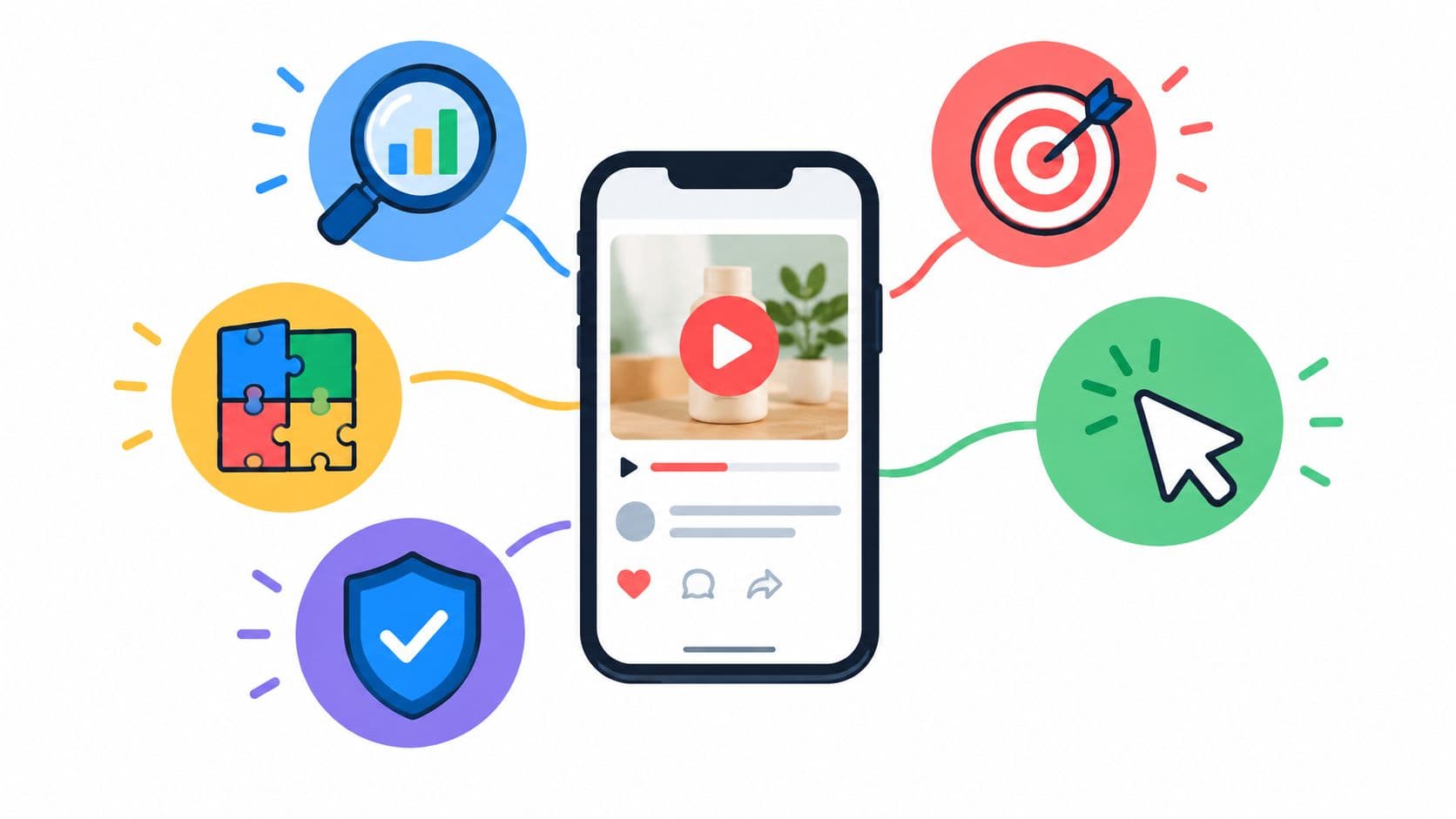
Effective UGC-style advertising feels native because it begins with a recognizable human experience, not a polished brand claim. A person struggles with a crowded schedule, opens a package, tests a product, or explains why they changed their routine. That context gives the viewer a reason to pay attention before the sales message arrives.
The performance case is stronger than the aesthetic appeal. Industry compilations report that UGC-based ads can produce 4x higher click-through rates, 50% lower cost-per-click, and 28% higher engagement than standard ads, although the exact outcome depends on the creative, audience, offer, and platform. A 2025 paid-social whitepaper also reported a 21% higher conversion rate, 17% lower CPA, and 14% higher ROAS for UGC creatives than for non-UGC ads in its analysis of paid social campaigns, as documented by UGCera's paid social whitepaper.
The useful question isn't which UGC ad examples look appealing. It's which repeatable system matches your viewer's intent. The ten formats below connect each creative to its hook, narrative mechanism, proof, CTA, audience fit, production trade-offs, script pattern, and AI adaptation workflow. Tools such as Hooked can help turn one idea into testable variations, but adaptation matters more than copying.
Authentic delivery, clear disclosures, permission for customer content, and realistic claims remain essential. AI can accelerate scripting, editing, localization, and variation. It can't turn an unsupported promise into credible proof.
1. Problem-Solution Format UGC Ads
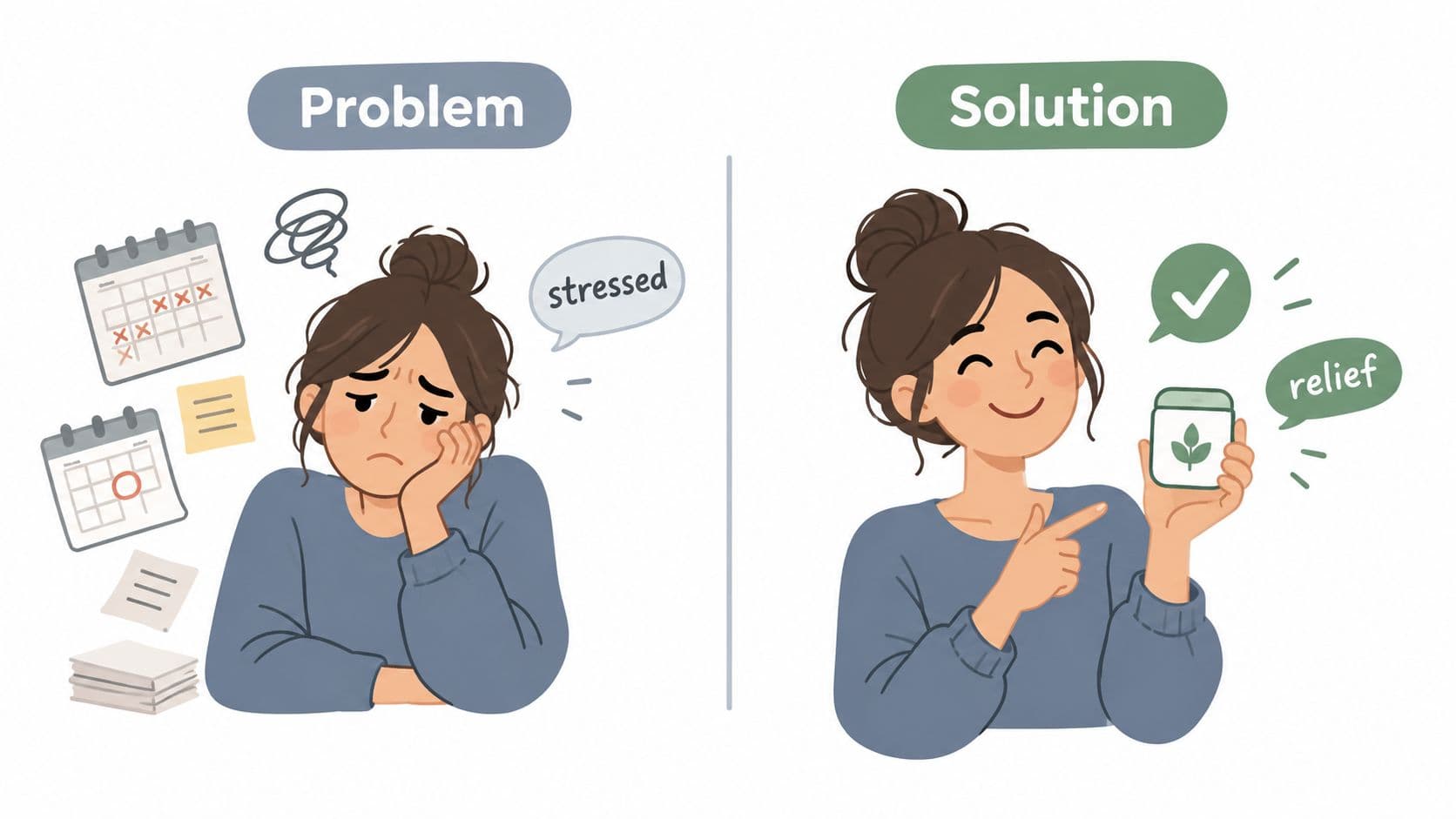
Problem-solution ads work because they earn attention with friction the viewer already recognizes. A skincare creator might open by showing an irritated routine and explaining what kept going wrong. A productivity app creator might show a chaotic calendar before revealing the system that organizes it. The product enters as a response to tension, not as an interruption.
The strongest version keeps the problem specific. “My schedule was a mess” is weaker than showing missed tasks, scattered notes, or a workflow that repeatedly breaks. A fitness supplement ad can frame low energy during a familiar routine, while a delivery service can show the frustration of waiting for an order. The audience identifies with the situation before it evaluates the product.
Build tension, then reduce it
A practical script pattern is:
- Hook: “I kept running into this problem.”
- Context: Show the moment, habit, or failed workaround.
- Product: Introduce the feature that addresses the problem.
- Proof: Demonstrate the product in use.
- CTA: Invite the viewer to try, compare, or learn more.
Keep the setup tight. If the ad delays the solution too long, the viewer may understand the pain without understanding the offer. Natural dialogue, visible expressions, and ordinary locations usually support the native feel better than polished staging.
Hooked's AI script writer can generate alternative problem angles and conversational openings for different audiences. Its voiceover support across 29 languages can also help global teams adapt the same customer problem without translating every line manually. The team still needs to review every version for cultural fit, substantiation, and believable delivery.
Practical rule: Show the problem the product can actually solve. Don't dramatize a minor inconvenience into a claim the product can't support.
2. Unboxing and First Impression UGC Ads
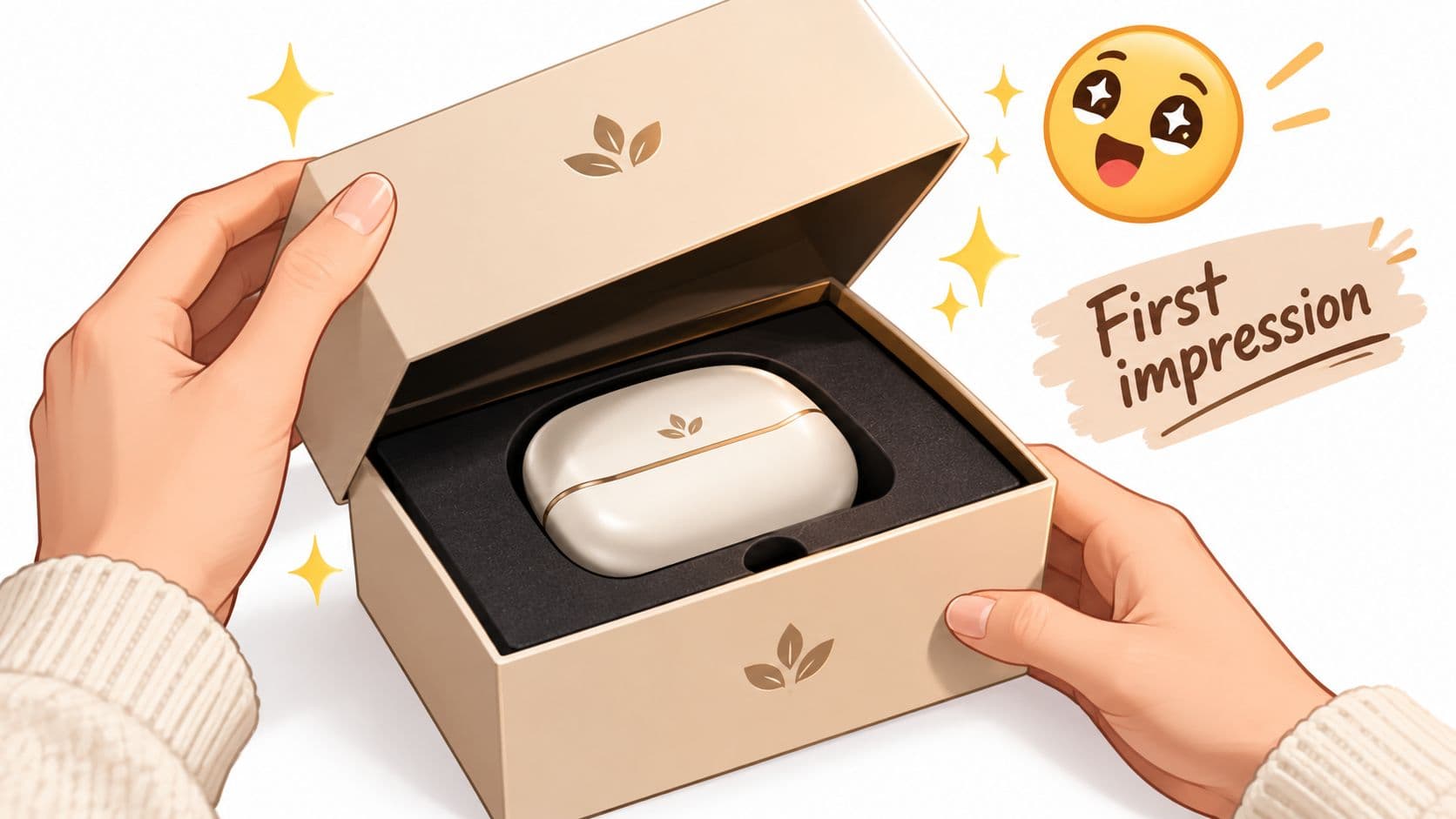
An unboxing ad turns product discovery into the hook. The viewer watches the seal break, the packaging open, and the first reaction unfold. That sequence creates anticipation while answering practical questions about presentation, size, materials, included components, and the first-use experience.
This format suits products where the arrival moment carries meaning. A premium pair of wireless earbuds, a beauty subscription box, a gaming peripheral, or a specialty coffee delivery can all make packaging part of the value proposition. For a luxury product, the visual details communicate care and positioning. For an ecommerce product, the unboxing can reduce uncertainty about what the customer will receive.
Capture discovery without manufacturing surprise
A useful structure starts with the package entering the frame, moves through the reveal, and ends with immediate use. A creator can say what they expected, point out a detail they noticed, and then test the product rather than offering generic praise. The reaction should remain plausible. Overstated excitement makes the ad feel directed.
Production has a clear trade-off. Close-up shots reveal packaging, but they can obscure the creator's face and emotional response. Face-led footage builds connection, while overhead shots make the product easier to inspect. Capture both, then edit versions that prioritize either reaction or detail.
Teams creating repeatable ecommerce variants can use Hooked's UGC ad generator for ecommerce to develop product-review concepts and alternate scripts. Drag-and-drop editing can help cut multiple unboxing takes into platform-native versions. The workflow should preserve the creator's actual reaction, not replace it with synthetic enthusiasm.
Use different creators when the product needs broader audience representation. Their settings, voices, and expectations become testing variables, while the package and first-use sequence remain consistent.
3. Before-After Transformation UGC Ads
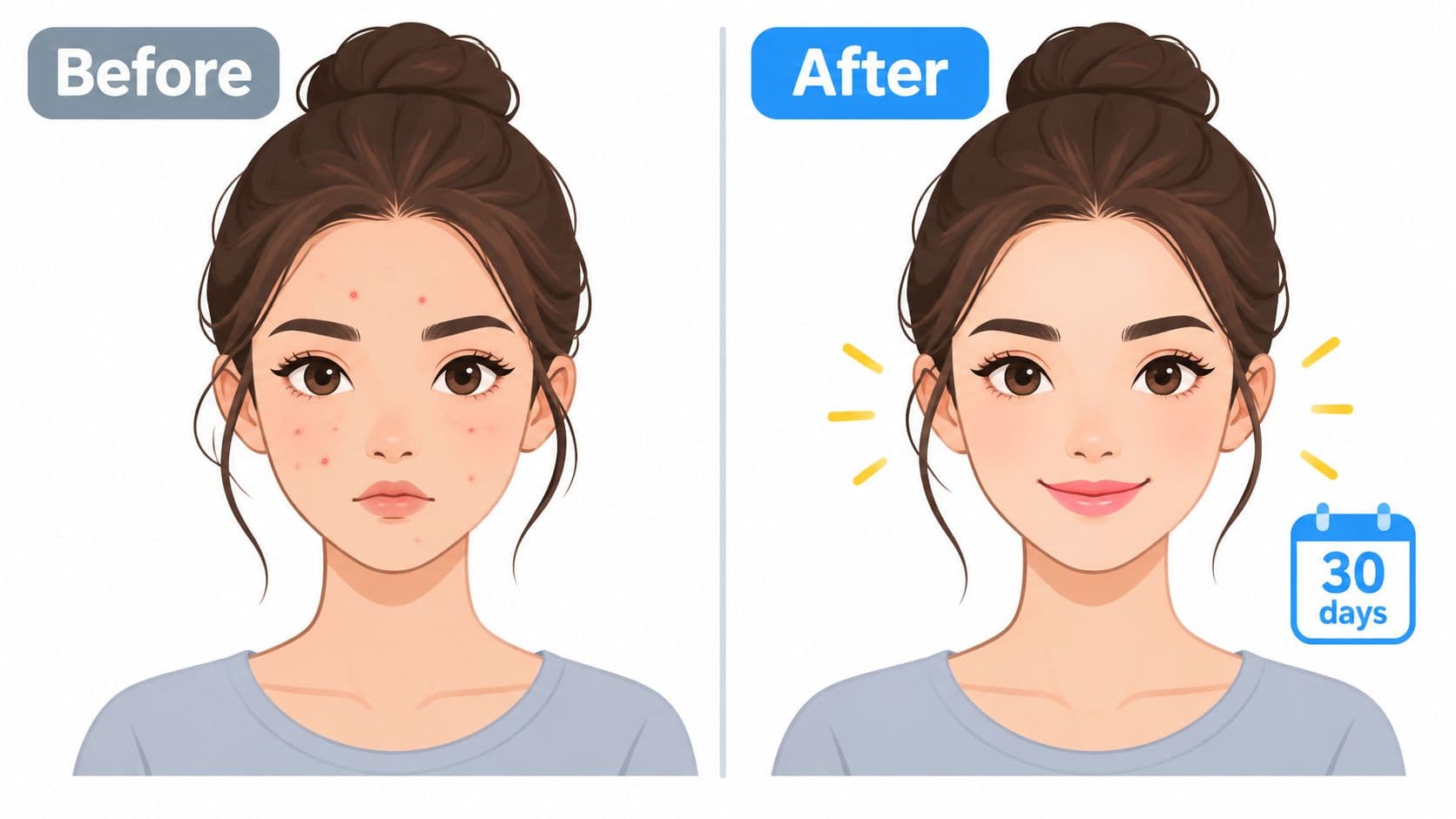
Before-after creative makes the outcome visible. A skincare ad can contrast two moments in a consistent setting. A home brand can show a disordered room before and after a furniture or organization change. A hair product can document a change in appearance, while a teeth-whitening ad can present a shade comparison.
The format works only when the comparison is fair. Lighting, camera angle, distance, styling, and timing can change what the viewer sees. If those variables shift, the ad may appear to prove more than the product caused. That risk is especially serious in beauty, wellness, fitness, and other categories where results vary across people.
Make the process part of the proof
The basic narrative is before, product, process, after. Showing application, setup, repeated use, or the work required gives the transformation context. A timeline can also prevent viewers from interpreting the result as immediate when it isn't. Don't state a fixed outcome unless the evidence supports that claim for the relevant audience.
A credible script sounds more like a personal record than a guarantee:
- Starting point: Describe the original condition or frustration.
- Routine: Explain how the product was used.
- Observation: Identify what changed, without overstating certainty.
- Qualification: Mention relevant limits or individual variation.
- CTA: Direct the viewer to product details or usage guidance.
Disclose paid relationships and incentives clearly. If a creator received the product, payment, or another benefit, that relationship should be visible to the audience. Obtain permission before using customer transformations in paid media, and keep documentation for any result shown.
Hooked's AI tools can draft testimonial variations around different transformation narratives, but generated copy shouldn't invent experiences. Use real customer language as the source material, then test different openings, timelines, and proof sequences.
4. Tutorial and How-To UGC Ads
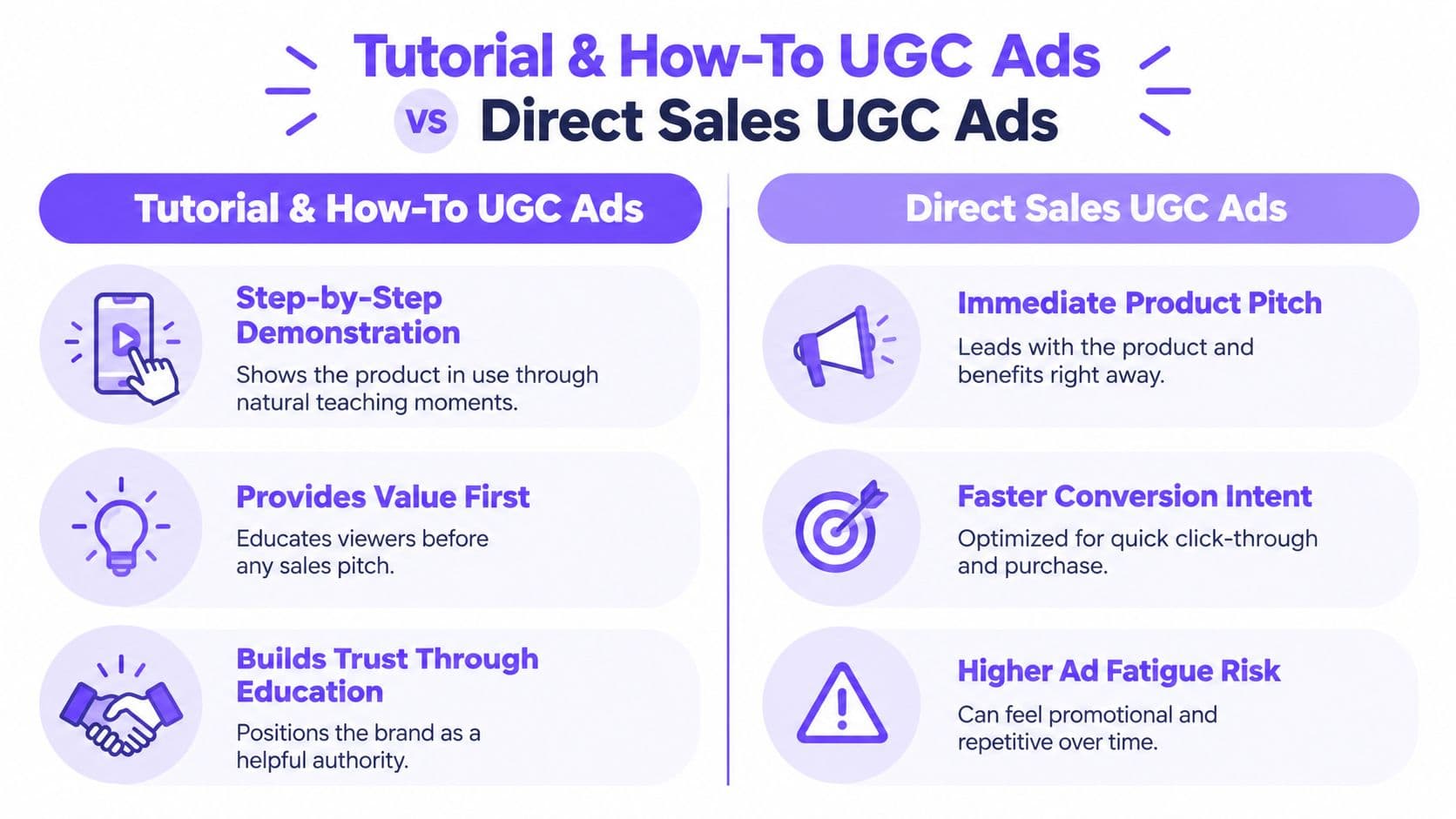
Tutorial ads sell by helping first. A creator demonstrates a project-management workflow, a kitchen gadget during meal preparation, a photography technique, a software shortcut, or a makeup application. The product appears as part of the solution, so the viewer receives useful information before encountering the CTA.
That structure is particularly useful for products with a learning curve or multiple use cases. A SaaS tool can demonstrate how a team moves from scattered tasks to a shared workflow. A cosmetics creator can show application technique while making the product's texture and finish visible. A kitchen brand can prove convenience by placing the gadget inside a real preparation sequence.
Let the instruction carry the opening
The hook should promise an outcome the audience wants to learn. “This is how I organize a client launch” is more informative than “Let me show you this app.” On-screen text should label steps, while the voiceover explains decisions and the footage proves that the method is practical.
A compact tutorial script can follow this order:
- Result: State what the viewer will learn.
- Starting point: Show the relevant problem or task.
- Steps: Demonstrate the process with clear visual changes.
- Product role: Explain which feature or component makes the process easier.
- Next action: Invite the viewer to try the method or explore the product.
For a structured production workflow, Hooked's tutorial video use case can support script development and adaptation. Its multilingual voiceover capability can help teams localize instructional content, but translation needs more than literal accuracy. Measurements, cultural references, interface labels, and product terminology should be checked by someone who understands the target market.
Tutorials also create useful testing signals beyond clicks. Compare completion, replay behavior, saves, and downstream conversion. A tutorial that attracts viewers but fails to move qualified users may be educationally strong but commercially misaligned.
5. Comparison and Difference UGC Ads
Comparison ads address a buyer who already has alternatives in mind. The creator contrasts a new VPN with an existing setup, compares productivity tools, tests coffee makers, or explains how one ecommerce platform handles shipping differently from another. The narrative works because it converts an abstract preference into a decision.
The danger is obvious bias. A creator who praises every feature and dismisses every alternative sounds like a salesperson. A credible comparison defines the criteria first, shows the relevant products or workflows fairly, and then explains where the advertised option fits best.
Turn objections into testable criteria
A useful script begins with the buyer's decision rule:
- Criterion: What matters, speed, setup, price structure, compatibility, or output?
- Baseline: What does the old method or alternative require?
- Demonstration: Show both options under comparable conditions.
- Interpretation: Explain who benefits from the advertised product.
- CTA: Send the viewer to a comparison page, trial, or product details.
Avoid unsupported superlatives such as “fastest” or “best.” If the ad makes a factual comparison, verify the underlying information and keep records of the evidence. Competitor names, trademarks, pricing, and feature descriptions can create legal and compliance issues, so review the final cut before launch.
Hooked's competitor monitoring capabilities may help teams identify recurring comparison angles and creative gaps. Monitoring can inform the brief, but it doesn't validate a claim. The advertiser remains responsible for checking the facts and presenting the comparison accurately.
This format usually belongs closer to purchase than broad awareness. The viewer is already asking, “Why this instead of what I use now?” Answer that question directly, then make the next step easy.
6. Day-in-the-Life Integration UGC Ads
Day-in-the-life ads make the product useful by placing it inside a routine. A fitness app appears during a morning workout, a coffee maker supports a workday ritual, an organization app helps a parent manage competing tasks, and a fashion product moves through several real settings.
The narrative mechanism is continuity. Instead of listing benefits, the creator demonstrates how the product fits from morning through evening. Viewers can evaluate whether the product belongs in a life like theirs. That makes audience fit more important than visual polish.
Build a routine with a real problem
A strong sequence has a beginning, a pressure point, and a resolution. The morning establishes the person and context. The middle shows the task or friction. The final scene demonstrates how the product helps, then gives the viewer a clear next action.
A creator might open a work-from-home routine with a crowded task list, use the productivity tool during a meeting, and return to the organized workspace later. A fashion creator can show one item styled for work, errands, and an evening setting. The product shouldn't appear in every shot just to increase exposure. Repeated appearances should advance the story.
Use authentic environments, natural light, and the creator's own delivery. A heavily staged home can weaken the relatability that makes the format useful. Production teams can still control continuity by planning wardrobe, screen states, props, and time-of-day transitions.
Hooked's AI workflow can help draft dialogue and transitions for multiple routine angles. Teams can then create versions for different personas, such as a student, parent, freelancer, or manager, without changing the central product promise. Review each script for realism. A routine that contains too many benefits becomes a catalogue, not a story.
7. Customer Testimonial and Review UGC Ads
Testimonials let customers explain value in their own frame of reference. A software user can describe a workflow change, a beauty customer can discuss product use, and an ecommerce buyer can explain why the delivery experience mattered. The persuasive force comes from relevance, not celebrity.
Start with actual customers whenever possible. Post-purchase outreach can ask open questions such as what problem they had, what they tried before, what they noticed during use, and who they think the product suits. Loose guidance protects authenticity better than a word-for-word script.
Ask for evidence, not praise
A weak testimonial says the product is “amazing.” A useful one explains what the customer did and what they observed. The editor can then place the most informative sentence near the beginning, add product footage, and end with a CTA that matches the customer's level of certainty.
For a reliable testimonial system:
- Recruit for fit: Select customers with relevant use cases, not just enthusiastic comments.
- Prompt naturally: Ask open questions instead of supplying conclusions.
- Show context: Include the product in the environment where the customer uses it.
- Secure permission: Document releases, paid usage rights, and any incentives.
- Preserve variation: Keep different voices, objections, and outcomes in rotation.
Hooked's testimonial video use case can help teams organize testimonial concepts and repurpose customer input into social formats. A TikTok Shop team may also use a TikTok Shop user showcase API to support a broader workflow for finding or organizing user-focused commerce content, subject to rights and platform requirements.
Paid relationships and incentives must be disclosed. A customer who received a free product or payment isn't automatically disqualified from giving a useful testimonial, but the audience needs to understand the relationship. Don't edit a real experience into a claim the customer didn't make.
8. Trending Audio and Meme Format UGC Ads
Trend-led UGC ads work as fast cultural translation systems. A POV format, sound-synced transition, or meme gives viewers a familiar hook before the product appears. The creative task is to connect that shared meaning to one concrete benefit, then move quickly toward consideration or action.
Their advantage is speed, not production complexity. A rapid-cut meme can demonstrate apparel or food versatility, while a “tell me without telling me” structure can show a benefit through behavior. The trade-off is a short creative window. Trends become crowded, stale, or commercially restricted, so teams need a decision process that evaluates relevance before investing in polished production.
Make the trend serve the product
Start with the audience's interpretation of the format, then write several product-specific versions. Each script should preserve the recognizable setup, introduce the product at the moment the joke or reveal gains meaning, and finish with a direct CTA. If viewers remember only the meme, engagement may increase without strengthening purchase intent. If the trend has no natural connection to the category, the ad can resemble imitation rather than a product demonstration.
Use this testing sequence:
- Identify the format, audience meaning, and product benefit it could express.
- Draft multiple hooks with different levels of product visibility.
- Confirm commercial rights for the audio, footage, and format.
- Produce short variations while the pattern remains relevant.
- Test hook, product reveal, and CTA separately before broader distribution.
- Retire versions when cultural context or audience response changes.
Hooked's real-time trend tracking, AI video builder, and scheduling tools can support this rapid workflow. AI can generate script options, captions, and edits from a selected pattern. Human review still needs to cover timing, cultural sensitivity, rights, and whether the product remains unmistakable.
For adapting existing clips into platform-native assets, review these TikTok repurposing tactics. Repurposing preserves neither rights nor context automatically. Reusable footage, voices, and licensed audio each require separate confirmation before publication.
9. Expert and Influencer Endorsement UGC Ads
Authority works only when it is relevant to the buying decision. A technology reviewer can demonstrate a device in a familiar review format, a skincare professional can explain a routine, and a fitness creator can show how a product fits into training. Each format pairs a credibility cue with product evidence, giving the ad a role beyond attention: reduce uncertainty for viewers already evaluating a category.
The commercial arrangement changes what the asset can do. An influencer partnership may provide access to the creator's audience, while a UGC creator may mainly produce paid-media footage. Both require a genuine product relationship, clear disclosure, and a brief that protects accuracy without flattening the creator's voice.
Build the endorsement around evidence
Choose partners for category judgment and audience fit, not reach alone. A productivity creator who regularly shows project planning may suit a workflow tool better than a larger creator unrelated to work systems. Their content can supply the hook, while the demonstration and evaluation carry the conversion argument.
Build the script around five decisions:
- Personal context: Why the creator uses or tested the product.
- Demonstration: Where and how it appears in the creator's normal environment.
- Specific evaluation: Which feature or experience changed their judgment.
- Audience qualification: Who may benefit, and who may not.
- Disclosure and CTA: The relationship statement and next action.
Give creators accurate product information, prohibited claims, deliverables, and rights requirements, then leave room for their natural delivery and genuine opinion. Test each creator, hook, placement, and audience separately. A strong personality can conceal a weak product message if these variables are combined.
Professional claims need verification. Titles, qualifications, and experience should be accurate, while health, financial, and technical statements need suitable substantiation. Authentic tone does not replace compliance.
AI can adapt one approved endorsement into alternate hooks, captions, cutdowns, and scene orders. Human review must confirm that edits preserve the creator's meaning, disclosure, product facts, and intended audience. This makes the format a repeatable testing system rather than a one-off partnership.
10. Carousel and Multi-Scene Narrative UGC Ads
Carousel and multi-scene UGC ads work as sequenced proof systems, not collections of attractive product shots. Each frame or scene should advance the viewer from recognition to evaluation to action. A productivity story might show an overloaded workflow, the setup, early use, and a more controlled routine. A skincare narrative can connect a morning concern, application, daytime use, and later observation. An ecommerce sequence can follow problem recognition through browsing, delivery, and satisfaction.
The creative system has four jobs: earn attention, define the obstacle, demonstrate the product, and resolve the decision. If a scene does not answer a new question, it adds editing cost without strengthening the conversion argument.
Design the evidence before filming
Begin with the viewer's decision path, then assign visual proof to each beat. The creator can keep a natural delivery while the production plan controls continuity, including wardrobe, color, screen states, and framing. These details help the audience read separate moments as one credible experience.
A practical script pattern is:
- Opening scene or frame: State the recognizable problem quickly.
- Tension beat: Show the failed workaround or reason to change.
- Product proof: Demonstrate setup, first use, or the feature under evaluation.
- Outcome: Show a credible reaction, changed routine, or observed result.
- Final frame: Give the CTA and any qualification the viewer needs.
Hooked's AI video builder can assist with multi-scene editing, voiceover drafts, and alternate scene orders. Use it to create controlled variations, then test the narrative logic. Earlier product proof may clarify the offer for lower-awareness viewers, while delayed proof can preserve curiosity when the category needs less explanation. Keep the audience, product complexity, and funnel objective constant while changing the order.
Carousel adaptations divide the same argument into swipeable frames. Give each frame one idea, keep text readable, and retain customer language where it supplies credibility. The final frame should make the next action clear. A longer sequence should provide more evidence, not repeat the sales pitch.
10 UGC Ad Formats: Quick Comparison
| Format | Implementation Complexity 🔄 | Resource Requirements ⚡ | Expected Effectiveness ⭐ / Impact 📊 | Ideal Use Cases 💡 | Key Advantages / Main Limitations |
|---|---|---|---|---|---|
| Problem-Solution Format UGC Ads | 🔄🔄 Moderate, short structured hook, authentic VO required | ⚡⚡ Low–Medium, creator + basic shoot/VO | ⭐⭐⭐ High conversion; 📊 Typical CTR 3–8% | D2C, e‑commerce, SaaS conversion campaigns | Advantages: quick emotional hook, scalable. Limitations: can feel formulaic; needs universally relatable problem |
| Unboxing & First Impression UGC Ads | 🔄🔄🔄 Moderate–High, staging and pacing matter | ⚡⚡⚡ Medium–High, quality lighting, closeups, edits | ⭐⭐ High engagement; 📊 Drives desire and perceived quality | Premium products, luxury, subscription boxes, tech | Advantages: showcases packaging & quality. Limitations: time‑consuming; authentic reactions hard to manufacture |
| Before-After Transformation UGC Ads | 🔄🔄🔄 High, requires timeline and consistent documentation | ⚡⚡⚡ Medium–High, real usage, follow‑ups, editing | ⭐⭐⭐ Very high conversion potential; 📊 CTR often 4–10% | Beauty, fitness, wellness, home improvement | Advantages: tangible proof and credibility. Limitations: FTC disclosures needed; results vary and take time |
| Tutorial & How-To UGC Ads | 🔄🔄 Medium, needs expertise and clear steps | ⚡⚡ Medium, longer runtime, on‑screen text, demos | ⭐⭐ Builds trust and reduces hesitation; 📊 Good for consideration metrics | SaaS, tools, kitchen gadgets, cosmetics | Advantages: provides value and authority. Limitations: less immediate conversion focus; needs product expertise |
| Comparison & Difference UGC Ads | 🔄🔄 Medium, requires accurate research and fair framing | ⚡⚡ Low–Medium, data visuals, side‑by‑side shots | ⭐⭐ Useful for consideration; 📊 Speeds decision making | Crowded categories, SaaS, consumer electronics | Advantages: highlights competitive edges. Limitations: legal/FTC risk; may raise competitor awareness |
| Day-in-the-Life Integration UGC Ads | 🔄🔄🔄 High, narrative cohesion across scenes | ⚡⚡⚡ Medium–High, casting, locations, longer edits | ⭐⭐ Strong brand lift and relatability; 📊 Good for engagement/time watched | Lifestyle, tech, fashion, wellness brands | Advantages: authentic context and aspiration. Limitations: subtler CTA and longer production |
| Customer Testimonial & Review UGC Ads | 🔄 Low, capture genuine user stories | ⚡⚡ Low–Medium, recruit customers, permissions | ⭐⭐⭐ Highest trust; 📊 CTR often 5–12% | D2C, SaaS, courses, marketplaces | Advantages: strong social proof and repeatable. Limitations: depends on willing customers; quality varies |
| Trending Audio & Meme Format UGC Ads | 🔄🔄 Low, fast turnarounds but trend‑sensitive | ⚡ Low, quick shoots, edits, trend monitoring | ⭐⭐⭐ Very high viral potential; 📊 Exceptional engagement on short‑form | TikTok, Gen‑Z‑focused brands, agile D2C teams | Advantages: high shareability and low cost. Limitations: short trend lifespan; risk of misfit with product |
| Expert & Influencer Endorsement UGC Ads | 🔄🔄 Medium, partner selection & coordination | ⚡⚡⚡ High, influencer fees, vetting, disclosures | ⭐⭐⭐ High credibility and niche trust; 📊 Strong conversion in targeted segments | Premium products, niche markets, expert categories | Advantages: authority + authenticity. Limitations: higher cost, less message control, FTC disclosures needed |
| Carousel & Multi-Scene Narrative UGC Ads | 🔄🔄🔄🔄 Very High, multi‑scene scripting and pacing | ⚡⚡⚡⚡ High, production, editing, cohesive vision | ⭐⭐ Extended engagement; 📊 Works for longer ad formats (45–60s) | Premium storytelling campaigns, lifestyle brands, SaaS brand films | Advantages: deep engagement and multiple benefit showcases. Limitations: costly, complex to execute and risk losing viewers if pacing fails |
Turn Inspiration Into a Repeatable UGC Testing System
The ten formats become more useful when treated as decision tools rather than a gallery of inspiration. Problem-solution and testimonial ads usually fit direct-response conversion work because they address pain, trust, and objections in a person's voice. Tutorials and day-in-the-life narratives are better suited to education and consideration, where the buyer needs to understand use before deciding. Comparison ads serve decision-stage audiences with a clear alternative in mind. Transformations provide visible proof when the outcome can be shown. Trending formats help teams pursue rapid reach, but their cultural relevance can expire quickly.
The evidence supports using UGC as more than a visual style. Industry roundups report that UGC ads can deliver 4x higher CTR, 50% lower CPC, and 28% higher engagement than standard ads, while other industry reporting says 45% of brands use UGC in paid search ads and 27% of those brands report click-through rates at least 30% higher. Those figures come from industry compilations rather than a universal benchmark, so treat them as directional evidence, not a promise for every campaign. The broader conclusion is sound: creator-led creative has become a measurable acquisition lever across major social advertising environments. See the 2026 UGC statistics compilation from Kapwing for the reported figures and context.
A practical workflow starts with one audience and one pain point. Choose the format that matches the buyer's next question, then write several hook variations and several CTA variations without changing the central promise. Produce platform-native cuts with the right framing, captions, pacing, and disclosure. Keep the creator's real language, but edit the opening so the viewer reaches the idea quickly.
Measure the full path. Retention shows whether the opening earns attention. Click-through rate shows whether the message creates interest. Conversion rate, CPA, and ROAS show whether the creative attracts commercially useful traffic. A TikTok dataset reported UGC-style ads at 1.4% to 2.3% CTR, compared with 0.7% to 1.2% for polished brand ads, and reported 30% to 50% lower CPA for the UGC-style group, as described in Stackmatix's TikTok UGC performance analysis. Use such benchmarks for hypotheses, not guaranteed targets.
Testing principle: Change one meaningful variable at a time when you need to understand why an ad worked. A new creator, hook, offer, and landing page together may produce a result, but they won't explain it.
Hooked can support this operating system with trend tracking, script generation, AI-assisted video building, multilingual voiceovers, competitor monitoring, and scheduling across social channels. Those tools can increase the number of variations a team produces, but authentic customer input still determines whether the message deserves trust. AI should help teams test and distribute a sound idea, not fabricate results, endorsements, or customer experiences.
Production partners can still add value when a brand needs controlled visuals, complex demonstrations, or a larger campaign system. The choice isn't UGC versus professional production. It's deciding what the viewer needs to believe next, then selecting the format that supplies credible evidence. Research on commercial production companies can help teams compare where controlled production fits alongside creator-led assets.
Start with the format that matches your largest unresolved buying question. Record several honest hooks, show the product doing its job, disclose every material relationship, and compare the resulting retention and conversion data. That process will teach you more than collecting another folder of attractive UGC ad examples.
Use Hooked to turn these UGC formats into scripts, variations, trend-led concepts, multilingual voiceovers, and scheduled social videos without removing the human proof that makes the format credible. Visit Hooked to build a practical testing workflow for your next UGC ad campaign.