
Many marketers call paid creator videos “UGC,” yet the original definition of user-generated content excludes professional production. That distinction matters because 92% of consumers trusted organic UGC more than traditional advertising, while the same Nielsen data reported by ZDNET associated social context with approximately 50% higher ad recall and a 35% higher online-sales lift. Those figures aren't guarantees, but they reveal the central idea: trust comes from perceived user experience, not from adding a casual filter to an advertisement.
So, what is UGC creation? In strict terms, it's the public creation of content by users who contribute creative effort outside professional routines. In commercial practice, the phrase also describes paid, creator-style production made for brands. Treating those paths as identical creates confusion around authenticity, rights, disclosure, and measurement. This guide separates them, then shows how brands can use organic proof, commissioned production, faceless workflows, and AI-assisted tools without losing the trust mechanics that make UGC persuasive.
Understanding What UGC Creation Actually Means
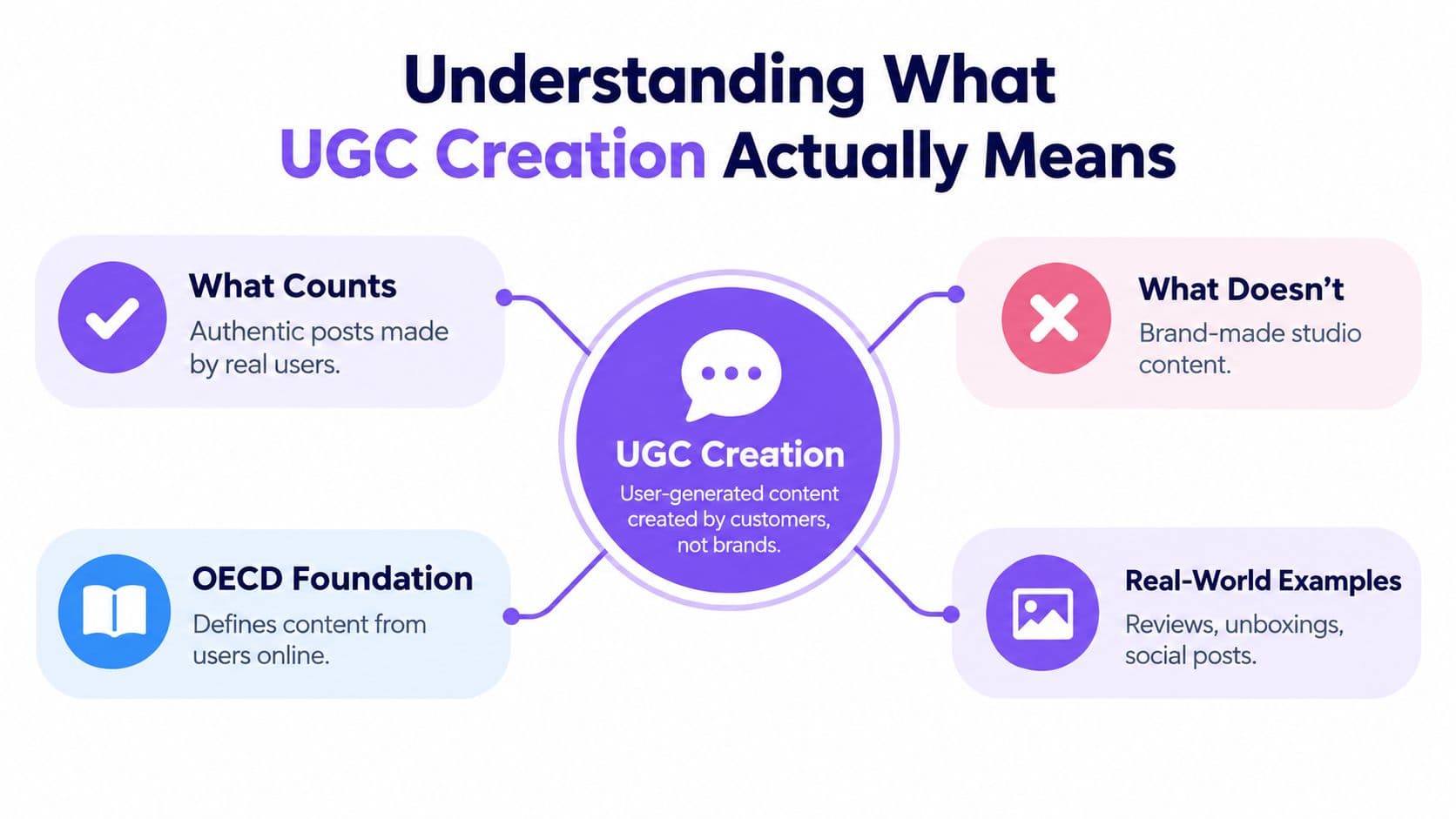
Not every customer-facing post is UGC. The foundational framework from the OECD's work on measuring user-created content defines it through three conditions that must appear together.
The three-part OECD test
First, the content must be publicly available online. A public product review, social-media post, podcast, independent blog entry, or unboxing video can meet this condition. A private email, one-to-one message, or file uploaded only for storage generally doesn't.
Second, the user must contribute creative effort. That effort can be modest. A written review, photograph, tutorial, product comparison, or personal video still reflects a person's perspective and choices. UGC isn't limited to polished storytelling or professional editing.
Third, the content must be created outside professional routines and practices. An ordinary customer sharing a personal experience fits the original framework. A company employee publishing the brand's official product description does not, even if the post appears on a social platform.
What qualifies and what doesn't
A customer posts a public video showing how a backpack performs during a commute. That's a strong example of organic UGC because the user publishes a personal experience and adds original creative value.
A brand hires a production team to film the same demonstration in a studio. It may be excellent advertising, but it isn't UGC under the OECD definition. The brand controls the production, message, and professional process.
The gray area appears when a brand asks a customer to create a review in exchange for payment or a free product. The content may still show a genuine experience, but the commercial relationship changes the workflow and disclosure obligations. The audience needs enough information to evaluate that relationship.
Practical rule: Separate the question “Who created the asset?” from “Who paid for or controls its distribution?” Those answers determine whether you're dealing with organic advocacy, commissioned creator production, or paid media using customer content.
A creator making product-style designs for a brand without a substantial audience may be producing valuable creative work, but the deliverable isn't automatically organic UGC. For teams that need fast visual assets, resources such as on-brand merch designs in minutes can support production, but the brand should still document who made the asset, what experience it represents, and where it may be used.
The Evolution of User-Generated Content
UGC became commercially important because publishing moved from institutions to individuals. During the Web 2.0 expansion of the mid-to-late 2000s, blogs, forums, photo-sharing sites, video platforms, and social networks gave ordinary internet users practical ways to publish and respond.
Early UGC didn't look like today's vertical product testimonial. It appeared as blog entries, forum discussions, customer reviews, photographs, mailing-list contributions, and short videos. A review of 285 empirical UGC studies found that 28% focused on weblogs, while 22% examined discussion forums, Usenet, newsgroups, and mailing lists, according to the Oxford research review.
From participation to a research field
Academic attention followed the behavior. The same review recorded 52 UGC-related articles in 2011 and 49 in 2012, showing that user participation had become an established research subject rather than a marginal internet trend.
The format also exposed a different production economy. Earlier platform research found that user-generated videos were shorter than non-UGC videos while being produced at a faster rate. That contrast captures the model's enduring advantage: many people can contribute varied perspectives without the timeline, staffing, and institutional structure associated with professional media.
As social platforms evolved, the medium changed but the participation model stayed intact. Text and forum posts expanded into short-form video, livestreams, reviews, creator testimonials, images, audio, and mixed-media posts. A customer who once wrote a paragraph about a product can now record an unboxing, answer comments, demonstrate a use case, and publish the entire experience within one platform.
The shift changed expectations for brands. Teams no longer need one finished commercial to communicate one message. They can collect multiple perspectives, openings, formats, and contexts, then learn which combinations help a specific audience understand the product.
That doesn't make every casual video effective. It means UGC gives brands a replenishable supply of perspectives, provided they respect the user's experience and manage the rights properly.
Organic Versus Commissioned UGC
The most useful distinction is simple: organic UGC is voluntarily created by a customer or user, while commissioned UGC is paid creator production designed to feel native to a social platform.
An organic example might be a customer posting an unsolicited review after using a skincare product. The brand didn't control the script, filming conditions, or publishing schedule. It can ask for permission to reuse the post, but it shouldn't assume that public visibility equals unrestricted advertising rights.
Commissioned UGC follows a different path. A brand briefs a creator, supplies a product, pays a fee, or offers another benefit in exchange for a video or image. The creator may have no meaningful audience at all. In that case, the brand is buying creative production and usage rights, not guaranteed distribution.
| Factor | Organic UGC | Commissioned UGC |
|---|---|---|
| Origin | Voluntary customer or user contribution | Paid or incentivized creator assignment |
| Brand control | Limited before publication | Greater control through a brief and revisions |
| Rights | Permission and licensing must be confirmed | Usage rights should be defined in the agreement |
| Disclosure | Needed when a material relationship exists | Generally required when payment, free products, or another relationship affects evaluation |
| Main value | Experience evidence and social proof | Scalable creative for organic channels or advertising |
| Audience | May reach the creator's community | Often distributed through the brand's channels or paid media |
| Measurement | Conversation, sentiment, saves, and assisted actions | Hook performance, watch-through, qualified clicks, and conversions |
The FTC guidance summarized in the research on UGC effectiveness makes the compliance principle clear. Payment, free products, employment, or another relationship that could affect audience evaluation requires clear disclosure, and compensation doesn't remove the need for a genuine opinion or substantiated claim.
Where faceless and AI-assisted UGC fit
Faceless UGC can use hands-only demonstrations, screen recordings, product close-ups, captions, voiceovers, or an AI avatar. AI assistance can help with scripts, editing, narration, or visual assembly. These methods don't become organic UGC just because the final video resembles a customer post.
They belong in the commissioned creator-style category when a brand controls the production or uses synthetic elements to construct the asset. The ethical question isn't whether a face appears on screen. It's whether the content accurately represents a real product experience and clearly communicates any material relationship or meaningful synthetic involvement.
For brands building paid creative systems, an UGC ads workflow should track source, creator relationship, claims, permissions, disclosure language, and approved placements. That record protects the campaign from a common mistake: treating a production asset as if it were unsolicited customer advocacy.
Why UGC Outperforms Traditional Advertising
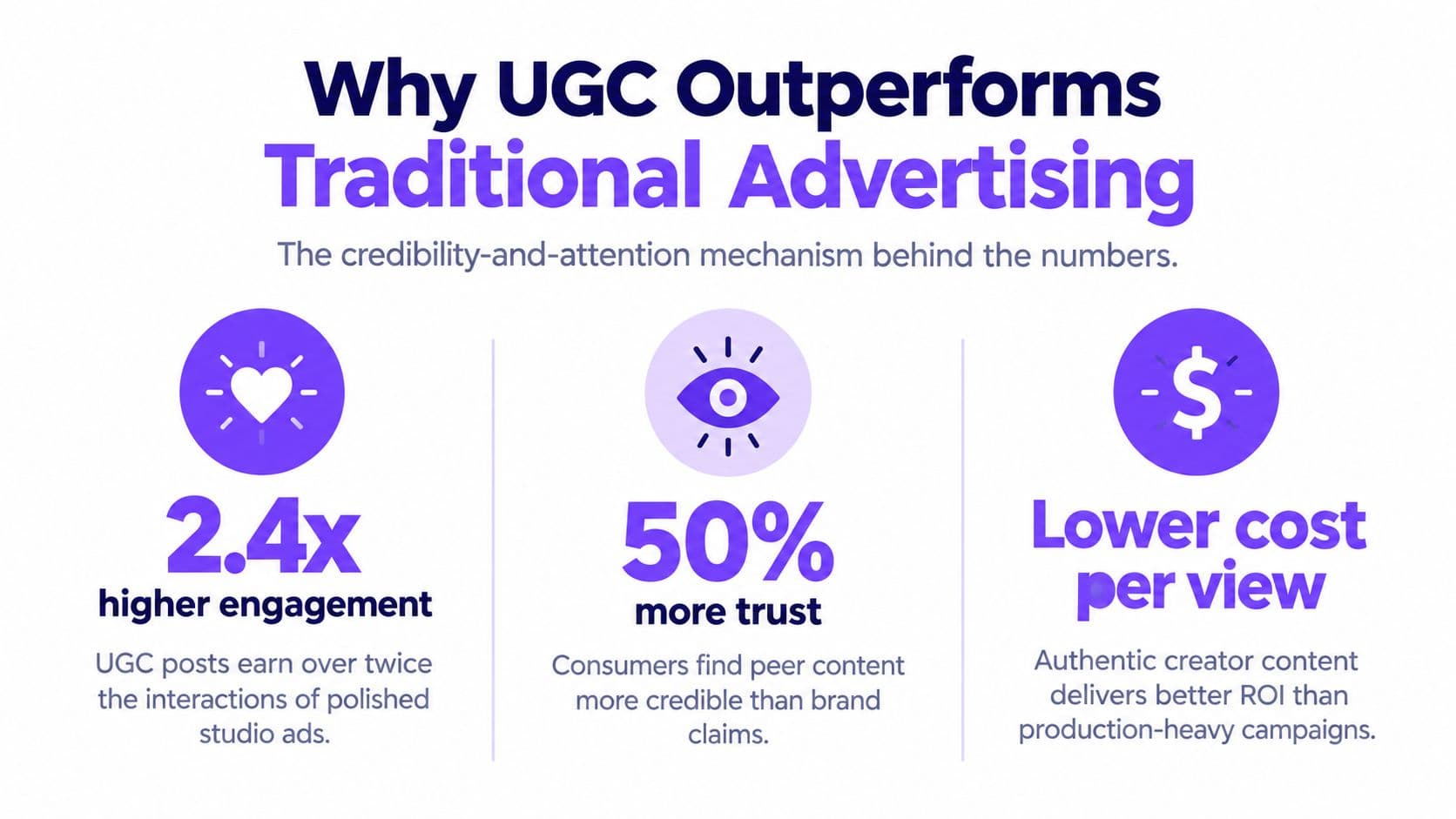
UGC can outperform polished advertising because it places a product inside a situation viewers recognize. A customer-style story supplies social context, demonstrates use, and gives the audience something to evaluate before the brand makes its sales case. That combination can reduce resistance to the message while preserving the clarity needed for a commercial decision.
Nielsen data reported by ZDNET found that 92% of consumers trusted organic UGC more than traditional advertising. The same report associated social context with approximately 50% higher ad recall and a 35% higher online-sales lift. These figures are directional benchmarks, not promises. Category, platform placement, creator fit, offer, landing page, and creative quality can all change the result. A campaign that pairs a creator's real product demonstration with a focused landing page may benefit from the same recall mechanism, but its outcome still requires measurement.
Why the format lowers resistance
A polished advertisement usually announces its persuasive intent immediately. UGC-style creative can open with a problem, a question, or visible product use. The viewer sees the item in an ordinary setting, which makes the claimed benefit easier to judge.
A casual appearance alone does not create trust. Scripted or exaggerated testimonials can weaken credibility once viewers recognize the pattern. Strong UGC preserves specific experience, avoids unsupported claims, and shows enough product interaction for the audience to assess the message. Organic customer posts and paid creator productions may share this visual language, but their source and disclosure should remain clear.
Teams can connect this approach with a broader branding and advertising unified strategy, using UGC to support the brand system rather than replace it. The brand still owns its positioning, product facts, visual standards, and customer promise.
A practical test compares variations around one verified benefit:
- Change the opening: Try a question, problem statement, and demonstration while keeping the underlying claim consistent.
- Change the proof format: Compare an unboxing, tutorial, testimonial, and product comparison.
- Change the presenter: Test creator personas, including faceless formats, without implying experiences the presenter has not had.
- Keep the destination stable: Use the same offer and landing page when possible, so creative differences remain interpretable.
- Track the full path: Compare thumb-stop rate, watch-through rate, click-through rate, cost per qualified click, add-to-cart rate, and purchase conversion.
A testimonial video workflow can organize these variations. Reporting should still separate organic UGC from paid creator endorsements, so production volume is not mistaken for genuine advocacy.
Building a Scalable UGC Workflow
A scalable UGC program starts with evidence, not a template. Before asking for videos, identify the questions customers ask, the product moments they demonstrate, and the claims they can support from direct experience.

Build the system in clear stages
1. Collect authentic signals. Search reviews, support conversations, public social posts, community discussions, and customer emails. Look for repeated language, visible use cases, objections, and moments where the product solves a concrete problem.
2. Classify the source. Mark each asset as unsolicited organic content, requested customer content, commissioned creator production, employee content, or synthetic production. This label should remain attached to the file throughout the workflow.
3. Request permission. A public post isn't automatically cleared for paid advertising. Ask the creator for specific usage rights, including channels, duration, edits, territory, and whether the brand can combine the asset with other creative.
4. Write a focused brief. Give commissioned creators one audience, one product context, one verified benefit, and clear deliverables. Leave room for natural language. Over-scripted instructions often produce a video that looks like an advertisement pretending to be a customer story.
5. Review claims and disclosure. Confirm that testimonials reflect genuine opinions and that product claims have support. Add clear disclosure when payment, free products, employment, or another relationship could affect audience evaluation.
6. Test and learn. Keep the offer and destination stable while varying hooks, creator personas, framing, captions, voice, and proof. Use thumb-stop rate, watch-through rate, click-through rate, cost per qualified click, add-to-cart rate, and purchase conversion to assess the full journey.
A team can use Hooked once in this workflow as one option for creating UGC-style videos with AI avatars, scripts, voiceovers, and platform-specific formats. That kind of tool can help produce faceless or synthetic variations, but it doesn't turn simulated experience into organic customer evidence. The brand still needs accurate claims, transparent labeling, and a clear record of how the content was made.
Teams producing product pages and campaign assets may also use tools that generate SEO product descriptions, but descriptive copy should remain consistent with the claims approved for the video. A product description that promises more than the testimonial can substantiate creates a conversion problem later in the journey.
For a visual walkthrough of the production stages, use the following video as a process reference:
Keep a central rights and approvals register. Store the original file, edited versions, creator agreement, disclosure wording, claim review, approval date, permitted placements, and expiration terms together. When a winning asset moves from organic posting to paid media, update its classification and usage record rather than duplicating the file without context.
The Trust Paradox in Scaled UGC
UGC doesn't create trust automatically. Perceived authenticity creates trust, and scale can weaken that perception when every video uses the same hook, script, pacing, background, and testimonial language.
Audiences recognize repetition. They can also notice when a creator appears to endorse a product without showing credible use, when a brand hides a material relationship, or when an AI-generated voice presents a personal experience that never happened. A casual visual treatment may increase attention while reducing credibility if the underlying story feels manufactured.
The commercial model is expanding, which makes the distinction more important. Industry data cited by IJSS Bulletin reports that 77% of brands repurpose creator content in paid ads, while 67% include usage rights in the initial contract. Those figures describe a growing operational pattern, but they don't prove that repurposing improves performance. They do show why rights, disclosure, and source classification belong in the creative process.
Preserve the experience while increasing output
Start with the claim, not the format. If customers repeatedly mention ease of setup, show the setup process. If they value portability, demonstrate the relevant context. Don't ask a creator to pretend to have solved a problem they haven't experienced.
Use variation where it helps the audience, not merely where it increases the asset count:
- Keep the product truth stable: Don't rotate unsupported benefits to create novelty.
- Vary the human context: Different routines, environments, voices, and use cases can make the message more relevant.
- Test disclosure language: Make the relationship clear without burying it in fast captions or distant text.
- Label synthetic production internally and externally when appropriate: Your team should know whether an avatar, cloned voice, or generated visual appears in the asset.
- Compare trust signals alongside conversion metrics: Watch comments, negative feedback, hide actions, sentiment, qualified clicks, and purchases.
Organic UGC should retain the user's original meaning when the brand republishes it. Commissioned work should retain the creator's genuine perspective while clearly presenting the commercial relationship. The aim isn't to make paid production indistinguishable from spontaneous advocacy. It's to make the content useful, recognizable, and honest enough that viewers can evaluate it.
Final Framework for UGC Success
A strong UGC program begins by classifying each asset. Ask whether a customer created it independently, a creator made it under a paid agreement, or synthetic tools produced part of it. That classification determines permissions, disclosure, and how confidently the brand can describe the experience.
Use organic UGC to preserve unsolicited customer evidence and community context. Build discovery, permission, rights management, and curation into the workflow. If a useful customer insight needs a repeatable format or controlled product demonstration, commissioned UGC lets a creator interpret it in their own voice. Purchase production and usage rights, not assumed audience reach.
Faceless or AI-assisted production can extend this system when the format suits the message. Keep product claims accurate, disclose commercial relationships, and identify synthetic elements when appropriate. Never present a generated scenario as a customer experience that did not happen.
Connect the paths through testing. Organic posts reveal what customers notice, commissioned work develops controlled variations, and paid distribution tests qualified traffic and purchases. Review comments, negative feedback, hide actions, sentiment, clicks, and sales alongside conversion results.
Decision test: If knowing who made, funded, or generated an asset could change the viewer's judgment, disclose it and classify the asset accordingly.
Build every workflow around source, experience, rights, disclosure, and evidence. Hooked helps creators and brands produce UGC-style videos with AI avatars, scripts, voiceovers, faceless formats, platform-ready editing, and trend tracking. Visit Hooked to explore that workflow.