An ad script is more than just words on a page. Think of it as a blueprint for persuasion, carefully mapping out the dialogue, visual cues, and story beats designed to grab someone's attention and guide them to take action.
For short-form video on platforms like TikTok, a killer script isn't just a creative exercise—it's a data-driven tool. The best ones are built on a proven structure that’s engineered to maximize engagement in just a few crucial seconds.
The Science Behind a Billion Dollar Ad Script

Before you even think about writing, you need to internalize a key idea: a powerful ad script is less about art and more about science. In a world where attention is the most valuable currency, the structure of your script is what determines whether someone stops scrolling or just keeps swiping.
This is especially true on fast-paced platforms like TikTok and Instagram Reels, where you have maybe three seconds—if you're lucky—to make an impression.
The stakes have never been higher. By 2025, global ad spending is on track to blow past $1 trillion for the first time. Digital ads are expected to gobble up 75.2% of that massive budget, with video ads alone commanding a $110 billion slice of the pie. The need for scripts that actually convert has gone from important to absolutely critical.
The Core Components of Every Winning Script
Every single ad script that works—whether it's a 15-second TikTok or a 60-second spot on YouTube—is built on the same foundational pillars. These components are designed to take a viewer on a psychological journey, moving them from a passive scroller to an active customer. Nail these, and you’re on your way to crafting ads that deliver a real return.
This table breaks down the essential building blocks of any effective video ad script, explaining the purpose and goal of each element.
Core Components of a High-Converting Ad Script
| Component | Purpose | Timing Goal (for a 15-30s video) |
|---|---|---|
| The Hook | Stop the scroll and spark immediate curiosity or connection. This is your first and only shot to earn their attention. | 0-3 Seconds |
| The Problem | Introduce a relatable pain point or challenge that your target audience feels deeply. Make them nod in agreement. | 3-8 Seconds |
| The Solution | Seamlessly present your product or service as the clear, obvious, and ideal answer to that specific problem. | 8-20 Seconds |
| The Call-to-Action (CTA) | Give a direct, simple instruction telling the viewer exactly what to do next (e.g., "Shop Now," "Learn More"). | 20-30 Seconds |
By understanding this structure, you can start building ads that resonate on a deeper level.
Even though the format has changed, the core principles of what makes a good TV commercial still hold true today; many of the same psychological triggers are at play. Each part of your script has a job to do, moving the story forward and keeping your viewer hooked until the very last frame.
A well-structured script doesn’t just sell a product; it tells a micro-story where the customer is the hero and your product is their powerful tool for success. This narrative shift makes the advertisement feel less like a pitch and more like a solution.
Crafting a Hook That Stops the Scroll
You have three seconds. That's it.
In the fast-paced world of short-form video, that isn't a dramatic overstatement—it's the harsh reality. If your opening shot doesn’t physically stop someone's thumb from swiping, you’ve already lost. The most brilliant ad script in the world is useless if no one gets past that first beat. A truly great hook doesn't just ask for a viewer's attention; it yanks it away from them.
Forget vague advice like "be interesting." A hook that actually works is a calculated move designed to disrupt someone's mindless scrolling. You need to create a jarring disconnect between what they expect to see in their feed and what you actually show them. This is called a pattern interrupt, and it's your only way in.
Think about it: a skincare ad opens with a creator scooping up murky pond water and splashing it on their face. It’s so bizarre and out of place that it forces you to stop and figure out what on earth is happening. That's a hook.
Keys to an Unskippable Opening
To nail that opening, you have to tap into something primal. The goal is to make the viewer feel like you’ve read their mind, surfacing a problem they didn’t even realize they were thinking about in that exact moment.
Here are a few proven ways I've seen work time and time again:
- Drill Down on a Hyper-Specific Pain Point: "Tired of a messy kitchen?" is weak. "If you have that one junk drawer that’s pure chaos, you need to see this," is a direct hit. Specificity feels personal and instantly relatable.
- Open Up a Curiosity Gap: Start with a bold, almost unbelievable claim that begs for an explanation. A classic I love is, "This is how I replaced my entire skincare routine with one product that costs less than a latte." Their brain needs to know the answer.
- Flip the Script with Negative Framing: Sometimes, focusing on what people should avoid is way more powerful than focusing on what they'll gain. An opener like, "Stop wasting money on supplements that don’t work," hits a nerve with anyone who’s ever felt that sting of buyer’s remorse.
Your hook is a promise. You're promising a secret, a solution, or a story that’s worth their time. The first three seconds are your chance to prove you’ll deliver.
Real-World Hooks in Action
Let’s get practical. A user-generated content (UGC) ad for a cleaning product could open with a disgustingly tight shot of a burnt-on stove stain. Then, add a simple text overlay: "My landlord is coming tomorrow..." The tension is immediate, and the problem is instantly understood.
Or imagine a faceless ad for a kitchen gadget. It could start with rapid-fire cuts of five different bulky tools being tossed into a trash bin, followed by a single shot of the sleek new gadget. Without saying a word, you’ve shown the problem and hinted at the perfect solution. The key is to demonstrate the value in a way that feels completely native to the platform. Honing this part of your script for an advertisement is, without a doubt, the most important thing you’ll do.
Structuring Your Story for Maximum Impact
An explosive hook buys you a few precious seconds. That's it. To keep someone from swiping away, you need a story—a real narrative that pulls them in and makes them care about what you have to say. Without that clear path, even the best opening will fall flat, and your viewer is gone before you ever get to the good part.
Think of your ad script as a micro-journey. The goal is to build emotional momentum, and thankfully, you don’t have to reinvent the wheel. Two of the most reliable frameworks I’ve seen work time and time again are Problem-Agitate-Solution (PAS) and Attention-Interest-Desire-Action (AIDA). They might sound like classic marketing talk, but they’re incredibly effective for short-form video when you know how to use them.
Choosing Your Narrative Framework
For the fast-paced world of TikTok or Reels, Problem-Agitate-Solution (PAS) is almost always my first choice. It’s direct, hits an emotional nerve, and fits perfectly within a tight 15-30 second window. The magic of PAS is that it doesn't just point out a problem; it twists the knife just a little bit. You make the viewer feel that pain point more deeply right before you swoop in with the perfect solution.
The AIDA model, on the other hand, is better for products that are more aspirational or need a little more explanation. It’s a slower burn, focused on building genuine desire before you ask for the click.
This diagram shows the core idea behind grabbing and holding onto that initial attention, which is the foundation for either framework.

Whether you're using PAS or AIDA, it all starts with interrupting the scroll, highlighting a problem, and sparking just enough curiosity to keep them watching.
Putting PAS into Practice
Let’s see how the PAS model plays out in a real-world UGC ad for a smart coffee mug. It’s a simple, but powerful flow.
- Problem (Seconds 3-8): Start with a shot of someone taking a sip of coffee and visibly recoiling. The on-screen text could say, "Hate when your coffee gets cold before you can finish it?" It's a simple, universal frustration that hooks almost anyone who drinks coffee.
- Agitate (Seconds 8-15): Now, show the consequences. Quick cuts of them sadly pouring the cold coffee down the drain or, even worse, microwaving the mug (we all know that ruins the taste). This isn't just a problem anymore; it's a frustrating, daily ritual. You’re making the pain tangible.
- Solution (Seconds 15-25): Here’s the payoff. Introduce the smart mug. A satisfying shot of steam gently rising from the cup an hour after it was poured. The creator takes a sip, a genuine smile spreading across their face. The transformation from frustration to delight is immediate and easy to understand.
This structure is so effective because it mirrors how we actually make decisions. We don't look for a solution until a problem becomes annoying enough to solve. Your script should follow that same emotional journey, making your product feel less like an ad and more like a much-needed answer.
Practical Ad Script Templates You Can Steal Today

Alright, theory is great, but what you really need is a starting point—something you can grab and adapt right now. Let's get straight to the good stuff with a few editable templates that we've seen work time and time again.
These aren't just random ideas; they're proven structures that resonate with audiences on platforms like TikTok and Instagram. Each one is broken down scene-by-scene, so you can plug in your product, nail the timing, and start creating a high-quality script for an advertisement immediately.
Ad Script Format Comparison
Before diving into the templates, it helps to understand why certain formats work better for different goals. Here's a quick breakdown to help you pick the right starting point for your campaign. This table offers a comparative look at different ad script formats, their strengths, and when to use them for optimal results.
| Script Format | Best For | Key Strength |
|---|---|---|
| UGC Testimonial | Building trust in saturated markets (skincare, supplements) | Raw authenticity and powerful social proof. |
| Problem/Solution (Faceless) | Visually satisfying or demonstrable products (cleaning, gadgets) | Hyper-focused on the product's power and transformation. |
| "Day in the Life" | Lifestyle or subscription products (coffee, apps, wellness) | Aspirational selling; integrates the product into a desirable routine. |
Choosing the right format from the get-go is half the battle. Now, let's break down how to actually write these things.
The Classic UGC Testimonial Script
This is your go-to for building instant trust. It’s all about authenticity and social proof, making it feel less like an ad and more like a genuine tip from a friend. Keep the language super casual and focus on one or two clear benefits.
- (0-3s) The Hook: Start with a creator holding your product, looking genuinely frustrated. Add a text overlay like: "I almost gave up on finding a [Product Category] that actually works."
- (4-10s) The Problem: Show quick cuts of other failed products or the messy "before" situation. Voiceover or text could say: "I've tried everything, from [Competitor A] to [Competitor B], and was just wasting money."
- (11-20s) The Solution & Demo: Now the energy shifts. The creator enthusiastically uses your product, showing a clear, visible transformation. "But then I found [Your Product]. The difference was instant. Look at this..."
- (21-25s) The CTA: End with the creator holding the product and smiling. Make the call-to-action direct and friendly: "Seriously, stop scrolling and go check it out. You won't regret it. The link is right here."
This approach is killer for any market where trust is a huge buying factor—think skincare, supplements, or home goods. For a deeper look at crafting these, you can find a solid https://www.tryhooked.ai/blog/sample-advertisement-script on our blog.
The Problem-Solution Faceless Ad Script
This one is perfect when your product is the star of the show. It's fast, punchy, and all about showing the product's power to solve a nagging problem. No need for a person on camera; the visuals do all the heavy lifting.
Because you're relying on visuals, your shot selection and on-screen text have to be on point.
- (0-2s) The Hook: Get right to it with an extreme close-up of the problem. A stained shirt, a messy countertop, tangled cables—whatever it is. Text: "THIS is so frustrating."
- (3-8s) Agitate the Pain: Use rapid-fire cuts showing failed attempts to fix the issue with old methods.
- (9-18s) The Reveal: Here’s the payoff. A clean, satisfying shot of your product effortlessly solving the problem. Use slow-motion or a great sound effect to make it pop. Text: "The solution is this simple."
- (19-23s) The CTA: Finish with a beautiful shot of the "after" state. Text: "Get yours now - 50% off today only!"
This faceless style taps into the oddly satisfying/ASMR trend that's huge right now. The visual transformation is the entire story, which makes the ad incredibly effective and shareable.
It’s no wonder this format dominates. Mobile ads, where these tight scripts shine, account for 75% of digital ad spend. And on mobile, video scripts pull in 1.8x more engagement than static images. For agencies and small businesses, that can translate to a 200-400% ROI from retail media alone.
The "Day in the Life" Integration Script
This script is more subtle. Instead of a hard sell, you're positioning your product as a seamless, essential part of a lifestyle your audience desires. It feels native to the feed and works beautifully for building brand affinity.
- Hook (0-3s): An aesthetic opening shot—someone making coffee, a sunrise, a tidy desk. Text: "My 3 non-negotiables for a productive morning."
- Integration (4-15s): Show the creator moving through their routine, naturally using your product along the way. "First, I [Action 1], then I [Action 2], and I never skip using [Your Product] to..."
- Benefit (16-22s): Connect the product to the outcome. "It helps me [Achieve Specific Benefit], so I'm ready for the day."
- CTA (23-26s): Keep the call-to-action low-key. "If you want to upgrade your routine, you can find it linked in my bio."
These templates give you a fantastic foundation, but mastering the actual words you use is what separates a good script from a great one. If you want to dig deeper into that, exploring strategies for writing ad copy that converts is a great next step.
Bringing Your Script to Life with AI Tools
Writing a great script is a huge win, but let's be honest—it's only half the battle. In the not-so-distant past, taking those words and turning them into a polished video was a serious grind. You were stuck wrestling with clunky editing software, trying to find voice actors, and spending way too much time hunting for the right clips. That whole production phase was a massive bottleneck, especially when you needed to launch ads at the speed of social media.
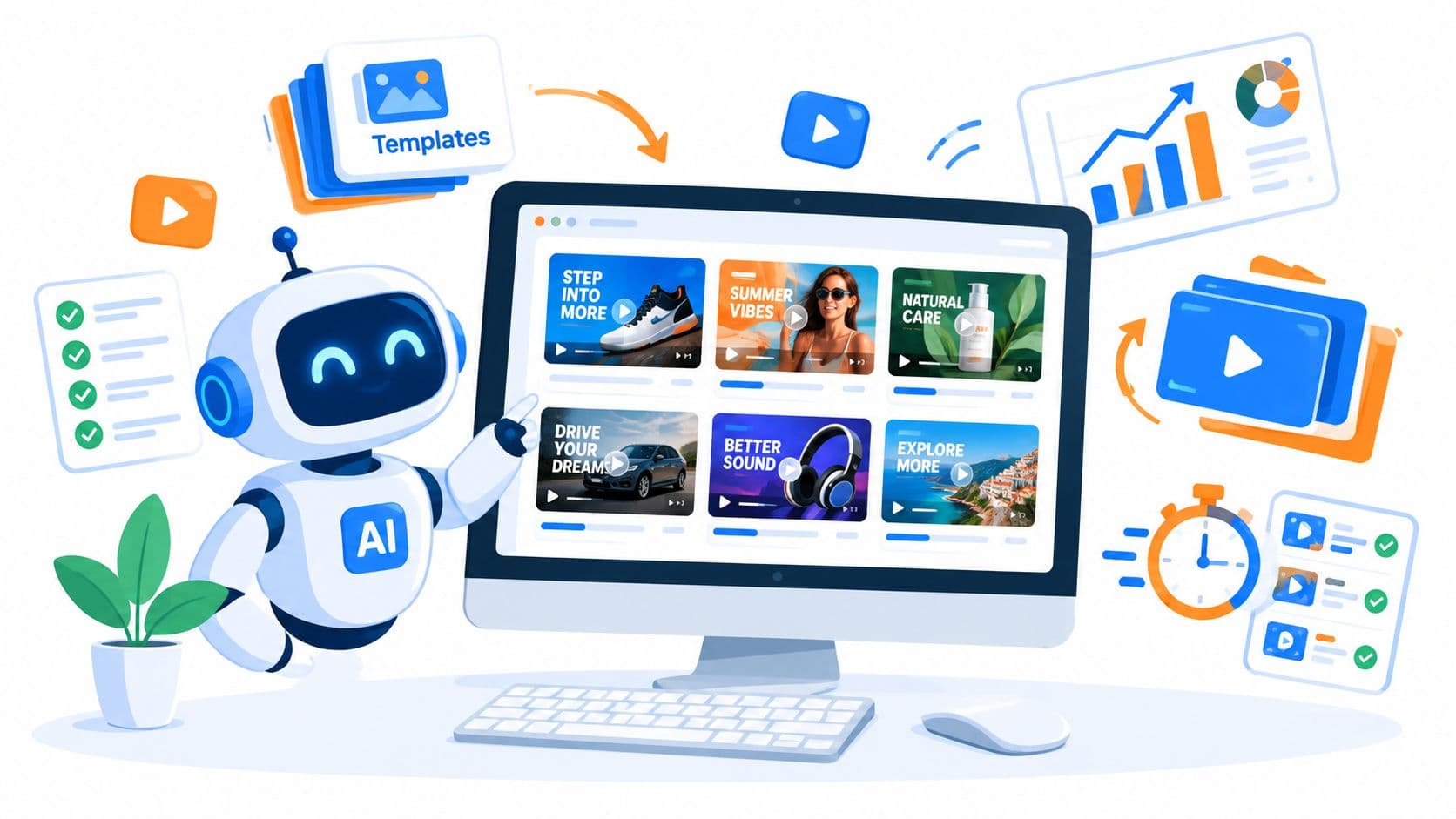
That entire process? It's been condensed from days of work into just a few minutes. AI video builders have completely changed the game, creating a direct path from your final script to a finished, ready-to-publish video ad. This isn’t about cutting out creativity; it's about getting rid of the technical headaches so you can focus on the creative side of things.
From Text to Video in a Flash
At its core, an AI video builder is designed to take the story beats from your script and turn them into a visual story that flows. You just copy and paste your script into the platform, and it instantly gets to work, generating a sequence of scenes. This first draft alone shaves off hours you'd otherwise spend manually piecing everything together.
But the real power comes from how easy it is to refine that first draft. From there, you can:
- Find the Perfect AI Voice: Browse through dozens of surprisingly natural-sounding AI voices. You can pick different languages, dialects, and tones to find one that perfectly fits your brand—whether you're going for high-energy, calm and trustworthy, or just a friendly, conversational vibe.
- Nail the Visuals with a Simple Editor: The AI will suggest stock footage and images that it thinks match your script, but you have the final say. Swapping out clips, uploading your own branded content, and trimming scenes to get the timing just right is all done with a simple drag-and-drop interface.
- Add Your Brand’s Finishing Touches: Drop in your logo, set your custom fonts, and apply your brand colors to make sure every ad is instantly recognizable. This keeps everything consistent across your campaigns.
By taking care of the most tedious parts of video editing, these AI tools let you pour your energy into what actually moves the needle: the story and the strategy behind your advertisement script. You can go from one great idea to testing multiple versions of it in a fraction of the time it used to take.
AI as Your Creative Partner
It's not just about production, either. The best AI tools have become a valuable partner in the creative process itself. For instance, platforms like Hooked are constantly analyzing real-time trends—what audios are going viral, what visual styles are popping off, and what your competitors are up to.
Think about it: you get a roadmap of what’s already grabbing attention in your specific market. You can use that data to build your next script for an advertisement with a much higher chance of it actually working. For a closer look at how this works, you can learn more about how to turn your script into video with AI and make these tools a core part of your workflow. It's a powerful feedback loop, where performance data from today fuels your next winning ad script for tomorrow.
Your Script is Live. Now What? Testing and Optimization
Getting your ad launched is the starting line, not the finish line. Think of your first script not as a final product, but as version one of a potential high-converting machine. The real magic happens when you stop guessing and start listening to what your data is telling you. It’s a shift from a "creation" mindset to one of constant "iteration."
The first step is knowing which numbers actually matter. Don't get bogged down in vanity metrics. You need to focus on the data points that tell the real story of how your script is performing. For instance, a low click-through rate isn't necessarily a sign your product is bad—it could just mean your call-to-action isn't hitting the mark.
Adopting the A/B Testing Mindset
This is how you turn a good script into a great one. The core principle of A/B testing is simple: change only one thing at a time. If you swap out the hook, the visuals, and the CTA all at once, you'll have no clue which change actually moved the needle. It's all just guesswork at that point.
So, where do you start? Always, always, always start with the most important element: the hook.
- Hook Rate: What percentage of viewers are still watching after the first three seconds? This is your make-or-break metric. If your hook rate is languishing below 30%, the rest of your script might as well not exist.
- Watch Time: How long are people sticking around? If you see a massive viewer drop-off at the 10-second mark, that’s a huge red flag that your story or solution isn't connecting.
- Click-Through Rate (CTR): Are people actually doing what you ask them to do? This tells you exactly how effective your call-to-action is.
Let’s say you’re running a simple test. You create two identical ads, but with one tiny difference. Ad A's hook is a question: "Tired of messy countertops?" Ad B's hook is a bold statement: "This is the last kitchen gadget you'll ever need." Let them both run, and see which one grabs a better hook rate. That’s your winner.
Once you’ve found a hook that consistently performs, you can move on to testing the next element. Maybe you test two different CTAs or experiment with a different piece of background music.
By making these small, methodical, data-backed decisions over time, you’re not just throwing money at a wall and hoping it sticks. You’re systematically improving your ROI. To get a better handle on what to track, our guide to competitor ad analysis is a great place to see how other successful campaigns are structured.
Still Have Questions? Let's Clear Things Up.
Got a few more questions rattling around about nailing your next ad script? Perfect. This is where we tackle some of the most common hurdles I see people run into, giving you straight-up answers so you can write with a lot more confidence.
What's the Real Sweet Spot for Video Ad Script Length on TikTok?
You want to aim for the 15 to 30-second range on platforms like TikTok and Instagram Reels. Any longer and you're fighting for attention you probably won't get.
This short timeframe is actually a blessing in disguise—it forces you to be ruthless with your messaging. For a natural, conversational pace that doesn't sound like you're speed-reading a teleprompter, keep your script to about 40-75 words.
Think about your timing this way:
- Your Hook: The first 3 seconds are everything. This is your one shot to stop their thumb.
- The Story: Use the next 10-15 seconds to quickly present the problem and introduce your solution.
- The Ask (CTA): Wrap it up with a clear, direct call-to-action in the last 2-3 seconds.
How Can AI Actually Help Me Write a Better Ad Script?
Think of AI as your creative partner, not just a robot spitting out words. Instead of getting stuck staring at a blank document, you can use AI tools to instantly pull ideas from what’s already going viral, making sure your concept is relevant right out of the gate.
An AI script writer is fantastic for sharpening your hooks and can structure your entire ad using proven formulas like PAS (Problem-Agitate-Solution). It's the ultimate cure for writer's block and ensures your script isn't just a guess—it's built on patterns that are already working.
What Numbers Should I Really Be Watching When Testing a Script?
Once your ad is out in the wild, don't get lost in a sea of data. Zero in on three specific metrics to see if your script is actually doing its job.
First, your Hook Rate. This is the percentage of people who stick around past the 3-second mark. If this number is low, your opening is weak, and nothing else matters.
Next, check your Average Watch Time. This tells you how compelling your story is after the hook. Are people bailing halfway through? Finally, keep a close eye on the Click-Through Rate (CTR). This is the ultimate test—did your script actually convince someone to take action?
Ready to stop guessing and start creating? Hooked gives you the AI tools and daily trend roadmap to turn your script ideas into high-performing videos in minutes. Start building content that actually converts at Hooked.ai.