Posting more often isn't a brand-awareness strategy. It's a distribution tactic, and distribution only helps when people notice, remember, and correctly associate the content with your brand.
The practical answer to how to increase brand awareness starts with diagnosis. You need to know whether people are failing to discover you, failing to recognize you, or seeing you but forgetting you immediately. Short-form video can solve all three problems, but each requires different creative, distribution, and measurement choices.
Brand familiarity also reduces purchase friction. Branding summaries report that brands often need about 6 to 7 impressions to produce awareness, while 63% of customers are more willing to buy from familiar brands. The same research reports that 81% of consumers need to trust a brand before buying, and that brand consistency can increase revenue by up to 23%. These branding findings point to one operational truth: recognition grows through repeated, consistent exposure, not one lucky post.
Why Most Brand Awareness Strategies Fail
The most popular advice is also the least useful: post consistently, chase reach, and wait for awareness to rise. That approach treats awareness like a single volume dial. It doesn't tell you whether your content is reaching the wrong people, failing to create recognition, or attracting attention without leaving a memory.
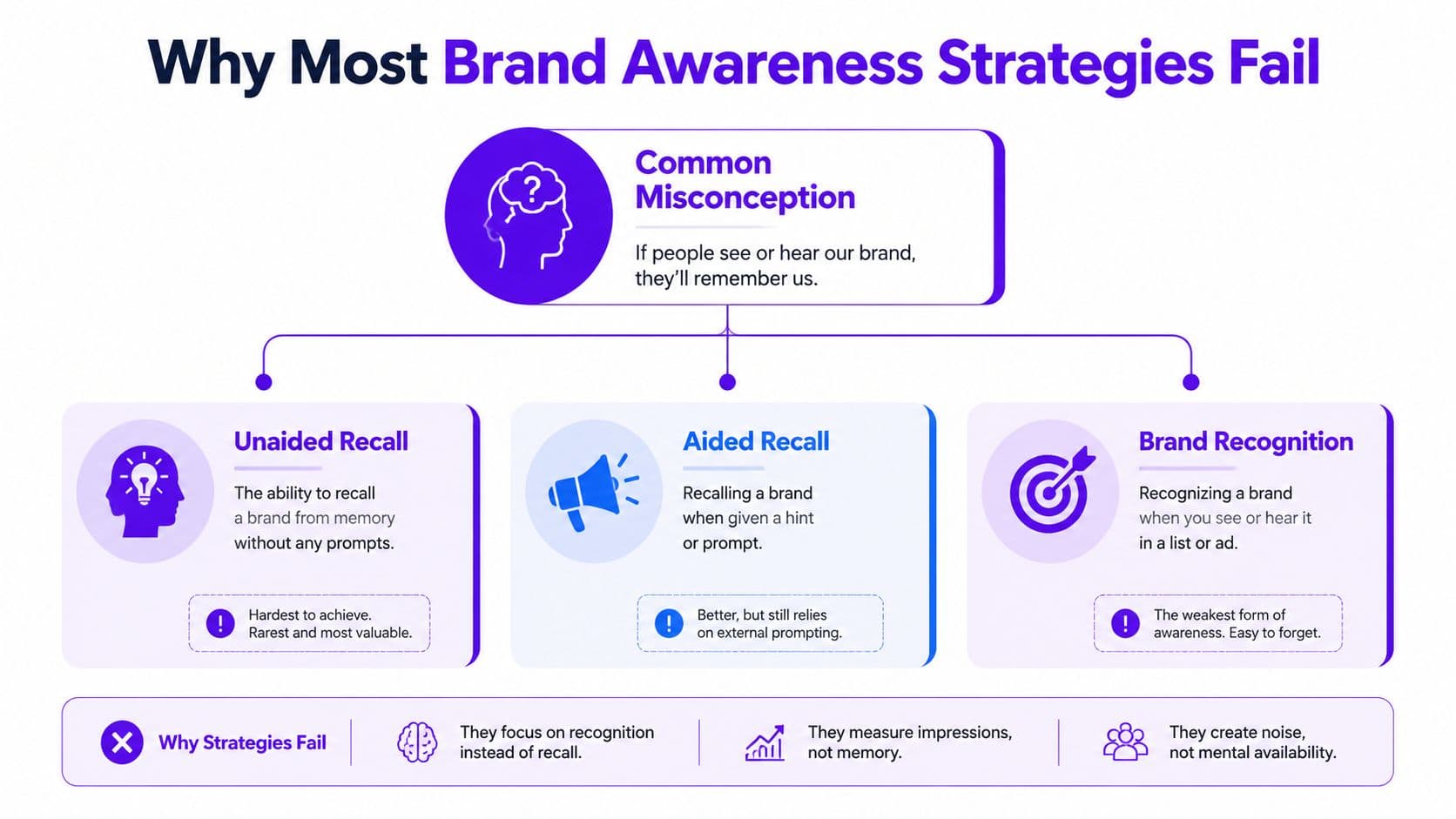
A brand can have impressive reach and weak recall. Someone may watch a video, enjoy it, and still be unable to name the company a few minutes later. Another audience may recognize the logo or packaging when prompted but never think of the brand first when asked for a recommendation.
Separate discovery from memory
Treat these as different jobs:
- Reach: How many relevant people had an opportunity to see the brand or its content. Reach is a distribution condition, not proof of awareness.
- Aided recognition: Whether someone recognizes your brand when shown its name, visual identity, product, or content.
- Unaided recall: Whether someone can name your brand without a prompt when thinking about a category or problem.
Each failure has a different remedy. Low reach demands better targeting, channel selection, or paid distribution. Weak recognition usually signals inconsistent visual and verbal assets, unclear branding in the video, or creative that looks interchangeable with competitors. Weak unaided recall means your audience has seen you but hasn't built a strong association between your brand and a specific need.
A quick audit can expose the gap. Ask a small group of target customers to name brands in your category without showing them anything. Then show them your profile, packaging, or a paused video and ask whether they recognize it. Compare those answers with your reach and frequency data. The pattern matters more than a blended awareness score.
Practical rule: Never prescribe more content until you know which awareness layer is broken.
Short-form video is especially vulnerable to this mistake because entertaining clips can outperform branded clips on views while doing little for memory. Use recurring visual cues, a recognizable opening style, a consistent point of view, and a clear connection to the problem you solve. If you're building a creator-led presence, this practical guide to social media branding for creators is useful for formalizing those recurring identity signals.
The goal isn't to make every video identical. The goal is to make the brand easy to identify across different stories, trends, and formats.
Define Your Audience and Unique Selling Proposition
A broad audience creates broad, forgettable content. “People who like skincare,” “small businesses,” or “busy professionals” tells a creative team almost nothing about what to say, show, or challenge.
Start with the problem your audience already describes in their own language. Read reviews, support tickets, comments, community discussions, and sales objections. Look for repeated frustrations, desired outcomes, failed alternatives, and moments when the problem becomes urgent. Those details are more useful than a demographic label because they give you hooks and scenarios for video.
Build an audience profile that drives creative
Document four dimensions:
- Core need: What job does the audience need completed, and what consequence follows when it stays unresolved?
- Psychographics: What do they value, distrust, aspire to, or avoid? A budget-conscious buyer and a convenience-first buyer may want the same product for different reasons.
- Content behavior: Do they save tutorials, comment on hot takes, follow experts, watch product demonstrations, or share humor with colleagues?
- Decision context: Who influences the purchase, what proof do they need, and what language makes them skeptical?
A useful audience statement looks like this:
We help [specific audience] solve [specific problem] by providing [distinct mechanism or outcome], unlike [common alternative], because [credible reason to believe].
The template forces precision. “We help everyone improve marketing” is a category description. “We help early-stage ecommerce teams turn product insights into platform-native short videos without building an editing department” is a position a content team can execute.
Make the USP visible in the content
Your unique selling proposition shouldn't live only on a website. It should determine your first sentence, examples, visual demonstrations, creator partnerships, and calls to action.
A skincare brand that says “skincare for everyone” has no obvious creative territory. A narrower position, such as barrier repair for sensitive skin in dry climates, gives the brand a sharper problem, vocabulary, environment, and audience signal. That kind of narrowing can make content more relevant, but don't claim a result until you validate it with your own data.
Test positioning before scaling production. Create several organic videos that express different versions of the same promise. Watch which audience segments comment with specific problem language, save the advice, ask product-related questions, or describe the brand to others. High views alone don't validate a USP. A strong position produces recognizable audience response.
Avoid three common traps:
- Feature-led positioning: A list of ingredients or functions doesn't explain why the audience should care.
- Competitor-shaped positioning: Saying you're faster, better, or more affordable without defining the comparison makes the claim easy to ignore.
- Audience maximalism: Adding every possible customer weakens the message for the people most likely to buy first.
Keep a one-page brand brief with the audience, problem, promise, proof, tone, visual rules, and exclusions. Every creator or AI-assisted workflow should use it. Consistency becomes much easier when the team has a reference document instead of relying on memory.
Choose the Right Channels for Discovery
Channel selection should follow discovery behavior, not personal preference. A 2025 industry summary reported that search engines led brand discovery for 32.8% of consumers, television advertising followed at 32.3%, and social media ads contributed 29.7%. The cited brand-awareness summary supports a multi-channel approach rather than the belief that social platforms own discovery.
Search captures active curiosity. Television can create broad familiarity. Social advertising and organic short-form video can combine targeting, participation, comments, creator credibility, and rapid creative testing. These channels do different jobs, so comparing them only by immediate clicks distorts the strategy.
| Channel | Discovery Rate | Best For |
|---|---|---|
| Search engines | 32.8% | Active problem and category discovery |
| TV advertising | 32.3% | Broad familiarity and repeated exposure |
| Social media ads | 29.7% | Targeted discovery, demonstrations, and creator-led proof |
A brand that relies only on organic social may miss people who search after hearing about the category elsewhere. A brand that buys broad media without recognizable creative may create exposure without recall. Strong programs connect the surfaces. A short video introduces the problem, search-visible content answers the follow-up question, and retargeting or creator proof gives the audience a reason to investigate further.
Match the platform to the buying context
TikTok suits fast cultural participation, founder personality, humor, product demonstrations, and problem-led hooks. Use it when the audience responds to native, informal storytelling and when you can react quickly without making every post feel like an advertisement.
Instagram Reels works well for visual identity, lifestyle demonstrations, creator collaborations, and content that can travel through profiles, Stories, and paid placements. It rewards a polished system, but over-polishing can remove the spontaneity people expect from short-form feeds.
YouTube Shorts gives short videos a relationship with a broader search and video library. Educational explainers, comparisons, product use cases, and recurring series can work particularly well when viewers may continue researching after the first impression.
LinkedIn is better suited to professional insight, customer problems, founder perspectives, hiring narratives, and category education. A B2B brand shouldn't copy entertainment formats blindly. It should translate its expertise into concise stories, strong opinions, and specific workplace situations.
Use organic content to learn which messages earn attention and meaningful response. Use paid amplification when a format already communicates the position clearly and reaches a strategically relevant audience. Paying to scale an unclear video usually buys more ambiguous data, not more awareness.
The practical channel mix depends on the audience, sales cycle, creative resources, and existing demand. Start where your customers already discover solutions, then add a second channel that captures the next step in their research rather than duplicating the same post everywhere.
Craft Repeatable Short-Form Video Formats
Viral content is rarely a sustainable operating model. A recognizable format is. The strongest awareness teams build a small library of repeatable structures, then vary the topic, example, creator, and visual treatment without changing the underlying promise.
A good format reduces creative hesitation. It gives the writer a starting point, the creator a performance pattern, and the editor a predictable shot list. It also helps the audience recognize your content before reading the username.
Build a format portfolio
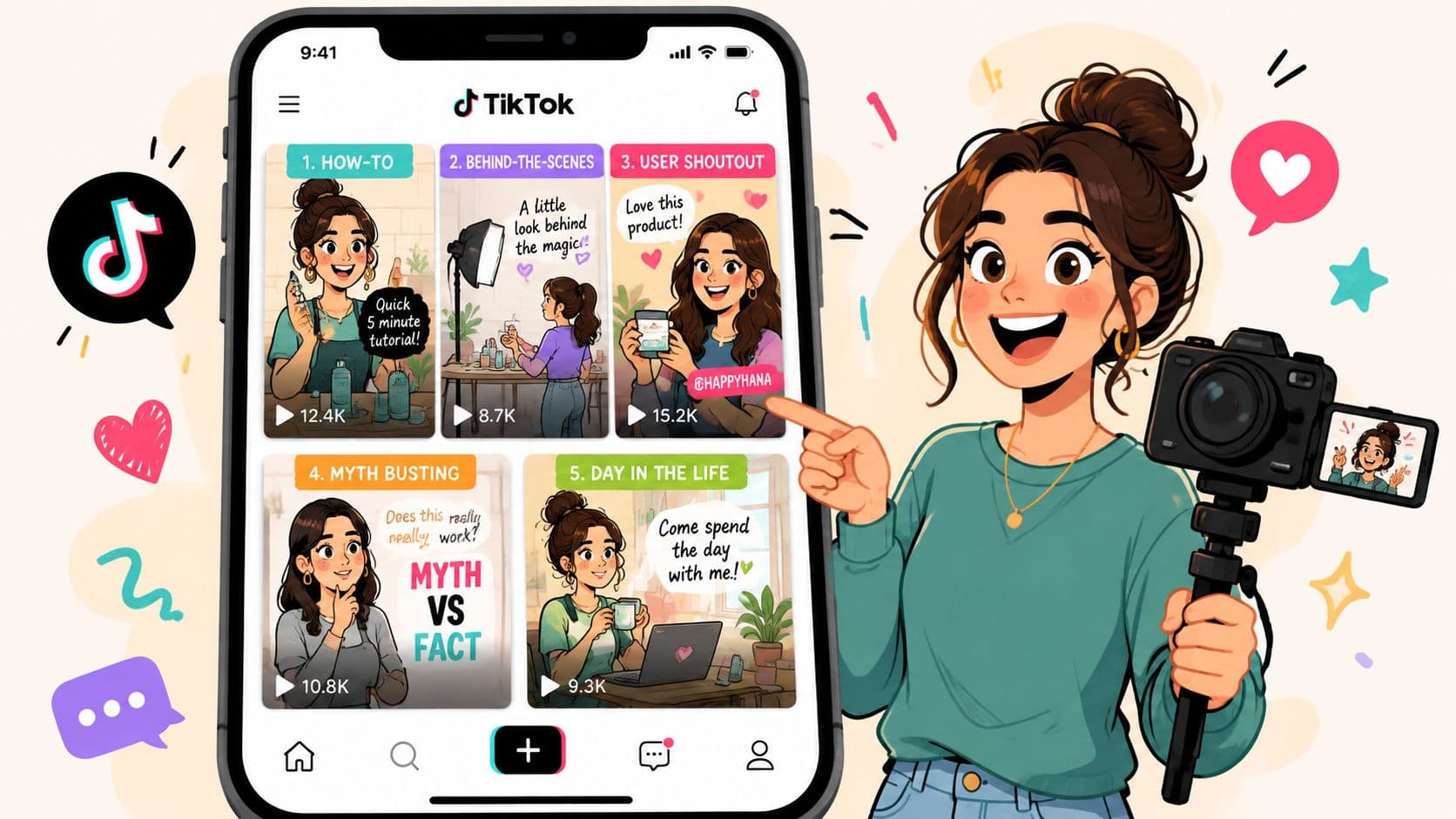
Use three to five recurring formats, each with a distinct role:
- Problem, agitate, solve: Open with a specific frustration, show the cost of leaving it unresolved, then demonstrate your method.“Your product videos aren't boring because your product is boring. They're boring because the first frame explains the feature instead of showing the problem.”
- Myth versus reality: State a belief your audience repeats, challenge it, and replace it with a practical explanation. This works best when the correction is useful rather than manufactured controversy.
- Day in the life: Follow a customer, founder, employee, or product through a real situation. Use environmental details to make the brand feel present in a life, not isolated in an ad.
- Comment response: Turn a real question into the opening line. Display the comment, answer it directly, and show evidence through a demonstration or example.
- Three-part teardown: Analyze a common mistake, explain why it happens, and give the viewer a better checklist.
Hooks need tension, specificity, or an immediate payoff. Try structures such as:
- “Before you buy [category], check this.”
- “Most [audience] solve [problem] in the wrong order.”
- “I tested [approach] so you don't have to.”
- “The part nobody shows you about [task].”
- “If [specific symptom] keeps happening, start here.”
Don't cram the entire brand story into the first second. The opening earns attention, the middle proves relevance, and the ending makes the association memorable. Put the product or brand into the narrative early enough to connect the value to the source, but don't interrupt a useful story with an unrelated sales pitch.
Choose the right production style
Founder-led videos are powerful when trust, expertise, or personality drives the category. They can also create operational risk if every post requires the founder's availability. Faceless videos work well for demonstrations, screen recordings, product workflows, visual explainers, and channels where the idea matters more than the presenter.
Use a consistent voice, caption treatment, color system, framing style, and closing device across both. AI tools can produce script variations, voiceovers, avatars, and edits, but they shouldn't decide what the brand believes. Feed them approved claims, audience language, examples, and prohibited phrases.
For practical guidance on structuring paid and organic short-form creative, the Wojo Media short video playbook provides a useful reference. You can also use Hooked's viral video library to study repeatable patterns without copying another brand's identity.
Use the same concept differently by platform. TikTok may need a conversational opening and comment reply. Reels may benefit from stronger visual polish and profile continuity. Shorts may need clearer searchable wording. The footage can overlap, but the first frame, caption, pacing, and closing line should reflect the platform.
Before publishing, check four things:
- Can a viewer identify the problem immediately?
- Does the video contain a distinctive brand cue?
- Does the proof support the promise?
- Would someone remember what category the brand belongs to after watching?
A format that earns views but produces no recognition needs a branding adjustment, not just a higher posting frequency.
Scale Production with Trends and User-Generated Content
Scaling awareness content requires a production system that protects two things at once: speed and identity. Trend-jacking supplies timely distribution opportunities, user-generated content adds lived experience, and AI-assisted production reduces repetitive execution work. None of these replaces judgment.
Create a trend-to-publish workflow
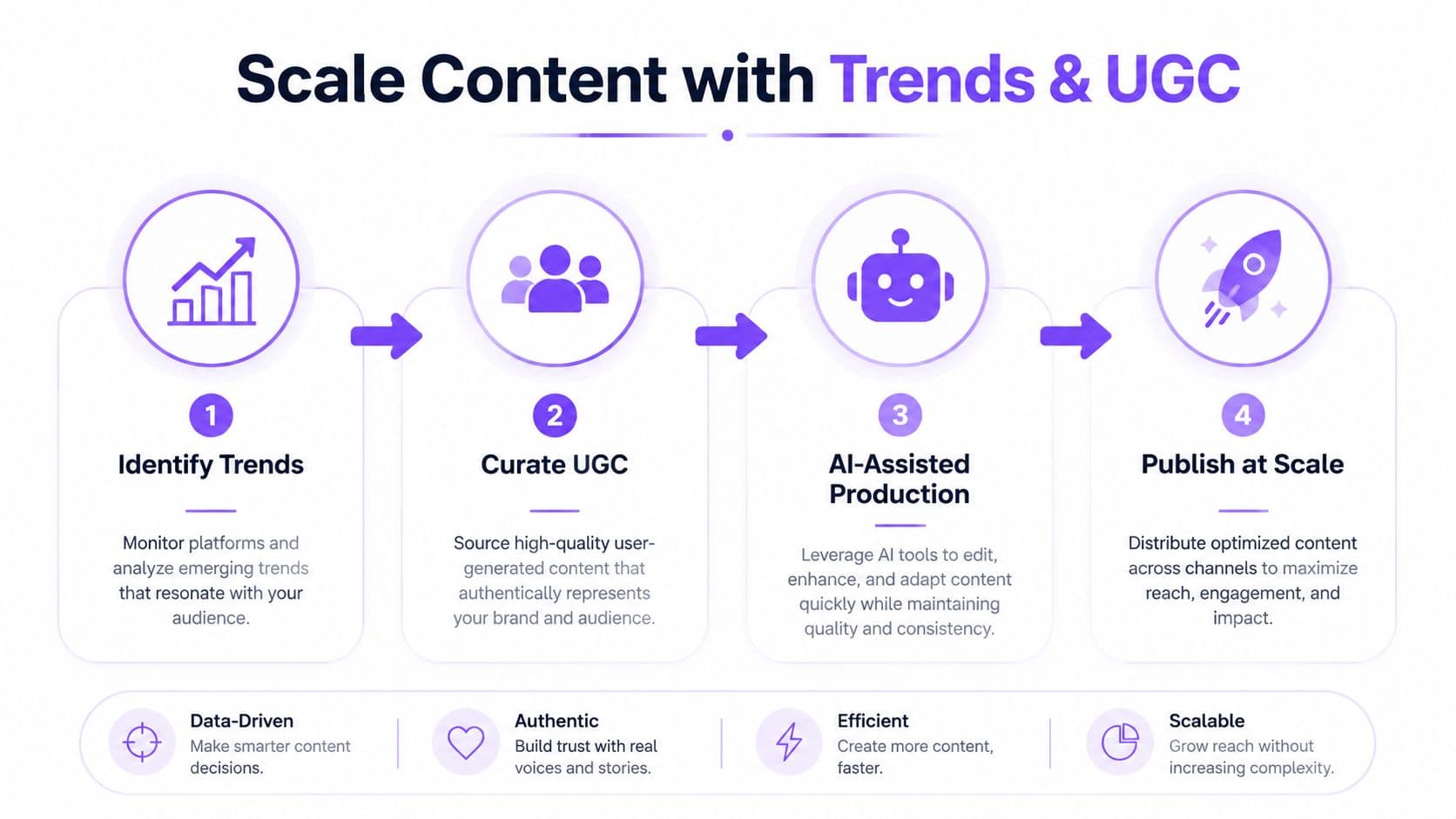
Trend monitoring should produce a decision, not an endless feed of sounds and memes. For each trend, ask whether it fits the audience, category, promise, and brand voice. If it does, write the brand adaptation quickly, record multiple variations, and publish while the cultural reference still makes sense. If it doesn't, skip it. Forced relevance makes a young brand look opportunistic.
A simple workflow looks like this:
- Identify: Capture emerging formats, recurring jokes, questions, and visual patterns.
- Filter: Score each idea against audience relevance, brand fit, production effort, and potential for a clear message.
- Adapt: Replace the generic punchline with a category-specific insight, demonstration, or customer situation.
- Package: Produce platform-specific openings, captions, and calls to action.
- Review: Check claims, rights, visual consistency, and whether the brand remains understandable without the trend.
UGC belongs in the same system, but it shouldn't become a collection of unedited testimonials. Request specific scenes, objections, routines, unboxings, before-and-after processes where appropriate, and honest product-use moments. Give creators a brief with the audience, problem, mandatory facts, prohibited claims, delivery style, and permission requirements. Leave room for their natural language.
Micro-creators can provide credible footage and distinct interpretations of the same message. The trade-off is coordination. Without a central brief and asset library, each creator may describe the brand differently, weakening recognition.
Use AI for variation, not identity
AI can turn one approved concept into multiple hooks, scripts, captions, voiceovers, and edits. A human should still select the angle, verify factual claims, preserve the brand vocabulary, and reject versions that sound generic. A production team can also repurpose a strong customer clip into a response video, a short explainer, a product demonstration, and a founder commentary piece, as long as each version has a distinct reason to exist.
For teams building a UGC pipeline, Hooked's UGC ad use cases show how AI-assisted video workflows can support creator-style advertising. The same principle applies whether the final asset is generated, edited from customer footage, or recorded in-house: scale the format, not random content.
Create an asset matrix with rows for audience problems and columns for formats. Add trend adaptations and UGC angles to the same matrix. This prevents the common scaling failure where a brand publishes frequently but repeats one shallow message, or produces many unrelated videos that no longer feel connected.
Speed earns the opportunity. Consistency earns the memory.
Keep a small approval gate before publishing. Verify the brand cue, core promise, product accuracy, rights, and platform fit. A fast workflow with no quality control can create more content while making the brand harder to understand.
Measure Brand Lift Beyond Vanity Metrics
Views and likes answer whether people interacted with a piece of content. They don't answer whether people can remember your brand, recognize it, or associate it with the problem you solve.
Start with separate measurement for the three awareness layers. Use unaided questions such as, “Which brands come to mind when you think about this category?” Use aided questions by showing the brand name, logo, product, or video and asking whether the respondent recognizes it. Track reach separately because exposure creates the opportunity for both outcomes.
A 2024 systematic review of brand-awareness measurement notes that measurement remains inconsistent across studies, while an advertising-research review argues that awareness forms shouldn't be collapsed into one score. That distinction changes campaign decisions. A reach problem needs distribution; a recognition problem needs stronger brand assets; a recall problem needs repeated category association and distinctive creative.
Build a practical measurement stack
Use a mix of behavioral and attitudinal indicators:
- Unaided recall: Ask people to name brands without prompts before and after a campaign.
- Aided recognition: Show brand assets and measure recognition separately from recall.
- Branded search: Monitor searches for the company, product, and distinctive campaign language.
- Direct traffic: Watch visits that arrive without a referring source, while interpreting the data cautiously.
- Share of voice: Compare your brand's visible presence in relevant conversations, search results, and creator content.
- Quality reach: Segment exposure by audience relevance instead of treating every impression as equal.
- Engaged response: Look for comments, saves, shares, questions, and descriptions that repeat your positioning.
Run controlled tests wherever possible. Hold out a comparable audience, region, campaign cell, or time period from the awareness treatment, then compare changes in recall, recognition, branded search, direct traffic, and downstream behavior. Performance marketing can contaminate the result, so document other campaigns running at the same time.
Social advertising research also supports the creative side of measurement. A Kantar and Oxford Saïd analysis of 235 global social campaigns from 110 brands found that most campaigns produced positive movement in brand KPIs, and that more human, emotional language outperformed more functional copy. The campaign analysis suggests testing tone, not just audience and budget.
A separate review covering social-media advertising research from 2010 to 2025 found recurring links between informativeness, interactivity, trendiness, electronic word of mouth, creative content, engagement, and brand awareness. That literature review reinforces the need to measure engagement as a bridge between exposure and memory, not as the final objective.
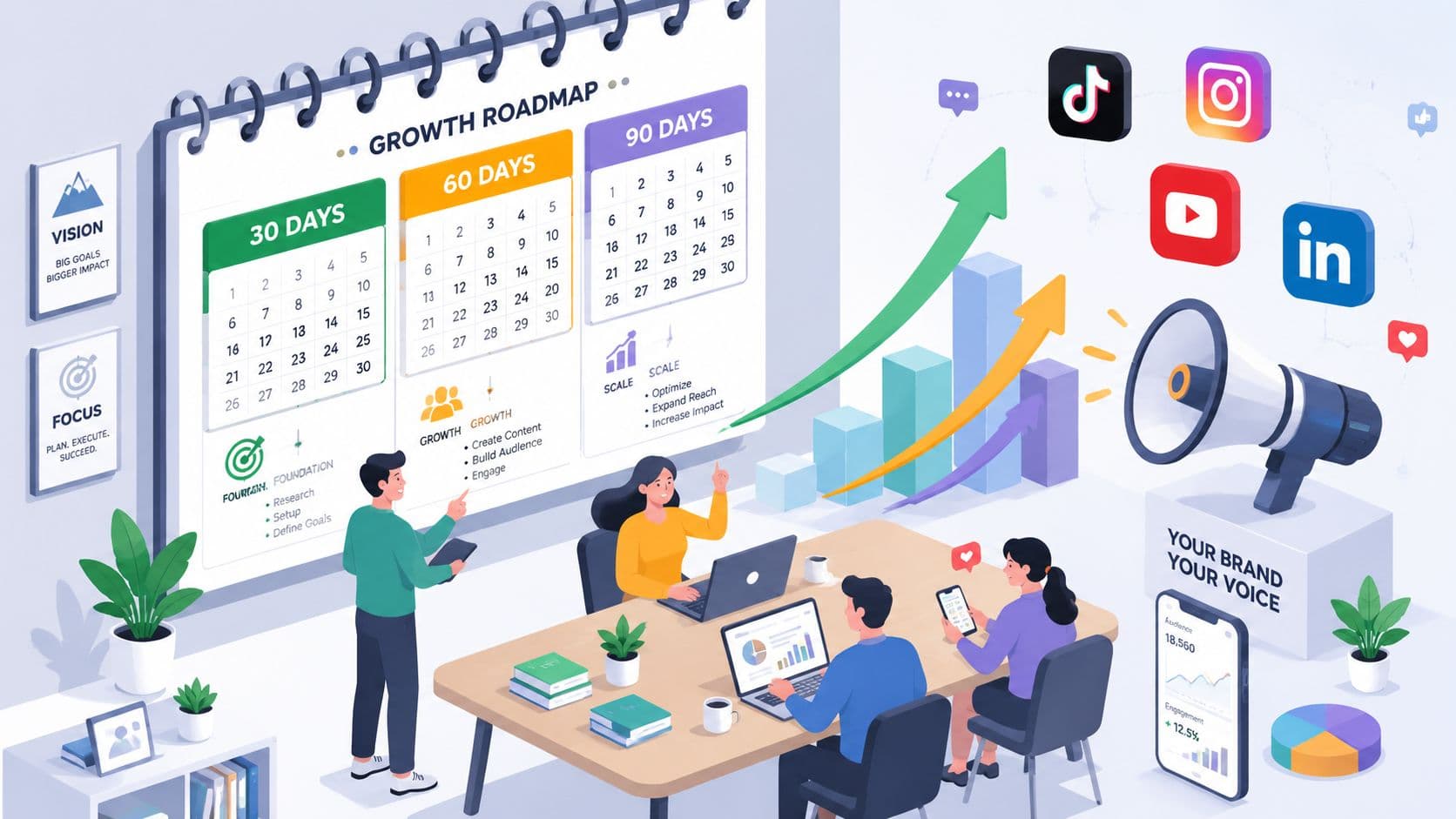
Your 30/60/90-Day Brand Awareness Calendar
A 90-day plan should move from clarity to production to diagnosis. Don't start by filling a calendar with random ideas. Establish the position, create a manageable format system, and use early audience signals to decide what deserves more distribution.
Days 1 through 30 build the foundation
Week 1, diagnose: Interview customers, review comments and objections, define the audience problem, and record baseline reach, recall, recognition, branded search, and direct traffic. Choose one primary audience and one category association.
Week 2, package: Finalize the USP, brand voice, visual cues, recurring opening style, caption rules, and proof library. Write several hooks for each core problem and reject any that could belong to a competitor.
Week 3, test formats: Produce a small batch across three recurring structures, such as problem-solution, myth versus reality, and comment response. Keep the subject matter connected so you can compare formats without changing the entire message.
Week 4, review: Identify which videos attract the right questions, saves, shares, profile visits, and recognition signals. Don't crown a winner based on views alone. Select the formats that combine attention with clear audience relevance.
Use a simple planning sheet with columns for audience problem, hook, format, proof, brand cue, platform, creator, status, and learning. This creates a record of why each video exists.
Days 31 through 60 create the engine
Weeks 5 and 6, systemize: Turn the strongest formats into templates. Batch scripts, filming, voiceovers, editing, captions, and approvals. Create evergreen versions alongside trend-responsive versions so the calendar isn't hostage to the news cycle.
Weeks 7 and 8, distribute: Repurpose approved concepts for TikTok, Instagram Reels, YouTube Shorts, and LinkedIn where relevant. Add UGC requests, creator variations, and search-oriented versions that answer the questions raised in comments. Introduce paid amplification only after the creative communicates the position clearly in organic testing.
A scheduler such as the Hooked content scheduler can help teams coordinate publishing across platforms and keep the production queue visible. The tool matters less than the discipline of assigning every asset an audience, format, platform, and learning objective.
Days 61 through 90 optimize for lift
Weeks 9 and 10, strengthen memory: Review whether viewers can recognize the brand and whether target customers associate it with the intended problem. Tighten recurring visual cues, opening language, product placement, and closing associations where recognition is weak.
Weeks 11 and 12, run the test: Compare exposed and less-exposed audiences where practical. Review unaided recall, aided recognition, branded search, direct traffic, quality reach, and meaningful engagement. Separate creative problems from distribution problems before changing the entire strategy.
For a broader planning reference, the brand awareness playbook from Sprints & Sneakers offers additional strategic context. Use it alongside your own customer language and measurement rather than treating any external calendar as universal.
At the end of the 90 days, keep the formats that create recognition and recall, not merely the posts that produce the largest audience spike. Archive weak hooks, refresh proven structures, and set the next cycle around the awareness layer that still underperforms.
Hooked helps creators and brands turn trend research into short-form videos through trend tracking, AI-generated scripts, UGC-style production, editing, voiceovers, and cross-platform scheduling. Visit Hooked to build a repeatable video workflow around the awareness problem you need to solve.