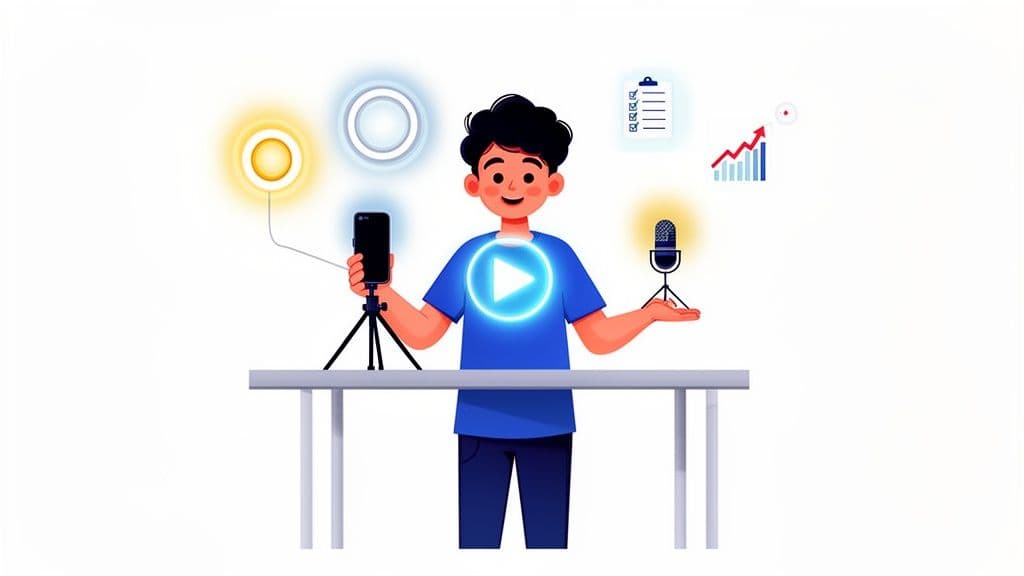
So, you want to become a UGC creator. The path is pretty straightforward: you need to find your niche, put together a portfolio that makes brands notice, and then start reaching out. Your main job isn't to build your own audience, but to create authentic, high-performing videos that brands can use on their own channels.
The UGC Gold Rush Is On (And You're Not Too Late)
First things first, let's clear up a common misconception: being a UGC creator is not the same as being an influencer. It's about being a freelance creative who partners with brands. You get paid for your skill in making relatable content, not for the number of followers you have.
Brands are actively moving their ad dollars from glossy, professional shoots to content that looks and feels like it was made by a real customer. Why the big shift? It’s simple: people trust people. A genuine video from a creator feels more like a trusted recommendation than a stuffy corporate ad, and that's exactly what brands are paying for.
The Numbers Don't Lie
This isn't just a hunch; the financial data shows that UGC is a massive, growing industry. The global market for user-generated content was valued at 132.73 billion by 2034. That kind of growth signals a huge, sustained demand for creators.
To give you a clearer picture, here's a simple roadmap that breaks down the journey into three key phases.

As you can see, the path is logical: figure out your unique angle, build the assets to prove your skills, and then go out and get paid for it.
Here’s a quick overview of the essential phases we'll be diving into throughout this guide.
Your Roadmap to Becoming a Paid UGC Creator
| Phase | Key Action | Primary Goal |
|---|---|---|
| 1. Conceptualize | Define your niche and personal brand. | Position yourself as a go-to expert in a specific area. |
| 2. Create | Build a portfolio with high-quality sample videos. | Showcase your skills and creative style to potential clients. |
| 3. Monetize | Pitch to brands and land your first paid deals. | Turn your creative skills into a reliable source of income. |
This table lays out the core steps—think of it as your high-level game plan for launching a successful UGC career.
Why Right Now Is The Perfect Time To Start
Honestly, the barrier to entry has never been lower. You don’t need an expensive camera, a production studio, or a massive social media following. All you really need to get started is your smartphone, a bit of creativity, and a solid grasp of what makes for good short-form video. The entire point of UGC video is authenticity, which means anyone with the right approach can succeed.
The secret to long-term success as a UGC creator is to treat it like a real business from the very beginning. You're not just making videos; you're a service provider solving a critical problem for brands: their constant need for fresh, relatable content that converts.
Thinking like a business owner from day one will put you miles ahead. Learning the basics of how to start an online business from scratch will help you structure your services, set your rates with confidence, and manage client relationships professionally. This mindset is what turns a fun side hustle into a sustainable career.
Finding a Niche That Brands Will Pay For
If you want to succeed in the crowded world of UGC, you can't be a generalist. You have to be a specialist. Brands aren't just looking for someone who can point a camera and talk; they're hunting for a creator who genuinely gets their specific customer. This is why nailing down a profitable niche is your first and most critical move.
Think about it. A generic "beauty" creator is a dime a dozen. But a creator who specializes in "cruelty-free skincare for sensitive, acne-prone skin"? Now that gets a brand's attention. Your niche is what makes you stand out from the noise. It’s your unique selling point.

Brainstorming Profitable Niches
To find your sweet spot, start by looking at your own life—your authentic passions and real-world experiences are your biggest assets. What problems have you already solved for yourself? What products do you find yourself recommending to friends all the time?
Let's drill down from broad categories into specific, marketable niches that brands love:
- Parenting: Instead of just "parenting," you could focus on "Montessori-inspired toys for toddlers" or "meal prep solutions for busy working moms."
- Pets: Move beyond "dog products" and get specific with "durable chew toys for power-chewer breeds" or "holistic supplements for senior dogs."
- Tech: Don't just be a "tech" creator. Niche down to "smart home gadgets for apartment renters" or "productivity apps for freelancers."
See how that specificity instantly positions you as an expert? That’s exactly what brands are looking for.
Validating Your Niche Idea
Once you've got a few ideas brewing, you need to make sure there's actually a market for them. The UGC gold rush is very real. Between 2020 and 2025, searches for how to become a UGC creator shot up by over 8,700%, and the number of creators themselves jumped 93% from 2024 to 2025 alone. With this much competition, you have to validate your idea. You can dive deeper into the creator economy's explosive growth over at Whop.com.
Your ideal niche lies at the intersection of three things: what you're genuinely passionate about, what you already know, and where brands are already spending money. Miss one of those, and you’ll either burn out, sound inauthentic, or struggle to find anyone to pay you.
A quick way to check for demand is to search your niche on TikTok and Instagram. Are brands already running ads targeting this audience? Are other creators making content in this space? A little competition is actually a great sign—it means there's money being spent. You aren't trying to invent a brand-new market, just carve out your unique space in a profitable one.
How to Build a Portfolio When You Have Zero Clients
This is the classic chicken-and-egg problem, isn't it? You need clients to build a portfolio, but you need a portfolio to get clients. The good news is, you can break this cycle yourself.
Your portfolio is your single most important sales tool. It’s what proves you can walk the walk before a brand cuts you a check. The secret? Stop waiting for permission and start creating spec ads—that’s just industry-speak for speculative content you make on your own.
The best way to do this is to grab 5-10 products you already have at home, use regularly, and genuinely love. This is a huge shortcut to authenticity. When you actually like the product, it comes through on camera, and your content will feel far more genuine than if you were just faking it.
The Only Gear You Really Need
Don't get bogged down thinking you need a professional camera setup. Your smartphone is more than powerful enough. What truly separates amateur content from professional-looking UGC are three simple things:
- Lighting: This is non-negotiable. Natural light is your best friend. Find a window, face it, and let that soft, flattering light do the heavy lifting. It makes everything look a thousand times better.
- Audio: Bad audio will make someone scroll faster than anything else. You don’t need a fancy podcasting mic, but a simple, inexpensive lapel mic that clips to your shirt will make your voice crystal clear and instantly elevate the quality of your videos.
- Editing: Keep it clean and simple. Apps like CapCut are perfect for this. Focus on quick cuts, clear text overlays to highlight key points, and adding a piece of trending audio. That’s it.
Your goal here isn't to be a Hollywood director. It's to show brands you speak the language of short-form video and understand what makes people stop scrolling.
The Kinds of Videos Brands Actually Want to See
Okay, so what should you actually film? You need to show brands you're versatile. A portfolio with a variety of video styles tells a potential client, "Whatever you need, I can deliver."
Here are the five essential video types you should have in your spec portfolio:
- The Unboxing: A classic for a reason. It builds excitement and gives viewers a clean first look at the product. Make sure you capture the details of the packaging, the big reveal, and your genuine first impressions.
- The Problem/Solution: This is the bread and butter of direct-response advertising. Start by clearly calling out a relatable pain point, then seamlessly introduce the product as the ultimate solution. It’s a powerful and proven formula.
- The Product Demo: Show, don't just tell. If you're demonstrating a skincare product, show the texture on your hand and how it applies to your face. If it's a new kitchen gadget, show it in action, creating something delicious.
- The Aesthetic Montage: This is all about the vibe. Think quick, visually pleasing clips cut together with a trending song. It's perfect for lifestyle brands where the feeling and aesthetic are the main selling points.
- The Testimonial/Review: This is where your genuine passion comes in. Speak directly to the camera and share your honest thoughts. Talk about the results you've seen and what makes this product a must-have for you.
Here's a little insider secret: brands care less about seeing your face and more about seeing results. Your portfolio's job is to prove you can create content that converts. You can build an incredibly successful UGC career creating "faceless" videos that only show your hands or use a voiceover.
Putting Your Work on Display
Once you've created a handful of killer spec videos, you need a central place to show them off. Don't just send random video files. A clean, professional portfolio is the goal.
When you're just starting, a simple and free platform like Canva or Carrd is perfect for building a one-page site. Even a well-organized Google Drive folder can work in a pinch. Just make sure it's easy for a busy brand manager to see your work at a glance.
The demand for this kind of content is exploding. The US User Generated Content Platform Market is valued at USD 2.66 billion in 2025 and is projected to hit USD 20.87 billion by 2033. This growth is being fueled by creators like you, especially in the short-form video space. This is a massive opportunity if your portfolio is ready to go.
Feeling stuck on your first few videos? You can even use a UGC ad generator to help you come up with scripts and ideas. It’s a great way to learn the proven formulas while quickly building out a portfolio that gets you noticed.
Pitching Brands and Landing Your First Paid Deal
Alright, your portfolio is looking sharp. Now for the exciting part—getting paid. This is where you shift from creating content to actively building a business. So many new creators get hung up here, but a smart, consistent outreach strategy is what separates the hobbyists from the pros. The goal isn't just to spray and pray with generic messages; it's about making genuine, targeted connections.
Don't just sit back and wait for brands to magically discover you. You've got to be proactive and show up where they're already spending their money.
Where to Find Your First Client
Finding brands that are actively looking for user-generated content is actually easier than you might think, as long as you know where to look. Instead of just cold-emailing massive brands like Nike or Sephora, put your energy where the demand is already high.
Here are a few goldmines I've seen work time and time again:
- TikTok Hashtags: Seriously, this is a game-changer. Spend some time searching for tags like #ugccreatorneeded, #ugccontentcreator, and #ugcsearch. You'll find brands, social media managers, and agencies posting casting calls right on the platform. These are warm leads ready for a conversation.
- Creator Marketplaces: Platforms like Upwork, Fiverr, and more specialized marketplaces like Insense and Cohley are literally built to connect brands with creators. Make sure your profile is polished and links directly back to your portfolio.
- Direct Outreach (The Smart Way): Look for brands that are already using UGC in their paid ads. If you're scrolling TikTok and see an ad that looks like a UGC video, that's your target. They've already proven they believe in (and pay for) this style of content.

Crafting a Pitch That Gets a Response
Your pitch is your first impression, and nothing gets deleted faster than a generic, copy-pasted message. Personalization is everything. A great pitch immediately shows you’ve done your homework and aren't just blasting out a template.
Here’s a simple, effective framework that consistently gets replies:
- Lead with a specific compliment. Mention a recent campaign you loved or a specific product feature that caught your eye. This proves you're a real person and a fan, not just another creator looking for a paycheck.
- Gently point out a gap. This is your "in." It could be something like, "I noticed most of your TikToks are beautifully shot montages. I specialize in creating direct-to-camera, problem/solution videos that could be amazing for your next ad campaign."
- Position yourself as the solution. Now, connect their need directly to your skills. Link to a specific video in your portfolio that demonstrates you can fill that gap. To really wow them, you could even pull some ideas from these UGC video scripts for your pitches to show you're already thinking about their brand.
- End with a clear, low-pressure ask. Keep it simple. Something like, "Would you be open to a quick chat about how I could create a few videos for your next campaign?" works perfectly.
Your pitch isn't just about you; it's about what you can do for them. Frame yourself as a strategic partner who understands their marketing goals, not just as a creator for hire. This mindset shift is what separates the beginners from the pros.
As you dive into pitching, remember that a strong personal brand is your secret weapon—it's what makes you memorable and defines your unique value. To really stand out in a crowded inbox, it's worth learning how to create a personal brand that opens doors and attracts the right kind of opportunities. This is a crucial step for any aspiring creator looking to move from spec work to consistent, paid deals.
Pricing Your Work and Navigating Contracts
Alright, you've got a brand interested. This is where the rubber meets the road. The conversation inevitably shifts to money and paperwork, which can feel like the scariest part when you're just starting out. But getting your rates right and knowing your way around a contract is what turns this from a hobby into a legitimate business.
The first rule? Don't sell yourself short. You're not just making a quick video; you're providing a valuable service that brands desperately need.

When you're new, a great starting point is somewhere in the 250 range for a single video. It’s a competitive rate that shows you’re serious but doesn't price you out of consideration while you're still building your reputation. As your portfolio gets stronger and you start getting referrals, you can—and should—start pushing those numbers up.
But here’s the thing: that single video rate is just your base. The real money in UGC isn't just about the video itself; it's about what the brand does with it. This is where usage rights come into play.
Decoding Usage Rights and Your Rates
Usage rights are simply the permissions you grant a brand to use your content. They dictate how, where, and for how long they can feature your work. Grasping this concept is probably the single most important factor in your pricing strategy. Think about it: a video the brand posts once on its organic TikTok feed is a world away from a video they're putting $50,000 in ad spend behind.
Here's a simple way to think about pricing factors:
- Organic Usage: This is your foundation. The brand gets to post the content on their own social media channels without any paid promotion. It’s the lowest-tier right and should be attached to your base rate.
- Paid Usage Rights: If the brand wants to run your video as a paid ad, the price needs to jump. A good rule of thumb is to add 25-50% of your base rate for every 30 days they plan to run the ad.
- Exclusivity: Sometimes a brand will ask you not to work with their direct competitors for a certain period. This directly limits your ability to earn from other companies, so you absolutely must charge a premium for it.
Never, ever give a brand perpetual, worldwide usage rights for a one-time flat fee. Your content has a lifespan and ongoing value, especially if it performs well. Always license your work for specific timeframes, like 30, 60, or 90 days.
Navigating Your First Contract
When that contract lands in your inbox, resist the urge to just skim and sign. I know it's tempting, but this document protects you just as much as it protects the brand. You need to know what you’re agreeing to.
Pay close attention to these key clauses—they're non-negotiable.
Key Contract Clauses to Review:
| Clause | What to Look For |
|---|---|
| Scope of Work | Does it clearly state the exact number of videos, their length, and any specific creative direction? Vague terms lead to trouble. |
| Revision Rounds | How many edits does the price include? One or two rounds is the industry standard. Any more should cost extra. |
| Payment Terms | How and when do you get paid? The gold standard is 50% upfront and the remaining 50% upon final delivery. |
| Content Ownership | The contract must spell out the usage rights we just talked about. Make sure it reflects your agreement. |
If you read something that feels off or unclear, speak up! Asking for clarification or proposing a small change is a normal part of doing business. Any brand worth working with will be happy to have a professional, transparent conversation.
Scaling Your UGC Business for Long-Term Success
Landing those first few brand deals feels amazing, right? But the real test comes next: turning that early success into a real, sustainable business. If you're not careful, juggling multiple clients, creative briefs, and deadlines is a fast track to burnout. The secret to growing isn't working harder; it's about working smarter.
The key is building repeatable systems for everything you do. Think about your entire process—from onboarding a new client and planning content to filming, editing, and delivering the final videos. When you standardize these steps, you stop reinventing the wheel every single time. This frees up precious mental space so you can focus on being creative, which is the whole point.
Streamline Your Creative Process
Once you start taking on more clients, your time becomes your most valuable—and limited—resource. Manually brainstorming script ideas, hunting for trending audio, and editing every single video from scratch will quickly become a massive bottleneck. This is where technology can seriously level up your game as a UGC creator.
AI-powered platforms like Capsule are built to automate the tedious, time-sucking tasks that slow you down. They can spit out dozens of high-converting script ideas in minutes, pinpoint relevant market trends, and even help assemble your final videos. This means you can dramatically increase how much content you produce without letting the quality slip. For scaling, that’s everything.
The goal is to evolve from being a creator who does everything by hand into a content production powerhouse. By building efficient systems and using the right tools, you can handle a larger client load, boost your monthly income, and build a UGC business that truly scales.
From Manual Labor to AI Efficiency
Think about all the hours it takes to research, script, and edit just one video. Now, imagine doing that for five different clients who each need 3-5 videos a week. The numbers get scary, fast. Switching to an AI-driven workflow helps you buy back that time.
Let's break down what this looks like in practice. Here’s a quick comparison of the old-school manual approach versus a modern, AI-powered one.
Scaling Your Content Output Traditional vs AI-Powered
The difference becomes clear when you compare the time spent on core tasks. A manual workflow relies on sheer effort, while an AI-powered one gives you leverage.
| Task | Traditional Method (Manual) | AI-Powered Method | Time Saved |
|---|---|---|---|
| Scriptwriting | Hours of brainstorming and writing from scratch for each concept. | Generate dozens of script variations instantly based on proven formulas. | 2-3 hours per client |
| Trend Research | Scrolling TikTok and Instagram for hours, hoping to find a relevant trend. | Access real-time data on viral trends specifically for your niche. | 1-2 hours daily |
| Editing | Manually piecing together clips, adding text, and syncing audio. | Use templates and AI assistance to create polished videos in minutes. | 4-5 hours per batch |
| Voiceovers | Recording, re-recording, and editing your own audio for each video. | Instantly generate natural-sounding voiceovers in multiple styles. | 1-2 hours per batch |
By adopting these tools, you change the entire equation. You stop trading your hours directly for dollars and start building a system that generates income far more efficiently. This is the fundamental shift you need to make if you're serious about turning your UGC hustle into a long-term, profitable career.
Common Questions About Becoming a UGC Creator
As you start to dip your toes into the world of UGC, you're bound to have questions. It's a newer field, after all. Let's tackle some of the most common things that pop up for aspiring creators.
Do I Need a Big Social Media Following?
Nope, not at all. This is probably the biggest misconception and the key difference between being a UGC creator and being a social media influencer. Brands are paying you to create content for their channels, not yours.
Honestly, they care way more about your creativity, how you come across on camera, and the quality of your videos than how many followers you have. Your portfolio is your sales tool—that's what proves you can do the work.
What Gear Do I Actually Need to Start?
You can get going with just the smartphone in your pocket. Seriously. The things that really make content look professional aren't a fancy camera; they're good lighting and clear audio.
- Lighting: Natural light from a window is your best friend and it's free. If you're often shooting at night or in a darker space, a simple, inexpensive ring light is a game-changer.
- Audio: Bad audio will get your video skipped instantly. You can dramatically improve sound quality with a cheap lapel mic that clips right onto your shirt. It makes a world of difference.
How Long Until I Land My First Paid Deal?
While it's different for everyone, many new creators who are consistent with their outreach land their first paid project within one to two months. This isn't a "build it and they will come" situation; you have to be proactive.
The real key is building a strong portfolio with at least 5-10 solid spec videos (practice videos) as soon as you can. With that in hand, you can start pitching brands you'd love to work with. The more focused and personalized your outreach is, the faster you'll get that first win.
Can I Do This Without Showing My Face?
Absolutely. "Faceless" UGC is a huge and growing niche. Plenty of brands need content that’s all about the product itself. Think aesthetic unboxings, product-in-use shots, or demos where only your hands are in the frame. If you're a bit camera-shy, this is a perfect way to get started.
Ready to scale your content creation and land more brand deals? Hooked helps you produce high-quality videos in minutes with AI-powered scripts, viral trend tracking, and easy editing. Stop spending hours on manual work and start building a smarter, more profitable UGC business today at https://tryhooked.ai.